Smart Panel or Load Management? Electrifying a 100Amp
Compare a service upgrade, lowerpower appliances, managed EV charging, circuit sharing, targeted load controls, and a smart panel for a 100amp electrification plan.
Direct Answer
Compare a service upgrade, lowerpower appliances, managed EV charging, circuit sharing, targeted load controls, and a smart panel for a 100amp electrification plan.
A 100-Amp Label Does Not Decide the Project
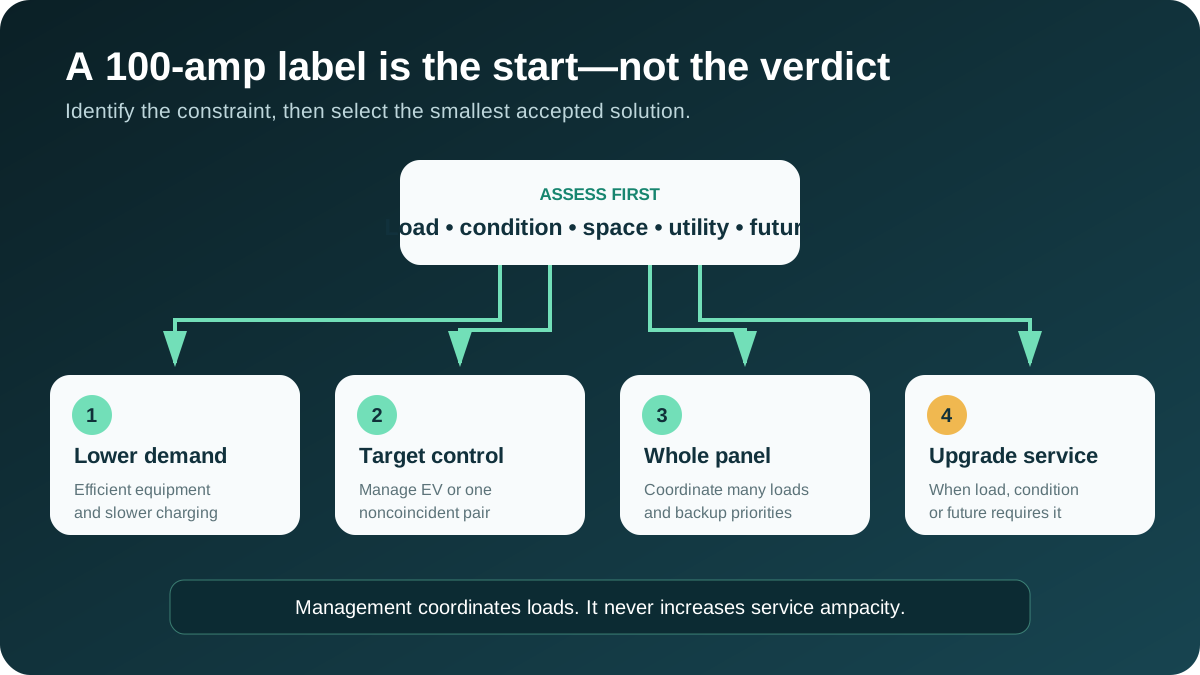
Short answer: Some 100-amp homes can add a heat pump, heat-pump water heater, induction cooking, dryer, and EV charging without a utility service upgrade. The path may use efficient lower-power equipment, slower charging, noncoincident circuits, or listed load-management controls. Other homes need a service upgrade because the accepted load calculation or demand study, equipment condition, utility system, local code, or future plan requires it. Start with a licensed electrician's documented assessment; choose the smallest control scope that solves the verified constraint.
A smart panel is one possible implementation, not a synonym for load management and not permission to exceed the service rating. A whole-panel product can monitor circuits, open selected loads, and coordinate backup power. A targeted controller may manage only an EV charger or prevent two appliances from operating together. Native appliance controls can limit charging or stage electric heat. These approaches have different costs, failure modes, and inspection requirements.
This page helps select the control architecture. Use the companion electrical panel capacity guide for service ratings, panel condition, load calculations, demand data, breaker space, and the full electrification inventory.
Five Questions Before Shopping for Hardware
1. Is ampacity actually the constraint?
A panel may lack spare breaker positions while the service has calculated capacity. A subpanel or approved panelboard change can solve space but does not create ampacity. Conversely, empty breaker spaces do not prove the service can accept a large continuous load. Condition, bus rating, utility-side equipment, and permitted breaker arrangements are separate checks.
2. What does the accepted load method show?
Electrical codes provide calculation methods for existing and new loads; some jurisdictions accept specified demand-history methods for existing dwellings. The applicable code edition and authority having jurisdiction (AHJ) decide. An online calculator can inform planning but does not replace the professional calculation submitted for a permit.
PNNL's panel calculator is based on a National Electrical Code existing-dwelling method and warns that it is an estimate rather than a licensed evaluation. Ask the electrician to name the method, list appliance inputs, show demand factors, and state remaining capacity.
3. Which loads truly need to overlap?
Space heating during a cold night may be nondeferrable. An EV parked for ten hours is often flexible. A dryer can wait while a range operates. A water heater with adequate storage can delay recovery. Load management works by defining these priorities without compromising health, safety, mobility, or equipment requirements.
4. Can product selection reduce the load?
Right-sized heat pumps, limited resistance backup, heat-pump water heaters, heat-pump dryers, lower-power EV charging, and other efficient products can change the calculation. Do not choose a 48-amp charger because the car supports it if the household needs only a small overnight energy refill.
5. What future projects should the design preserve?
List five- to ten-year plans: second EV, accessory unit, hot tub, cooling, solar, battery, V2H, workshop, addition, or resale goals. A targeted controller may be ideal for one EV but too narrow for a planned all-electric addition. A service upgrade may be sensible when utility work is already required or several constraints coincide.
The Five Main Paths
| Path | Best fit | What it does not solve |
|---|---|---|
| Efficient/lower-power equipment | Load is near the service limit and appliance choices are flexible | Unsafe or obsolete equipment; utility constraint |
| Scheduling without hard interlock | Loads are flexible and exceeding capacity is not possible under the approved calculation | Code-required capacity control; failed schedules |
| Targeted load management | One or two deferrable loads create the constraint | Whole-home monitoring or many complex priorities |
| Whole-panel energy management | Many circuits need coordination, monitoring, or backup selection | Inadequate service when management is not accepted; panel defects outside scope |
| Service upgrade | Verified demand, condition, utility, future load, or local rule requires more capacity | Appliance efficiency, operating cost, or utility-side delays by itself |
Often the best plan combines paths. A home might use a right-sized heat pump, managed 24-amp EV charging, and a panel replacement for condition—while retaining a 100-amp service. Another might install 200-amp service because a second dwelling unit and workshop make flexibility insufficient.
Path 1: Lower the Nameplate Load Before Managing It
EV charging
Daily energy need determines useful charge power. If a vehicle returns at 6 p.m. and leaves at 7 a.m., the available window is 13 hours. A 12 kWh refill requires less than 1 kW average before losses. Level 1 or lower-power Level 2 charging may meet most days, with public fast charging as an occasional backup.
EV charging is treated as a continuous load under U.S. electrical rules; circuit and conductor sizing must follow the adopted code and equipment instructions. PNNL notes that load calculations or studies may be required and that load controls can fit charging within available capacity. Have the electrician design the circuit; do not set a charger above what the circuit permits.
Heat pumps and backup heat
The compressor, indoor fan, crankcase or pan heaters, and resistance backup are separate loads. A right-sized cold-climate model and envelope improvements can reduce backup requirements. The backup-heat controls guide shows how to size strips from the capacity gap rather than automatically installing the largest kit.
Water heating and drying
Heat-pump water heaters and heat-pump dryers can reduce demand compared with conventional resistance products, but exact nameplates, recovery needs, space conditions, and circuits matter. A 120-volt heat-pump water heater can suit some retrofit contexts; it is not automatically appropriate for high hot-water demand or a cold installation space.
Cooking
Induction efficiency does not mean every induction range has a small service load. Compare exact cooktop and oven nameplates, household cooking patterns, and permitted demand calculations. Battery-buffered or lower-power products may be options in some markets, but availability, listing, service, and economics must be checked locally.
Path 2: Scheduling Helps Bills, but It Is Not Always Capacity Control
Appliance timers can shift EV charging, water heating, dishwashing, or laundry. This can reduce coincident demand and improve a time-of-use rate. However, a consumer schedule that can be overridden, loses its clock, or depends on the internet may not qualify as the required electrical load-management method.
Differentiate:
- behavioral scheduling: occupants intend not to overlap loads;
- native managed charging: vehicle or EVSE changes current based on a control signal;
- listed energy management: approved equipment enforces a defined capacity limit;
- noncoincident interlock: one load is physically prevented from operating while another is on.
The AHJ and equipment listing determine which method can be credited in the design.
Path 3: Targeted Load Management
A targeted device watches the service, feeder, circuit, or controlling appliance and pauses or limits a designated flexible load. Common applications include EV charging, an electric water heater, or two appliances sharing limited capacity.
Managed EV charging
A controller may measure whole-home current and reduce or pause EV charging to maintain a configured service limit. Another may allocate a fixed capacity among multiple chargers. Because the car is usually parked longer than it needs to charge, this can preserve mobility with little inconvenience.
Request documentation for:
- approved vehicle/EVSE/controller combinations;
- sensing location and accuracy;
- maximum permitted charging current;
- service or feeder limit used;
- response time and fallback behavior;
- network-independent operation;
- status indication and manual recovery;
- listing and code basis;
- commissioning test under high house load.
PNNL warns that networked products can have service fees and more maintenance opportunities, and that offline charging behavior varies. Capacity protection should not silently disappear with Wi-Fi.
Circuit sharing and noncoincident loads
A listed device may allow two compatible appliances to use a constrained circuit or feeder without operating simultaneously. The exact application, equipment listing, load types, and local approval are decisive. A homemade relay or generic smart switch is not an acceptable substitute.
Priority matters. Pausing an EV for an oven is usually tolerable. Interrupting a sump pump, medical device, fire/life-safety load, or space heating during freeze risk is not.
Path 4: Whole-Panel Energy Management
A smart electrical panel or integrated energy-management system can monitor circuits, control selected breakers or relays, maintain a service power ceiling, and coordinate backup resources. NREL reported laboratory testing of one smart-panel platform's circuit shedding and configurable backup features; that evidence shows the concept can work, not that every product or house has the same result.
When whole-panel control is attractive
- several deferrable loads need priorities;
- solar, stationary battery, generator, or V2H integration is planned;
- occupants value circuit-level energy data;
- backup power needs dynamic circuit selection;
- a panel replacement is already justified by age, condition, or space;
- the local code path recognizes the control strategy.
When it may be excessive
- one EV charger is the only new constraint;
- the existing panel is sound and has space;
- a lower charging current passes the calculation;
- the system requires subscriptions or cloud services the owner does not want;
- proprietary replacement parts or installer access are limited;
- the home will still need a service upgrade for verified nondeferrable load.
Monitoring is not the same as protection
A device that displays circuit power in an app may not be listed to manage service capacity. Ask which function is safety-rated, what actuates the load, and which standard/listing covers that use. Marketing terms such as “AI panel,” “smart breaker,” and “energy monitor” do not answer the electrical question.
Path 5: Service Upgrade
Load management is not a contest to avoid copper at any cost. A service upgrade can be the cleanest long-term choice when:
- an accepted calculation or demand study shows insufficient capacity for nondeferrable loads;
- the service or panel equipment is damaged, obsolete, recalled, or otherwise unsuitable;
- the utility, insurer, or AHJ requires work;
- an addition, second unit, workshop, or multiple vehicles creates sustained demand;
- the existing configuration lacks required spaces or integration paths and replacement is already needed;
- controls would be unusually complex or dependent on unacceptable failure modes;
- future projects would soon outgrow the managed design.
The scope may include panelboard, meter enclosure, service conductors, mast, grounding and bonding, trenching, utility work, transformer capacity, permits, and wall repair. Ask bidders to separate customer-side and utility-side work and identify schedule risks.
Build a Priority Table
Do not let an installer assign priorities from assumptions. Complete the table with the household.
| Load | Must run? | Can pause? | Maximum acceptable pause | Minimum service level | Failure state |
|---|---|---|---|---|---|
| Medical/life-safety equipment | Yes | No | None | Manufacturer requirement | Maintained |
| Sump/sewage pump | Usually | Limited by risk | Site-specific | Automatic operation | Maintained |
| Space heating/cooling | Climate/occupant dependent | Limited | Temperature-based | Safe indoor conditions | Defined fallback |
| Water heating | Often flexible | Yes | Tank/usage dependent | Hot-water reserve | Resume safely |
| Refrigerator/freezer | Cycles naturally | Short | Food-safety based | Normal cycling | Resume automatically |
| Cooking | User-controlled | Yes | Meal dependent | At least one safe method | Notify user |
| Clothes dryer | Flexible | Yes | Hours | None during pause | Manual/automatic restart defined |
| EV charging | Usually flexible | Yes | Departure dependent | Required departure energy | Charging resumes |
| Pool/spa | Usually flexible | Yes | Water-quality dependent | Freeze protection where needed | Seasonal logic |
Loads can change priority by season. A heat pump may be essential during a freeze and flexible for a mild afternoon demand-response event. The controller needs local logic appropriate to the risk.
Set the Capacity Ceiling From the Approved Design
Do not simply set a control at “80% of 100 amps” because that sounds conservative. Service ratings, continuous-load rules, conductor ampacity, calculated loads, sensing location, response, and the control's listing all matter. The electrician and AHJ should establish the enforceable ceiling and document it.
Also distinguish current on each leg of a North American split-phase service from total power. A 120-volt load affects one leg; a 240-volt load uses both. Whole-home energy in kW can look acceptable while one leg is more heavily loaded. The chosen equipment must monitor and control the quantities required by its design.
Failure Modes to Specify Before Purchase
Internet or cloud outage
Does capacity management continue locally? Can the owner see system state? Does an EV charge at full power, reduced power, or not at all?
Sensor failure
Can a disconnected or misoriented current transformer cause the controller to underestimate load? Does the system detect the fault and enter a safe state?
Actuator or breaker failure
If a controlled circuit does not open on command, does upstream protection remain correctly sized? Capacity management must not depend on an unverified software assumption.
Power restoration
Do all deferred loads restart together after an outage? Staggered restart may be needed to avoid a new peak or capacity event.
Vendor or subscription loss
Which functions remain if the vendor ends service, changes fees, or an account is inaccessible? Confirm local manual operation and replacement parts.
Manual override
Can an occupant override a shed command, and if so, how does the system preserve the service limit? A hidden “force on” button can undermine the design.
Commissioning Test
The electrician should follow manufacturer and AHJ procedures. A useful owner-facing acceptance record includes:
- equipment model, firmware, listing, and one-line diagram;
- service, panel, feeder, and controlled-load ratings;
- sensor locations and orientation;
- configured service or feeder ceiling;
- priority order and maximum pause times;
- test load used to approach the ceiling;
- measured current/power before and after shedding;
- response of each controlled circuit;
- behavior without internet connectivity;
- power-restoration and restart sequence;
- alarm and notification test;
- owner manual override and emergency procedure.
Do not create a dangerous overload merely to test the system. The installer should use approved commissioning procedures and controllable loads.
Acceptance table
| Test | Expected result | Observed result | Pass/fail |
|---|---|---|---|
| Normal operation below ceiling | All allowed loads operate | ||
| Flexible load active near ceiling | Controller reduces designated load | ||
| Nondeferrable load starts | Lower-priority load yields | ||
| Internet disconnected | Local capacity control remains as designed | ||
| Sensor fault simulated per manual | Safe state and alarm | ||
| Utility outage/restore | Defined backup and staggered restart | ||
| Manual override | Limit remains protected |
Monitoring Without Surveillance Creep
Circuit-level data can reveal when occupants cook, sleep, leave, charge a car, or use medical equipment. Ask:
- whether data stays local or goes to a cloud platform;
- retention period and deletion controls;
- who can access installer or utility accounts;
- whether data is sold or shared;
- how accounts transfer when the home is sold;
- what cybersecurity updates are provided;
- whether remote circuit control can be disabled.
Use unique credentials and multi-factor authentication where available. Keep a paper circuit directory and operating instructions; an app should not be the only way to understand the electrical system.
Cost Comparison: Price the Whole Scope
Avoid generic claims that a smart panel costs less than a service upgrade. Either project can trigger related work, and local labor and utility conditions dominate.
Request line items for:
- engineering/load calculation;
- permits and inspection;
- panel or controller hardware;
- compatible breakers, sensors, relays, gateway, and networking;
- branch-circuit or feeder changes;
- grounding/bonding corrections;
- drywall or finish work;
- utility/meter/service work;
- subscriptions and monitoring fees;
- battery, solar, generator, or V2H integration;
- commissioning and owner training;
- warranty labor and replacement availability.
Compare at least three architectures, not three brands of the same architecture:
| Scope | Initial cost | Recurring cost | Capacity result | Future expansion | Offline behavior |
|---|---|---|---|---|---|
| Lower-power appliances only | |||||
| Targeted EV/load controller | |||||
| Whole-panel management | |||||
| Service/panel upgrade |
Frequently Asked Questions
Can a smart panel make a 100-amp service behave like 200 amps?
No. It can coordinate loads so selected appliances do not draw simultaneously beyond a configured limit. The service remains 100 amps and must be protected as designed.
Does a full panel mean I need an upgrade?
Not necessarily. Physical breaker space and electrical capacity are different. An approved subpanel or panelboard solution may add spaces, but only a load calculation or accepted demand method addresses capacity.
Is a smart panel required for managed EV charging?
No. Targeted listed controllers or compatible EVSE can manage charging based on available capacity. A whole-panel system adds value when several circuits, backup resources, or monitoring goals need coordination.
Can I rely on appliance schedules instead?
Schedules may reduce coincidence and cost, but they may not qualify as code-recognized capacity management. Power interruptions, clock errors, overrides, and network loss can defeat them. Ask the electrician and AHJ.
Will a 200-amp upgrade prevent transformer problems?
It increases customer service capacity but does not guarantee utility transformer or feeder capacity. The utility must evaluate its side of the connection.
Does solar create more service capacity?
Solar generation can reduce grid import at some times but is variable and may be absent during peak household demand. Interconnection rules and approved energy-management designs determine whether and how it affects a project; do not subtract nameplate solar from appliance load by assumption.
Can a home battery solve the problem?
Some listed systems can limit grid import or support loads, but backup and grid-parallel modes differ. The battery's power rating, state of charge, controls, interconnection, and failure behavior must be part of an approved design.
The Decision Rule
Choose a whole smart panel when several controllable circuits, backup selection, or energy visibility justify central coordination and the product has an accepted code path with safe local fallback. Choose targeted management when one flexible load creates the capacity problem. Choose lower-power equipment when it meets the household need without added control complexity. Choose a service upgrade when verified nondeferrable demand, equipment condition, local requirements, or future use makes more permanent capacity the clearer solution.
Software can schedule copper; it cannot repeal ampacity, repair unsafe equipment, or replace a documented design.
About the Editorial Team EnergyBS reviews public program rules, product specifications, utility rates, and reader-facing cost assumptions. Treat savings figures as estimates until you verify local prices, permits, rebates, and contractor quotes.
What to Read Next
Electrical Panel Capacity for Home ElectrificationUse this next to compare the cost, incentive, installation, or operating-risk angle before you make a home energy decision.Sources and Verification
Editorial Review
EnergyBS Editorial Team
EnergyBS publishes practical homeowner guides. Important program, product, and cost claims should be checked against the linked source and local project documents before you commit to work.
Related Guides
View All ArticlesElectrical Panel Capacity for Home Electrification
A decision guide for homeowners adding heat pumps, EV charging, induction, water heating, solar, or batteries: service ratings, load calculations, demand data, panel space, load management, project sequencing, and quote review.
Are TimeofUse Rates Worth It? Model Your Bill From
Use a year of interval data and current tariff rules to compare flat and timeofuse electricity plans. Includes a bill model, loadshift inventory, demandcharge check, and trial scorecard.
Level 1 vs. Level 2 EV Charging 2026 Tool (Guide & Data)
Choose Level 1 or Level 2 home EV charging from daily miles, dwell time, winter conditioning, vehicle acceptance, circuit capacity, installation, tariffs, and a measured recoveryday test.