Heat Pump Backup Heat
Size and control heatpump backup from the home's load, lowtemperature equipment capacity, local rates, and outage plan. Compare dual fuel, electric strips, balance points, and lockouts.
Direct Answer
Size and control heatpump backup from the home's load, lowtemperature equipment capacity, local rates, and outage plan. Compare dual fuel, electric strips, balance points, and lockouts.
Choose Backup Heat From Four Curves, Not a Climate-Zone Slogan
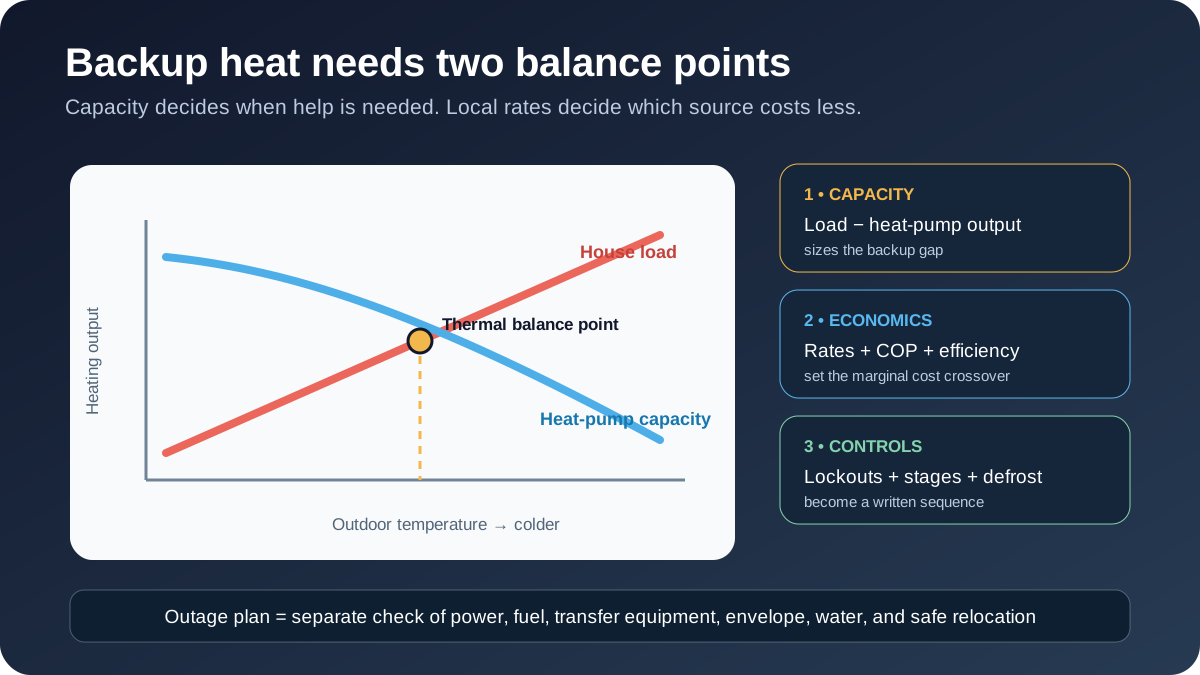
Short answer: A heat pump needs enough combined capacity to meet the home's design heating load, but the backup type and control settings should not come from a universal outdoor-temperature cutoff. Plot the house load against the exact heat pump's low-temperature capacity, calculate the delivered-heat cost of each fuel at local rates, check electrical and duct limits, and document how the controls stage auxiliary heat or switch fuels. Then make a separate outage plan—neither an electric heat pump nor a typical gas furnace operates through a power outage without an appropriately designed power source.
Four relationships govern the decision:
- House load: how heating demand rises as outdoor temperature falls.
- Heat-pump capacity: how the selected model's output changes with temperature.
- Operating cost: how electricity price, coefficient of performance (COP), fuel price, and combustion efficiency change the cheaper heat source.
- Resilience: how long the house can remain safe during equipment failure or a utility outage, and what safely supplies heat in each case.
Confusing these relationships produces expensive mistakes. The temperature at which a heat pump needs capacity help is not necessarily the temperature at which another fuel becomes cheaper. A thermostat lockout chosen from last winter's gas price may be wrong after rates change. A retained furnace provides equipment redundancy, but it still needs electricity for controls, combustion-air handling, and the blower.
If a battery is part of the outage plan, size it from the exact heating controls, blower, pumps, compressor stages, and permitted backup loads. The home battery critical-load guide checks both kWh runtime and kW motor-start demand, then tests winter and summer outage sequences.
First, Separate the Terms
Contractors, thermostat manuals, and homeowners sometimes use “balance point” to mean different things. Require every proposal to label the term precisely.
Thermal or capacity balance point
The thermal balance point is the outdoor temperature where the home's heating load intersects the heat pump's available capacity. Above it, the heat pump can meet the modeled load by itself. Below it, the house needs supplemental capacity unless internal or solar gains, conservative load assumptions, or short-term thermal storage cover the gap.
PNNL's cold-climate sizing guidance illustrates this intersection and notes its importance when a heat pump is intentionally sized to meet only part of the load. The point belongs to a specific house-model combination. Change the envelope, design load, or equipment, and it moves.
Economic balance point
The economic balance point is the outdoor temperature where the marginal cost of delivered heat from the heat pump equals the marginal cost from the alternative source. Because heat-pump COP changes with outdoor temperature, the cost relationship can cross at a different point than the capacity relationship—or may not cross within the equipment's operating range.
Compressor lockout
A compressor lockout is a control setting below which the heat pump is prevented from operating. It may be chosen because of manufacturer limitations, a dual-fuel control sequence, system design, or economic policy. It should not be copied from a generic thermostat default.
Auxiliary-heat lockout
An auxiliary-heat lockout prevents backup heat above a selected outdoor temperature or under specified conditions. It can reduce unnecessary strip or furnace use, but an overly aggressive value can prevent recovery or comfort when the heat pump is undersized, defrosting, or faulted.
Supplemental versus emergency heat
Supplemental or auxiliary heat is automatically staged to help meet load or support operating modes. “Emergency heat” on many thermostats disables the compressor and uses the backup source only. It is a service or failure mode, not a setting to select whenever the weather feels cold. Confirm the exact behavior in the equipment and thermostat manuals.
Build the House Load Line
Start with a room-by-room Manual J heating and cooling load calculation using local design conditions and observed house assemblies. Do not size backup from floor area, the old furnace input rating, or a climate-zone label. The Manual J heat-pump sizing guide shows how to review infiltration, insulation, windows, ducts, design temperatures, and safety factors.
For a screening graph, the heating load is often approximated as a line between a balance temperature at which the house needs no mechanical heating and the design heating load at the winter design temperature. Real buildings are not perfectly linear: wind, sun, internal gains, setbacks, and infiltration change the result. The line is still useful for comparing proposals when its assumptions are visible.
Example inputs:
- indoor design temperature: 70°F;
- local winter design temperature: 5°F;
- calculated design heating load: 36,000 Btu/h;
- approximate no-heat balance temperature: 60°F.
At an intermediate outdoor temperature of 30°F, a simple linear screening estimate is:
Load at 30°F = 36,000 × (60 − 30) ÷ (60 − 5) = about 19,600 Btu/h
Do not use this shortcut to replace the load calculation. Use it to visualize how the documented design load changes across temperatures and to check the equipment plot.
If insulation, air sealing, windows, or duct repairs are planned, calculate the post-retrofit load. Reducing peak load may eliminate a backup stage, avoid a panel upgrade, or let a smaller heat pump operate more efficiently during mild weather.
Plot the Exact Heat Pump's Capacity
Nominal tonnage is not cold-weather output. Obtain manufacturer extended performance data for the exact outdoor unit, indoor unit, coil, air handler or furnace, and approved controls. Record maximum heating capacity and COP at multiple outdoor temperatures near your climate's operating range.
ENERGY STAR's current cold-climate criteria require qualifying equipment to demonstrate a COP of at least 1.75 at 5°F and retain at least 70% of its 47°F capacity at 5°F under the specified test procedure. Those thresholds help identify a product category; they do not prove that a particular unit meets your house load at your design temperature.
Ask for a table like this:
| Outdoor temperature | House load | Heat-pump maximum capacity | Capacity gap or surplus | COP at relevant operating point |
|---|---|---|---|---|
| 47°F | ||||
| 32°F | ||||
| 17°F | ||||
| 5°F | ||||
| Local design temperature | ||||
| Manufacturer operating limit, if relevant |
Variable-capacity equipment also needs a minimum-capacity check in mild weather. A unit selected only to avoid backup at the coldest hour can be too large to modulate smoothly for much of the year. That can increase cycling and reduce comfort. The best selection balances peak coverage with low-load operation, duct capacity, and backup strategy.
Three Common Backup Configurations
1. Electric resistance elements in the air handler
Electric strips can stage alongside the heat pump to fill a capacity gap. One kilowatt of resistance heat provides about 3,412 Btu/h at the point of use. A nominal 10 kW bank therefore provides about 34,120 Btu/h before considering distribution losses. The heat pump can often continue contributing, so the strip bank does not automatically need to equal the entire design load.
Advantages include simple fuel infrastructure, no onsite combustion, and the ability to add capacity in stages. Constraints include high electrical demand, panel and service capacity, feeder and breaker requirements, control quality, and higher marginal cost than a heat pump whenever COP is greater than 1 at the same electric rate.
Ask whether the quote includes staged elements—for example, smaller increments rather than energizing the full bank at once—and how the thermostat or air-handler controls decide each stage. Confirm required blower airflow for every strip stage.
2. Dual fuel: heat pump plus furnace
A dual-fuel system uses a heat pump and a gas, propane, or oil furnace, commonly sharing a duct system. Unlike resistance auxiliary heat, a furnace generally cannot operate simultaneously with an indoor refrigerant coil in heating mode unless the matched system and controls are specifically designed for that sequence. Many systems switch from heat pump to furnace at a control point.
Dual fuel can preserve an existing fuel option and may reduce peak electrical demand. It also retains combustion maintenance, venting, fuel-price exposure, and often a fixed monthly utility charge. The indoor coil, furnace, outdoor unit, thermostat, and control board must be approved and configured as a system.
ENERGY STAR notes that dual fuel can allow homeowners to use each source based on costs and other goals. That flexibility only exists when the control sequence is accessible, documented, and updated as rates change.
3. Separate or room-level backup
A ductless heat pump may coexist with an existing boiler, electric baseboards, or other code-compliant heating source. This can provide room-level capacity but complicates control: two thermostats may fight, leave gaps, or cause the expensive source to lead.
Document which source serves each room, its design capacity, setpoint relationship, and failure behavior. A fireplace or stove should not be credited as automatic whole-house design backup unless its listed capacity, safe installation, fuel supply, heat distribution, and operating plan actually support that role. Never use an unvented or improvised combustion heater contrary to local law or manufacturer instructions.
Size Electric Backup From the Capacity Gap
Suppose the design heating load is 36,000 Btu/h at 5°F and the selected heat pump can provide 25,000 Btu/h at that condition. The modeled gap is 11,000 Btu/h.
Resistance capacity needed for the modeled gap = 11,000 ÷ 3,412 = about 3.2 kW
That calculation does not mean a 3.2 kW element is the correct installed size. Standard stage sizes, defrost, distribution losses, recovery expectations, equipment faults, load uncertainty, and local code all matter. It does show why automatically installing 15 or 20 kW “for safety” can be unnecessary and can trigger an avoidable service upgrade.
Evaluate at more than one condition:
- design temperature with the compressor operating;
- manufacturer low-temperature limit;
- defrost or temporary capacity-reduction conditions;
- recovery from an approved setback, if setbacks are planned;
- compressor failure if emergency heat is intended to maintain the whole house;
- generator or demand-management conditions, if applicable.
The desired failure coverage is a homeowner choice. Backup sized only to fill the design gap differs from backup sized to carry the complete house after compressor failure.
Check the Electrical Service Before Choosing Strip Size
Resistance backup is a large coincident load. A 15 kW bank draws about 62.5 amperes at 240 volts before applying code requirements to conductors, overcurrent protection, and load calculations. The outdoor unit, air handler, water heater, range, dryer, vehicle charging, and other loads may operate at the same time.
Have a qualified designer or electrician perform the applicable service load calculation and verify:
- service and panel ratings;
- available breaker spaces and bus limits;
- feeder and conductor sizes;
- air-handler and strip-heat nameplate requirements;
- required disconnects and overcurrent protection;
- demand-management controls, if approved and appropriate;
- future electrification plans.
Use the electrical-panel capacity guide before assuming a panel upgrade is inevitable—or assuming there is room. Staged backup, load reduction, or a different equipment match may change the result.
Calculate the Economic Balance Point From Local Rates
Convert every option to cost per unit of heat delivered to the house.
For a heat pump:
Heat-pump cost per million Btu = electricity price ($/kWh) × 293.071 ÷ COP
For electric resistance:
Resistance cost per million Btu = electricity price × 293.071
For pipeline gas billed by therm:
Gas heat cost per million Btu = gas price ($/therm) × 10 ÷ furnace efficiency
Use the marginal commodity, delivery, riders, and taxes that change with consumption. Treat fixed monthly customer charges separately. If removing the gas account eliminates a fixed charge, include the annual avoided amount in the whole-year comparison; do not bury it in the marginal switchover calculation.
Worked local-rate scenario
Assume illustrative rates—not national averages:
- electricity: $0.18/kWh all-in marginal rate;
- gas: $1.60/therm marginal rate;
- furnace seasonal delivered efficiency for this comparison: 92%;
- heat-pump COP at 30°F: 2.8;
- heat-pump COP at 10°F: 2.0.
At 30°F:
Heat pump = $0.18 × 293.071 ÷ 2.8 = $18.84 per million Btu
At 10°F:
Heat pump = $0.18 × 293.071 ÷ 2.0 = $26.38 per million Btu
Gas:
Furnace = $1.60 × 10 ÷ 0.92 = $17.39 per million Btu
Under these assumptions, gas is cheaper at both modeled heat-pump COPs. The break-even COP is:
Break-even COP = electricity price × 293.071 ÷ gas delivered-heat cost
Break-even COP = $0.18 × 293.071 ÷ $17.39 = about 3.03
The heat pump is cheaper whenever its marginal COP exceeds about 3.03 under these prices. If electricity falls to an off-peak rate, gas price rises, or the furnace has lower delivered efficiency, the result changes. Time-of-use rates can create different economic settings by hour, though not every residential control can optimize both temperature and price without creating comfort or equipment problems.
The full heat-pump versus furnace operating-cost guide provides worksheets for COP, tariffs, fixed charges, and weather bins.
Capacity and Economics Produce Different Control Choices
Consider a heat pump that can carry the full house load down to 10°F but becomes more expensive than gas below 30°F under current rates.
- A capacity-led strategy may run the heat pump to 10°F, then use backup below the thermal balance point.
- A cost-led dual-fuel strategy may switch to the furnace near 30°F, even though the heat pump still has capacity.
- A fuel-minimizing strategy may keep the heat pump running and use the furnace only for the capacity gap or faults, if the matched system permits that sequence.
- A peak-demand strategy may limit strips during utility peak periods while preserving safety and comfort.
Write the priority before programming the thermostat. “Efficient” can mean lower site electricity, lower utility bill, lower emissions, lower peak demand, or greater use of the heat pump. Those goals may not select the same point.
Defrost Is Not the Same as Heat-Pump Failure
An air-source heat pump can accumulate frost on the outdoor coil in cold, humid conditions. During a defrost cycle, many systems temporarily reverse refrigerant flow to warm the outdoor coil. Indoor supply temperature may fall, and auxiliary heat may operate to reduce a cold-air sensation.
Occasional defrost is normal. Repeated, unusually long, or ineffective cycles can indicate drainage, sensor, refrigerant, airflow, or control problems. Do not solve a defrost fault by permanently lowering the strip-heat lockout.
Ask the installer to explain:
- how the equipment initiates and terminates defrost;
- whether auxiliary heat is energized during defrost;
- which strip stage is permitted;
- how the thermostat displays auxiliary and emergency heat;
- where defrost water drains and whether it can freeze on a walkway;
- what operating pattern should trigger a service call.
Thermostat Settings Need a Written Sequence
Thermostat labels hide important differences. One “aux heat” setting may be based on outdoor temperature; another may use indoor temperature error, compressor runtime, rate of recovery, or a combination.
Request a controls schedule with these fields:
| Control item | Installed value | Basis | Review trigger |
|---|---|---|---|
| Compressor low-temperature lockout | Manufacturer/design/economic | Rate or equipment change | |
| Auxiliary heat high-temperature lockout | Capacity and recovery | Comfort or load change | |
| Dual-fuel switchover | Economic or capacity | Utility-rate change | |
| Stage 1 auxiliary delay | Load and comfort test | Event-log review | |
| Additional strip-stage delay | Capacity gap and electrical limit | Peak-demand review | |
| Setback recovery behavior | Occupancy and equipment guidance | Seasonal review | |
| Defrost auxiliary behavior | Manufacturer sequence | Service event | |
| Emergency heat behavior | Failure plan | Annual test |
Avoid large thermostat setbacks unless the equipment manufacturer and controls strategy support them. A deep morning recovery can call expensive backup even when steady heat-pump operation would have maintained temperature. ENERGY STAR advises steady heat-pump settings as a general consumer practice; specific systems may offer optimized recovery.
Commission the System in More Than Mild Weather
A heat pump installed in summer cannot be fully proven at the winter design condition. Complete the available commissioning at installation, then include a cold-weather return visit or remote trend review in the contract.
The commissioning record should include:
- equipment match and approved accessories;
- thermostat and control-board configuration;
- total external static pressure and blower airflow in each major stage;
- refrigerant commissioning per manufacturer procedure;
- supply and return temperatures;
- electric strip current by stage;
- furnace temperature rise and combustion-safety checks for dual fuel;
- outdoor temperature sensor accuracy;
- compressor and auxiliary lockouts;
- heat-pump capacity and load comparison;
- defrost observation when conditions allow;
- thermostat event logs showing compressor, auxiliary, and emergency-heat calls.
During a cold-weather check, compare actual indoor temperature maintenance and runtime with the design plot. A heat pump running continuously near the design condition is not automatically undersized; long runtime is expected when output closely matches load. Falling indoor temperature, unexplained strip use, repeated limit trips, or a switchover far above the documented setting needs investigation.
Outage Planning: Equipment Failure and Grid Failure Are Different
Compressor or outdoor-unit failure with grid power available
Electric strips can often provide partial or full emergency heat if sized and configured for that role. A dual-fuel furnace may also carry the load. A ductless system with retained baseboards may use those room circuits. Test the emergency mode annually according to manufacturer instructions and know which rooms or loads must be reduced if backup capacity is partial.
Electric-grid outage
The heat pump, resistance strips, controls, circulators, and typical forced-air furnace all depend on electricity. A gas furnace usually uses much less electrical power than resistance strips, but generator or battery compatibility cannot be assumed from running watts alone. Starting current, neutral and grounding arrangement, waveform, transfer equipment, fuel supply, venting, and carbon-monoxide safety all matter.
Only use listed equipment installed and operated under manufacturer instructions and local electrical, fuel, and fire rules. A licensed electrician should design any transfer arrangement. Never connect a portable generator directly to house wiring without approved transfer equipment, and never operate a generator or combustion engine indoors, in a garage, or near openings. Maintain working carbon-monoxide alarms and follow local emergency guidance.
A passive safety plan belongs in every option
Know the location of the main water shutoff, identify vulnerable pipes, maintain emergency contacts, and have a plan for safe relocation if indoor temperature cannot be maintained. The time a house takes to cool is specific to outdoor conditions, wind, thermal mass, insulation, leakage, starting temperature, and internal gains. Fixed “pipes burst after X hours” timelines are not dependable.
Envelope improvements reduce both routine load and outage cooling rate. Air sealing and insulation can be a form of thermal resilience even though they do not generate heat.
Compare Whole-System Costs, Not Just the Backup Appliance
For each option, request a lifecycle scope that includes:
- heat pump and indoor equipment;
- strip heater kit, breakers, feeders, disconnects, and panel work;
- furnace, venting, gas piping, combustion air, and annual service;
- thermostat, outdoor sensor, and control board;
- duct transitions and airflow corrections;
- utility fixed charges retained or eliminated;
- likely annual backup energy by temperature bin;
- maintenance and expected replacement timing;
- permits and commissioning;
- any approved backup-power interface.
Avoid universal dollar estimates. A retained modern furnace with compatible equipment is a different project from adding a new fuel service, chimney liner, or service-panel upgrade. Local labor, permits, utility rules, and existing conditions dominate.
A Quote-Comparison Worksheet
| Decision input | Bid A | Bid B | Bid C |
|---|---|---|---|
| Design heating load and temperature | |||
| Heat-pump capacity at design temperature | |||
| Thermal balance point | |||
| Minimum capacity in mild weather | |||
| Backup type and staged capacity | |||
| Full-load or gap-only backup objective | |||
| Electrical service impact | |||
| Economic break-even COP/temperature | |||
| Compressor lockout | |||
| Auxiliary lockout and delays | |||
| Defrost auxiliary sequence | |||
| Duct airflow/static-pressure results | |||
| Fixed fuel charge retained | |||
| Cold-weather commissioning included | |||
| Outage operating plan |
A bid that cannot fill these rows has not yet shown how backup heat will work.
Frequently Asked Questions
Does every cold-climate heat pump need backup heat?
Not every installation needs automatically operating backup at the design temperature, but every project needs a capacity analysis and a failure plan. Compare the home's load with exact low-temperature capacity and operating limits. Local code, owner risk tolerance, and outage conditions also matter.
Are electric strips always expensive to operate?
Resistance heat uses one unit of electricity for roughly one unit of heat at the equipment, so it usually costs more than a heat pump whenever COP exceeds 1. Whether it costs more than gas, propane, oil, or another source depends on local marginal rates and delivered efficiency. Limited strip runtime can still be economical compared with maintaining another fuel system.
Should a dual-fuel heat pump switch to gas at 35°F?
There is no universal 35°F setting. Calculate the economic break-even from local rates and temperature-dependent COP, then check equipment capacity, manufacturer limits, comfort, emissions goals, and the control system's capabilities.
What does AUX HEAT on the thermostat mean?
It usually indicates automatically controlled supplemental heat, but the exact sequence varies. Review the thermostat, air-handler, furnace, and heat-pump manuals. Emergency heat commonly disables the compressor and is not the same state.
Can heat pump and gas furnace run together?
Many conventional dual-fuel systems switch rather than run simultaneously because of coil temperature and equipment-control requirements. Some specialized systems may permit coordinated operation. Follow the approved matched-system design; do not invent a sequence in thermostat settings.
Can a portable battery run a gas furnace?
Possibly, but capacity in watt-hours is only one requirement. Starting load, output waveform, grounding and neutral behavior, transfer method, controls, runtime, and code compliance must all match. Have the system evaluated and use approved transfer equipment.
Will backup heat solve an undersized duct system?
No. More heat input can require more airflow and may worsen temperature-rise or pressure problems. Verify duct capacity and blower airflow for every proposed stage.
The Final Decision Rule
Choose backup heat by completing this sequence:
- calculate the home's post-retrofit design heating load;
- plot the exact heat pump's maximum and minimum capacity across temperature;
- identify the thermal balance point and capacity gap;
- size backup for the stated objective—gap coverage or full failure coverage;
- verify electrical, duct, venting, and equipment-match constraints;
- calculate delivered-heat cost from current local rates and COP data;
- write compressor, auxiliary, dual-fuel, defrost, and emergency sequences;
- commission all available stages and schedule a cold-weather verification;
- maintain a separate, code-compliant outage and water-protection plan.
The best system may be all-electric, dual fuel, or a heat pump with an existing room-level source. The defensible choice is the one whose load, capacity, cost, controls, and failure plan are visible on paper before installation.
About the Editorial Team EnergyBS reviews public program rules, product specifications, utility rates, and reader-facing cost assumptions. Treat savings figures as estimates until you verify local prices, permits, rebates, and contractor quotes.
What to Read Next
Heat Pump Sizing GuideUse this next to compare the cost, incentive, installation, or operating-risk angle before you make a home energy decision.Sources and Verification
Editorial Review
EnergyBS Editorial Team
EnergyBS publishes practical homeowner guides. Important program, product, and cost claims should be checked against the linked source and local project documents before you commit to work.
Related Guides
View All ArticlesHeat Pump Sizing Guide
A homeownerfocused guide to Manual J loads, Manual S equipment selection, coldweather capacity, balance points, duct constraints, and the documents a defensible heatpump quote should include.
Heat Pump vs Furnace Operating Cost: 2026 Comparison
A rateneutral method for comparing heatpump and gasfurnace operating costs using delivered heat, COP, AFUE, full utility charges, weather bins, backup heat, and gasservice fees.
Electrical Panel Capacity for Home Electrification
A decision guide for homeowners adding heat pumps, EV charging, induction, water heating, solar, or batteries: service ratings, load calculations, demand data, panel space, load management, project sequencing, and quote review.