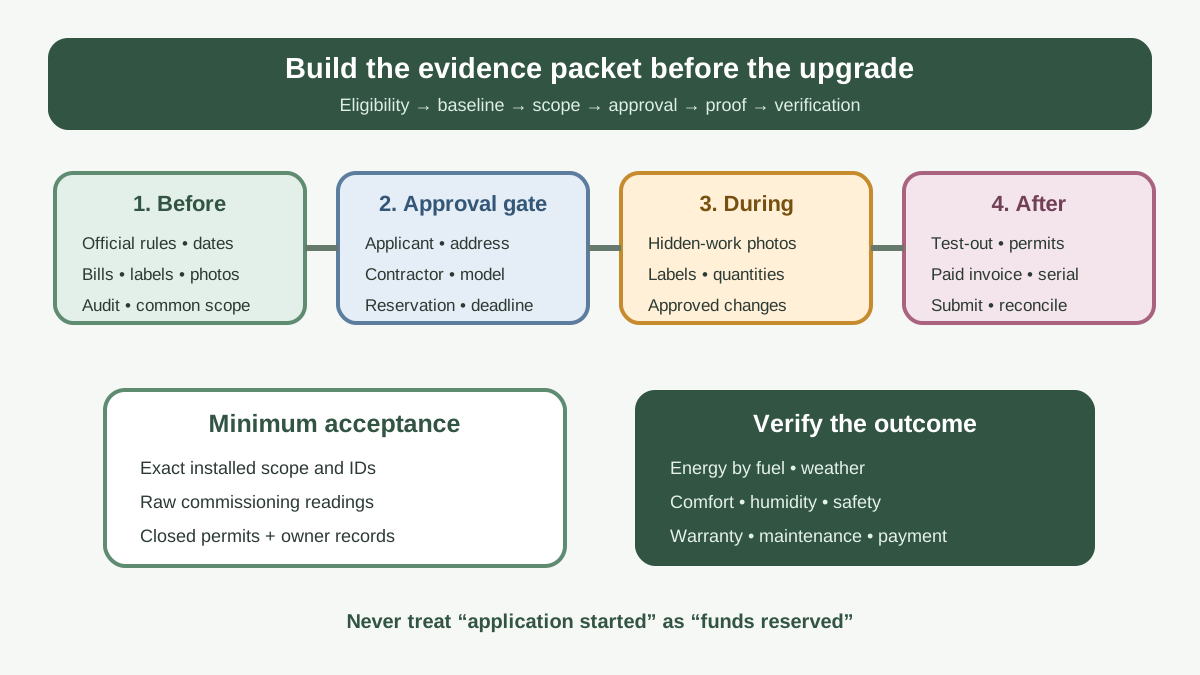
Home Energy Audit and Rebate Documentation Checklist
A programneutral evidence packet for audits and home upgrades: baseline bills, photos, model IDs, preapproval, comparable quotes, testin/testout, paid invoices, serials, permits, and savings verification.
The Short Answer
Short Answer: Before an audit or upgrade, create a dated evidence packet containing 12–24 months of utility consumption, rate codes, fuel deliveries, room comfort/moisture symptoms, existing equipment model and serial numbers, photos, permits, ownership/occupancy evidence, and the official program rules. Do not sign, buy, demolish, or install until you know whether the program requires enrollment, income verification, a pre-work audit, approved contractor, qualifying model, reservation, or pre-approval.
During the project, preserve change orders, material labels, hidden-work photos, test results, and inspection records. Afterward, collect paid itemized invoices, proof of payment, model/serial and certification records, commissioning, test-out, disposal evidence where required, warranties, and the final application. Then compare weather- and occupancy-aware energy and comfort results with the baseline.
The Evidence-Packet Workflow
Create these folders before contacting contractors:
- 00-program-rules — official pages/PDFs, effective date, contacts;
- 01-baseline — bills, fuel, weather, occupancy, symptoms;
- 02-existing-condition — labels, photos, plans, permits;
- 03-audit — auditor credentials, scope, readings, report;
- 04-quotes — normalized proposals and exclusions;
- 05-preapproval — application, reservation, eligibility notice;
- 06-construction — contract, changes, product labels, hidden work;
- 07-commissioning — test-out, permits, inspection, training;
- 08-payment-application — invoices, receipts, proof of payment;
- 09-follow-up — bills, performance, warranty and maintenance.
Use filenames beginning with YYYY-MM-DD. Keep originals read-only and work from copies with account, tax, or identity data redacted when sharing.
Programs Are Local and Time-Sensitive
DOE says Home Energy Rebate availability and rules are administered through participating states, territories, and Tribes, with programs available only in some locations at a given time. Utilities, municipalities, housing agencies, lenders, insurers, tax authorities, and manufacturers may have separate offers.
Do not assume a national summary is an application. For each program record:
| Rule | Verified entry |
|---|---|
| Official program and administrator | |
| Address/customer eligibility | |
| Owner, renter, landlord, or income rules | |
| Eligible project/equipment | |
| Effective and funding dates | |
| Pre-audit/pre-approval/reservation | |
| Contractor/auditor requirements | |
| Product list, efficiency, or model ID | |
| Eligible equipment/labour/permit costs | |
| Combining rebates, financing, tax treatment | |
| Test-out, inspection, disposal | |
| Submission deadline | |
| Payment recipient and timing | |
| Appeal/correction process |
Call only verified administrator contact information. Record date, representative, reference number, question, and answer. Ask for written confirmation when the interpretation changes spending.
Do not assume old federal tax-credit claims remain current
Federal tax law changed after many articles and contractor brochures were published. For example, ENERGY STAR's home-energy-audit tax-credit page states that the referenced credit applied to qualifying costs through December 31, 2025, and the IRS 2025 Form 5695 instructions describe 2025 requirements. A 2026 project should not deduct a 2025 credit from its price unless current IRS law and qualified tax advice establish eligibility.
Save the current IRS form/instructions for the tax year and placed-in-service date. A rebate, point-of-sale discount, refundable credit, and nonrefundable tax credit are not interchangeable cash.
Build a Consumption Baseline
Collect 12 months minimum; 24 months helps identify weather and occupancy variation.
| Energy source | Preserve |
|---|---|
| Electricity | service dates, import/export kWh, demand kW, rate code, fixed/variable charges, interval data |
| Natural gas | therms/m³, heat content if shown, rate, fixed/delivery charges |
| Propane/oil | delivery dates, volume, tank level, unit price |
| Wood/pellets | quantity, moisture/grade if known, cost, supplemental-heating hours |
| District energy | thermal units, demand/fixed charge, meter method |
Record dollars but normalize performance with consumption and weather. A lower post-project bill can come from a warm winter, lower rate, vacancy, or reduced comfort. A higher bill can follow electrification even while total site/fuel energy and emissions change.
Download hourly/15-minute electricity data when available. Preserve raw files and time zone. Do not upload household interval data to an unknown service.
Create a Comfort, Health, and Moisture Log
Energy is only one outcome. For two to four weeks record:
- room temperature and relative humidity at consistent sensor locations;
- drafts, cold floors, hot ceilings, glare, condensation, frost, damp odour;
- rooms/doors occupied and time;
- thermostat setpoint, equipment runtime, cycling, noise;
- showers, cooking, laundry, exhaust-fan use;
- outdoor temperature, wind, sun, rain/snow when relevant;
- safety/health constraints without storing unnecessary medical details.
Photograph sensor location and label instruments. A single reading in a supply-air stream or sunlit window does not represent the room.
This log helps an auditor distinguish whole-house load from a room distribution, ventilation, solar-gain, or moisture problem.
Photograph and Inventory Existing Conditions
Capture wide context and close readable labels:
- heating/cooling indoor and outdoor units;
- water heater, pumps, tanks, controls;
- main electrical service/panel exterior and directories—do not remove covers;
- thermostat and zone controls;
- filters, return/supply grilles, accessible ducts;
- attic hatch, insulation depth, bypasses visible from safe access;
- basement/crawlspace walls, rim joists, bulk water and drains;
- windows/doors, weatherstripping, condensation or damage;
- ventilation fans, range hood route, dryer vent;
- roof/exterior penetrations and shading;
- appliance labels for items in scope.
Do not enter an unsafe attic/crawlspace, disturb suspect asbestos/lead/mold, open energized equipment, or perform combustion/depressurization tests without appropriate expertise.
Build an equipment register:
| Item | Make/model/serial | Fuel/voltage | Capacity/efficiency | Age/condition | Service record |
|---|---|---|---|---|---|
| Space heating | |||||
| Cooling | |||||
| Water heating | |||||
| Ventilation | |||||
| Major appliances |
Choose an Audit Scope That Matches the Decision
A walk-through, program audit, blower-door/duct test, combustion-safety assessment, infrared survey, HVAC load calculation, and whole-home energy model are different services. Ask exactly what is included.
For the auditor, record:
- name, company, license/certification and expiration;
- whether a program recognizes the credential;
- independence or sales relationship;
- insurance where relevant;
- tests, instruments, calibration, standards/protocols;
- safety screening and stop conditions;
- written deliverables;
- energy/cost assumptions;
- prioritization and scope development;
- test-out/follow-up included;
- data ownership and model-file access.
DOE's Guidelines for Home Energy Professionals and Standard Work Specifications provide a quality framework, while each program can impose its own approved auditor requirements. “Certified” is incomplete without the credential and program match.
Use the professional home energy audit guide to define testing and deliverables. Use the DIY evidence audit to prepare observations safely.
Require a Decision-Ready Audit Report
The report should include:
- building description and conditioned boundary;
- occupancy/operating assumptions;
- baseline fuels, consumption, rates, and weather period;
- measured conditions and instrument details;
- photos and location map;
- safety/moisture/ventilation constraints;
- recommended measures with quantities and locations;
- prerequisite work and sequencing;
- modeled energy by fuel, not dollars only;
- comfort, durability, health, and resilience effects;
- low/base/high cost and savings assumptions;
- interactive effects among measures;
- verification/test-out plan;
- items requiring specialist evaluation.
Ask for an editable assumptions table. A report that says “save 30%” without baseline, weather, model, rate, scope, and uncertainty is not a financial forecast.
Turn Recommendations Into Comparable Quotes
Send all bidders the same scope. Require:
| Quote field | Required detail |
|---|---|
| Existing condition | diagnosis and quantities verified |
| Exact product | manufacturer, model, certification/ID |
| Design | loads, areas, R-values, airflow, capacity, settings |
| Preparation | removal, cleaning, repair, access, protection |
| Installation | materials, locations, methods, details |
| Electrical/plumbing/roof/duct work | included or excluded line items |
| Permits/inspection | responsible party and fee |
| Commissioning/test-out | measurements and acceptance values |
| Price | equipment, labour, tax, allowances, options |
| Schedule/payment | milestones, deposit, retainage if applicable |
| Warranty | product, labour, shipping, access, exclusions |
| Program paperwork | documents and submission owner |
For HVAC, obtain room loads, exact matched equipment, design-condition capacity, distribution, backup/control, electrical work, and commissioning. For envelope work, require exact areas, air-sealing locations, insulation assembly, moisture/fire/electrical protection, ventilation implications, and test-out.
Avoid allowance-heavy proposals. If hidden conditions are possible, specify investigation, unit prices, approval threshold, and change-order evidence.
Complete Pre-Approval Before Work
Create a gate checklist:
- customer/address/income/ownership eligibility confirmed;
- audit credential and audit timing accepted;
- approved contractor/vendor confirmed;
- exact model/material on qualified list;
- pre-existing-condition photos uploaded;
- quote matches eligible scope/cost categories;
- reservation or application submitted;
- written approval/number received;
- install and submission deadlines calendared;
- combination with other programs confirmed;
- payment recipient confirmed;
- cancellation/funding risk understood.
“Application started” is not “funds reserved.” Do not schedule irreversible work until the program's required authorization exists.
Document Hidden Work During Construction
Once insulation, drywall, roofing, cabinets, or equipment conceal the work, later proof is expensive. Photograph:
- air sealing before insulation;
- insulation depth, density, coverage, and labels;
- rim-joist/attic/penetration details;
- duct sealing and insulation before closure;
- flashing, penetrations, drainage and condensate;
- electrical conductors, disconnects, protective equipment before concealment where permitted;
- equipment labels/serials before access becomes difficult;
- removed equipment and disposal/recycling where required.
Include a ruler/location marker without obscuring work. Record date, room/assembly, contractor, and change order. Do not enter controlled work zones or direct unsafe photography.
For materials, save packaging labels, lot/product IDs, quantity, invoice, safety/data sheet where useful, and manufacturer installation requirements.
Control Change Orders
Every change should state:
- discovered condition with photo/test evidence;
- original scope affected;
- options considered;
- product/model/quantity;
- energy, safety, permit, warranty, and rebate effect;
- added/subtracted cost and schedule;
- approval before work;
- revised incentive eligibility confirmed.
Do not let an approved model become a “similar” substitute without checking the official qualified list. One suffix can change capacity, efficiency, certification, or voltage.
Commission and Test Out
The final invoice does not prove performance. Match tests to scope:
- blower-door/air-leakage change;
- duct leakage, static pressure, and airflow;
- HVAC model match, airflow/flow, controls, backup, temperature/humidity;
- ventilation flow and controls;
- combustion safety where applicable;
- insulation coverage/depth/density and assembly inspection;
- water-heater temperature, mixing, condensate and controls;
- electrical settings/load management;
- solar/storage production, settings, transfer and monitoring;
- permits and inspection closure.
Write acceptance values into the contract. Keep raw readings, not only “passed.” If a test fails, document correction and retest.
Build the Final Application Packet
Typical evidence may include:
- approval/reservation number;
- completed signed application;
- audit report and auditor credentials;
- itemized contract, changes, and paid final invoice;
- proof of payment matching applicant and invoice;
- exact model/serial and qualification/certification record;
- AHRI or other specified certificate where required;
- permits and inspections;
- before/during/after photos;
- commissioning/test-out;
- contractor license/certification;
- disposal/recycling proof;
- income/occupancy/ownership records through secure channel;
- tax forms requested by administrator;
- warranty registration.
Make a submission index showing filename, program requirement, page, and status. Export a read-only PDF copy and preserve originals. Submit through the official secure portal, not unencrypted email, when sensitive data is involved.
Reconcile Payment and Tax Treatment
Record gross contract cost, eligible cost, rebate/discount, financing, amount paid, date, and recipient. Confirm whether the incentive reduces basis or eligible tax-credit cost with current authoritative tax guidance.
Do not count:
- the same cost twice across programs;
- a mail-in rebate as cash at contract signing;
- a nonrefundable tax credit as a guaranteed refund;
- loan proceeds as a rebate;
- an estimated contractor incentive as approved funds.
If payment is delayed, use the program's correction/escalation process and preserve reference numbers.
Protect Against Rebate and Contractor Fraud
Treat urgency, identity requests, and guaranteed-government-money claims as risk signals. Before sharing documents or paying:
- navigate to the program from an official government, utility, regulator, or administrator website;
- verify the contractor/auditor through the program directory and licensing authority independently;
- call a published number rather than one in an unsolicited message;
- confirm who receives the incentive and whether an assignment is permitted;
- never provide a utility account transfer authorization merely to receive an estimate;
- avoid cash, gift card, cryptocurrency, or person-to-person payment requests;
- check that contract name, invoice payee, license, insurance, and program vendor identity agree;
- keep control of portal credentials and multi-factor authentication;
- review cooling-off/cancellation rights and financing disclosures;
- do not sign a completion certificate before acceptance tests pass.
A legitimate contractor can still make an outdated program claim. Separate fraud screening from eligibility verification. If an offer promises a rebate larger than project cost, “free” work contingent on assigning unknown benefits, or tax savings regardless of tax circumstances, pause and contact the administrator.
Build a Master Project Index
Large packets fail because evidence exists but cannot be matched to the requirement. Maintain a one-page index:
| Requirement | Filename/record | Owner | Due | Status |
|---|---|---|---|---|
| Eligibility approval | homeowner | before contract | ||
| Pre-audit/report | auditor | before work | ||
| Qualified model proof | contractor | before order | ||
| Permit | contractor/owner | before work | ||
| Hidden-work photos | contractor | before concealment | ||
| Commissioning | contractor | at startup | ||
| Inspection closure | inspector | before final | ||
| Paid invoice | contractor | final | ||
| Rebate submission | named party | deadline | ||
| Warranty registration | named party | manufacturer deadline | ||
| 12-month verification | homeowner | review date |
Name a person for every item. “Contractor handles rebates” is not a responsibility matrix. The contract should state whether the contractor prepares, submits, corrects, and follows up—or only supplies documents.
Plan a Sequenced Whole-Home Project
When several measures interact, create a dependency map:
- stop bulk water, structural, electrical, combustion, or hazardous-material problems;
- define the conditioned boundary and ventilation strategy;
- complete approved air sealing/insulation and verify it;
- recalculate room and equipment loads;
- install HVAC/water-heating/electrical equipment;
- commission distribution, controls, moisture, and safety;
- test out and verify whole-home results.
Programs may impose a different order or allow parallel work, so reconcile this technical sequence with their rules. If HVAC must be replaced urgently before envelope work, document the future enclosure assumptions in sizing and avoid claiming completed savings prematurely.
Create a measure-interaction table:
| First measure | Affected later decision |
|---|---|
| Air sealing | ventilation, combustion, moisture, heating/cooling load |
| Attic insulation | HVAC size, ice-dam/roof moisture, access |
| Heat pump | panel capacity, tariff, backup, envelope economics |
| Heat-pump water heater | room heat/moisture, electrical, condensate, HVAC load |
| Solar | roof life, tariff/export, future heat/EV loads |
| Battery | critical loads, solar controls, panel/transfer, tariff |
This prevents each contractor from optimizing an isolated product while another contractor inherits the consequences.
Special Cases: Renters, Landlords, Condominiums, and Shared Meters
First establish who can authorize work, who pays utilities, who owns equipment, and who is the applicant. Preserve:
- lease/condo/bylaw approval;
- landlord/board authorization;
- common versus unit meter and bill;
- allocation of costs and incentive;
- access, notice, restoration, and insurance;
- responsibility for filters, service, and warranty;
- move-out or sale transfer;
- protection against rent/fee changes where programs regulate them.
Do not expose another resident's bills, income, or identity. For shared systems, define which units and common areas the baseline and savings cover. A unit-level comfort complaint may require a building-level distribution or enclosure decision.
Maintain an Asset Register After Completion
Transfer the project packet into a durable home record:
- exact installed model/serial and location;
- commissioning settings/readings;
- filter, fluid, cleaning, inspection, and service schedule;
- permit and warranty contacts;
- software/account owner and transfer steps;
- spare material/product details;
- shutdown/emergency instructions;
- next audit or test date;
- unresolved recommendations.
When selling, provide relevant records without utility account or identity data. Documented loads, scope, permits, and performance are stronger than a listing claim that the home is “energy efficient.”
Verify Results After the Upgrade
At 30 days, one season, and 12 months, record:
- consumption by fuel and interval;
- weather and occupancy differences;
- thermostat/settings and operating schedules;
- comfort and humidity by room;
- equipment runtime, cycling, backup use, fault codes;
- maintenance and filters;
- unresolved noise, moisture, drafts, or safety issues;
- actual costs and incentive receipts.
Compare like periods or weather-normalize appropriately. Electrification can raise electricity while eliminating gas/oil. Track total cost and service, not one meter in isolation.
If results differ from the audit, decompose the variance: weather, rates, occupancy, scope change, control/settings, installation, model assumption, rebound, or fault. Preserve the analysis for warranty and future projects.
Project-Specific Addenda
Heat pump
Add room loads, design temperatures, low-temperature capacity, matched system, distribution, backup logic, electrical scope, condensate, refrigerant commissioning, controls, and sound.
Insulation and air sealing
Add conditioned-boundary map, assembly moisture assessment, leakage baseline, target locations, ventilation/combustion implications, fire/electrical clearances, product/quantity, and test-out.
Windows and doors
Add opening dimensions, ratings/certification, installation/flashing/air-sealing details, egress, condensation diagnosis, trim/finish, and disposal. Do not frame windows as universal first-priority energy work.
Water heating
Add household hot-water profile, fuel/rate, location temperature/volume, electrical/plumbing/condensate/venting, noise, mixing, controls, commissioning, and backup.
Solar and storage
Add roof condition, production model, shade, exact equipment, interconnection, tariff/export, battery critical loads/runtime, permits, monitoring/data access, and warranty/service.
Common Failure Modes
Work begins before approval
If pre-work evidence was mandatory, later photos may not cure it. Pause until written authorization.
Quote names a product family, not model
Eligibility commonly attaches to exact certification/model. Require the complete number before purchase and verify it again at delivery.
Contractor owns every portal account
Homeowners can lose access when the installer closes. Obtain administrator access, exports, credentials-transfer procedure, and raw reports.
Savings are stated only in dollars
Rates change. Require energy by fuel, weather assumptions, comfort service, and low/base/high cases.
Hidden work has no evidence
Create photo/test hold points before closing walls, attics, roofs, or equipment.
“Final” invoice is not itemized
Programs may need eligible equipment, labour, tax, model, quantity, and paid status. Agree on invoice fields in the contract.
Frequently Asked Questions
Should I get the audit before requesting quotes?
Usually, when the audit defines scope or a program requires it. For urgent failures, preserve evidence and contact the administrator before irreversible work if possible.
Are three quotes required?
Program rules vary. Multiple comparable quotes are useful for significant projects even when not mandatory, but quality depends on a shared scope.
Can I use a contractor's rebate estimate?
Use it as a lead, not approval. Verify exact written rules and obtain required reservation/pre-approval from the administrator.
What if the installed model differs from the quote?
Pause commissioning/payment as appropriate, verify technical and program eligibility, document the reason, update permits/certificates, and obtain written approval before accepting.
Do I need 12 months of bills?
It is a strong minimum for seasonal projects. Programs may require more, less, or specific data. Use 24 months when conditions changed.
How do I protect sensitive information?
Use official secure portals, redact copies, limit access, store originals securely, and avoid sending account, tax, income, or identity records through unverified channels.
When should I measure savings?
Check operation immediately, then compare representative seasons and at least a full year for annual claims. Account for weather, occupancy, rate, and fuel switching.
What to Read Next
Scope professional testing with the home energy audit guide, build safe pre-audit evidence with the DIY audit guide, normalize HVAC bids using the heat-pump quote worksheet, and compare envelope economics with the insulation payback by climate guide.
About the Editorial Team EnergyBS reviews public program rules, product specifications, utility rates, and reader-facing cost assumptions. Treat savings figures as estimates until you verify local prices, permits, rebates, and contractor quotes.
Sources and Verification
Editorial Review
EnergyBS Editorial Team
EnergyBS publishes practical homeowner guides. Important program, product, and cost claims should be checked against the linked source and local project documents before you commit to work.
Related Guides
View All ArticlesHome Energy Audit Guide: Stop Leaking Money (2026)
Choose and prepare for a professional home energy assessment, evaluate diagnostic evidence, turn recommendations into a sequenced retrofit plan, and verify completed work.
DIY Home Energy Audit: Find Air Leaks Yourself (2026)
Run a safe DIY home energy audit using bills, visual evidence, simple draft checks, plugload measurements, and disciplined documentation—then know when professional diagnostics are required.
Heat Pump Quote Comparison Worksheet 2026 Tool
A sidebyside homeowner worksheet for comparing heatpump and HVAC bids by load calculations, exact matched equipment, ducts, electrical work, refrigerant piping, controls, commissioning, warranties, exclusions, and true installed cost.