SodiumIon vs. LFP in 2026: The New Battery Economics
As Lithium prices stabilize, a new contender has entered the residential storage market. SodiumIon (Naion) batteries promise wider temperature ranges and lower costs, but can they beat LFP's density? A 2026 technical deep dive.
The Lithium Monopoly Is Over
Short Answer: As Lithium prices stabilize, a new contender has entered the residential storage market. Sodium-Ion (Na-ion) batteries promise wider temperature ranges and lower costs, but can they beat LFP
For the last decade, switching to renewable energy meant buying lithium. Whether it was Nickel-Manganese-Cobalt (NMC) for cars or Lithium-Iron-Phosphate (LFP) for home storage, the chemistry was fundamentally the same.
In 2026, that paradigm has shifted. Sodium-Ion (Na-ion) batteries have graduated from lab experiments to commercial shipping products. If you are quoting a home battery system today, you are likely facing a choice: the proven LFP workhorse, or the cheaper, cold-resistant Sodium challenger.
This guide explores the physics, economics, and operational realities of Na-ion technology in 2026.
1. The Chemistry: Salt vs. Rock
To understand the operational differences, we must look at the atomic level.
LFP (Lithium Iron Phosphate)
- Carrier: Lithium ions (Li+).
- Structure: Olivine crystal sctructure. Very stable, very tight.
- Voltage: ~3.2V nominal.
- Pros: Incredible cycle life (6000+), safe thermal runaway profile.
- Cons: Struggles below -10°C (14°F). Supply chain tied to lithium mining geopolitics.
Na-ion (Sodium-Ion)
- Carrier: Sodium ions (Na+).
- Structure: Prussian Blue Analogs or Hard Carbon anodes. The Na+ ion is 3x larger than Li+.
- Voltage: ~3.0V nominal (slightly lower).
- Pros: Sodium is abundant (ocean water/soda ash). Excellent low-temp performance (-30°C). Zero-volt transport (can be discharged to 0V for safety).
- Cons: Lower energy density (~160 Wh/kg vs LFP's ~175+ Wh/kg). Larger physical footprint.
Key Takeaway: You don't use Sodium for a sports car. You use it for a stationary box in your garage where weight doesn't matter.
2. Energy Density vs. Cost Matrix
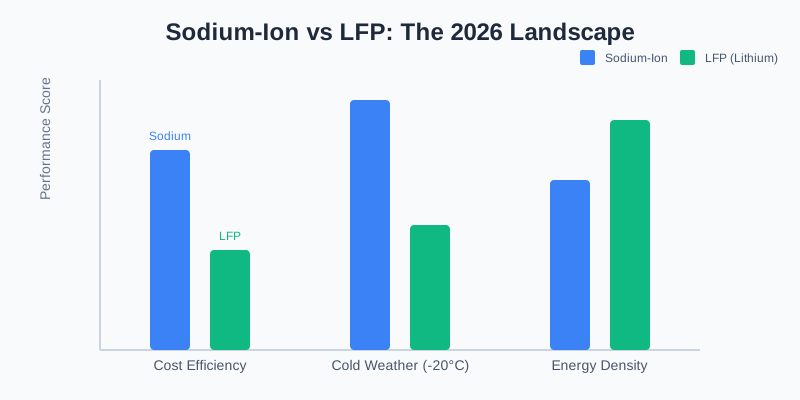
In 2026, the cost curve has intersected.
| Metric | LFP (Top Tier) | Sodium-Ion (Gen 2) | Winner |
|---|---|---|---|
| Cell Cost ($/kWh) | $85 | $55 | Sodium |
| Volumetric Density (Wh/L) | 450 | 300 | LFP |
| Cycle Life (80% DoD) | 6,000 - 10,000 | 4,000 - 6,000 | LFP |
| Round Trip Efficiency | 96% | 94% | Tie |
| Cold Weather (-20°C) | 50% Capacity | 90% Capacity | Sodium |
The "Cold Tax" Reality
If you live in Minnesota, Canada, or Scandinavia, LFP batteries require heating elements to charge in winter. This "parasitic load" consumes 5-10% of your stored energy just to keep the battery warm. Sodium-ion batteries do not need this. They charge happily at -20°C.
- Result: In cold climates, a 10kWh Sodium battery yields more usable energy than a 10kWh LFP battery, despite the lower density.
3. The 2026 Supply Chain: Why Sodium Wins on Price
Lithium is a "conflict mineral" adjacent resource. It requires massive evaporation ponds in South America or hard rock mining in Australia. Sodium is... salt.
- Anode Material: LFP uses Graphite (controlled largely by China). Sodium-ion uses Hard Carbon (made from bio-waste, sugar, or coconut shells).
- Cathode Material: No Cobalt. No Nickel. Just iron, manganese, and sodium.
- Collector Current: Sodium batteries use Aluminum for the anode collector (cheaper) instead of Copper (expensive) required for Lithium.
As of Q1 2026, this material difference translates to a 30% reduction in BOM (Bill of Materials) cost.
4. Safety Profile: The Zero Volt Transport
One of the logistical nightmares of Lithium batteries is shipping. They must be shipped at 30% State of Charge (SoC) because they are chemically active. If they short, they burn.
Sodium-ion batteries can be discharged to 0 Volts. They are effectively inert bricks of metal and plastic during transport.
- Installer Benefit: Safer to handle.
- Insurance Benefit: Lower fire risk ratings.
- Recovery: A Sodium battery at 0V can be revived. An LFP battery at 0V is often bricked permanently due to copper dendrite formation.
5. Payback Period Calculation (2026 Rates)
Let's look at the ROI for a typical home in California (NEM 3.0 environment) or Massachusetts (SMART program).
Scenario: 10kWh Battery added to existing Solar.
- Arbitrage Value: $0.30/kWh spread (Peak vs Off-Peak).
- Daily Profit: $3.00.
- Annual Profit: ~$1,095.
Option A: LFP System (e.g., Tesla Powerwall 4)
- Installed Cost: $8,500 (after 30% ITC).
- Payback: 7.7 Years.
- Warrior Warranty: 15 Years.
Option B: Sodium-Ion System (e.g., Natron Home / CATL EnerOne)
- Installed Cost: $5,800 (after 30% ITC).
- Payback: 5.2 Years.
- Warranty: 12 Years.
Economic Verdict: Sodium-ion offers a significantly faster ROI. For homeowners who plan to move in 5-7 years, Sodium is the clear financial winner.
6. Integration: AC vs DC Coupling with Sodium
Because Sodium-ion operates at a lower voltage range (2.0V - 4.0V) compared to Lithium (2.5V - 4.2V), older hybrid inverters may not be compatible.
- The Inverter Gap: In 2026, ensure your inverter is "Multi-Chemistry Ready". Brands like SolArk and Enphase have released firmware updates, but older SMA or SolarEdge models may need a dedicated Sodium interface.
- DC Coupling: Still the most efficient method. Sodium banks often come in 48V nominal racks (16 cells in series) vs LFP 51.2V racks (16 cells in series). The voltage curve is steeper, meaning the inverter needs better MPPT tracking for the battery bank to estimate SoC accurately.
7. The Future: Sodium Solid State?
The roadmap for 2027-2028 includes Solid State Sodium batteries. By removing the liquid electrolyte, we increase safety further and potentially bump energy density up to 200 Wh/kg, effectively killing the low-end LFP market.
Should you wait? Tech moves fast. But "waiting for the next battery" is like waiting for the next iPhone. You miss out on years of savings.
- Buy Sodium Now IF: You live in a cold climate or are budget-sensitive and have garage space.
- Buy LFP Now IF: You have limited space (need density) or need a 15-20 year proven track record.
Summary Checklist for Homeowners
- Check Your Climate: Average winter temp < -5°C? Go Sodium.
- Check Your Space: Can you accommodate a box 20% larger for the same capacity?
- Check Your Inverter: Is it 48V battery agnostic?
- Check the Warranty: Does the cheap Sodium brand offer a US-based service agreement?
The era of "Lithium or Gas Generator" is over. Salt is here to save the grid.
About the Editorial Team EnergyBS reviews public program rules, product specifications, utility rates, and reader-facing cost assumptions. Treat savings figures as estimates until you verify local prices, permits, rebates, and contractor quotes.
Common Questions
What should I check first before using this technology advice?
Start with the numbers that apply to your home: climate, utility rate, equipment age, contractor quote, and local program rules. As Lithium prices stabilize, a new contender has entered the residential storage market. SodiumIon (Naion) batteries promise wider temperature ranges and lower costs, but can they beat LFP
How should I verify rebates, tax credits, rates, or savings before spending money?
Treat program amounts, utility rates, and tax rules as date-sensitive. Check the named government, utility, or manufacturer source before you sign a contract, and keep screenshots or PDFs of eligibility rules for your records.
What is the next useful step after reading this?
Compare this with SodiumIon vs. LFP in 2026: The New Battery Economics so you can check the cost, rebate, installation, or operating-risk angle before making a decision.
What to Read Next
SodiumIon vs. LFP in 2026: The New Battery EconomicsUse this next to compare the cost, incentive, installation, or operating-risk angle before you make a home energy decision.Sources and Verification
Editorial Review
EnergyBS Editorial Team
EnergyBS publishes practical homeowner guides. Important program, product, and cost claims should be checked against the linked source and local project documents before you commit to work.
Related Guides
View All ArticlesSodiumIon vs. LFP in 2026: The New Battery Economics
As Lithium prices stabilize, a new contender has entered the residential storage market. SodiumIon (Naion) batteries promise wider temperature ranges and lower costs, but can they beat LFP's density? A 2026 technical deep dive.
The 2026 V2G Standard: What Canada's Bidirectional Charging Rules Mean for EV Owners
A practical look at Canada's 2026 bidirectional charging standard, including V2G hardware, battery wear concerns, backup mode, and the economics of controlled export.
Smart Energy Monitoring: How to Track Your Home's Usage (2026)
Stop waiting for the monthly bill shock. Install a realtime energy monitor to see exactly which appliance is robbing you.