Microinverters vs. String Inverters 2026 Tool
A roofspecific inverter comparison using shade and mismatch, DC/AC ratio, modulelevel electronics, monitoring ownership, service access, battery coupling, grid requirements, and a 25year replacement ledger.
The Short Answer
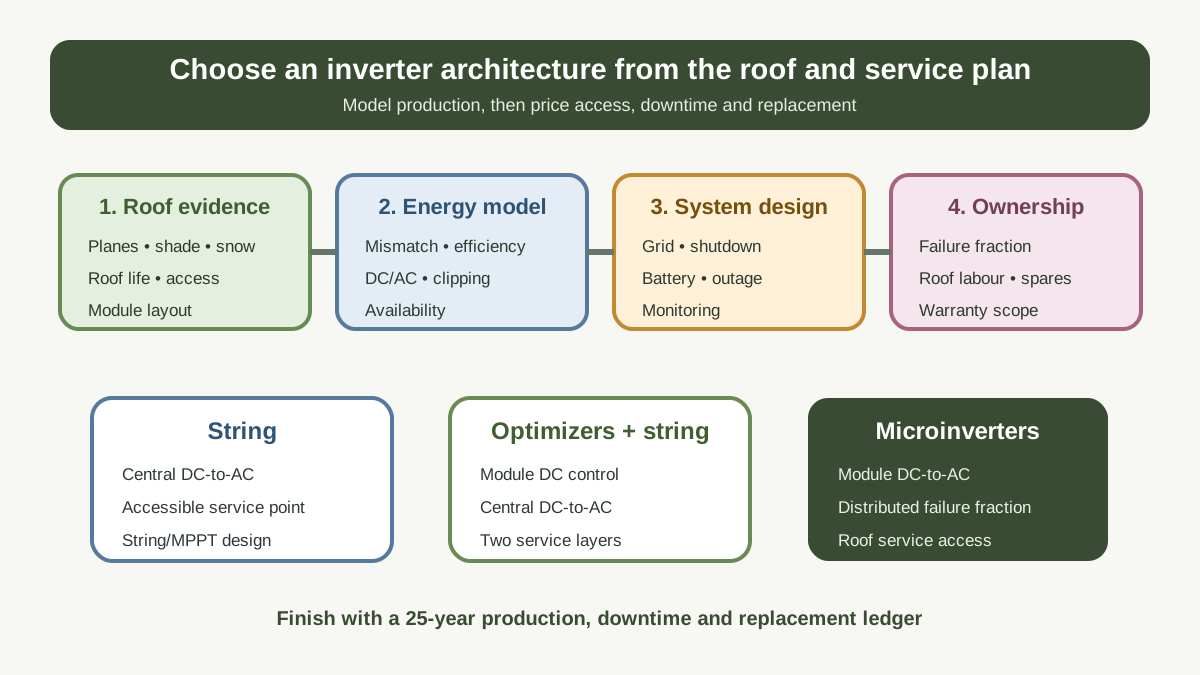
Short Answer: Choose the inverter architecture from the roof and ownership plan, not a brand slogan. Microinverters perform DC-to-AC conversion at each module and can isolate module-level shade, mismatch, or failure. A string inverter converts the output of one or more module strings at a central, accessible location; it may be paired with DC optimizers when module-level control is required. String equipment is often simpler to service at ground level, while module electronics put more replaceable devices on the roof.
Compare a code-compliant design for the same array using hourly production, shade, roof planes, DC/AC ratio, clipping, equipment efficiency, monitoring access, battery architecture, utility requirements, roof service, replacement labour, warranty responsibility, and 25-year net cost. A small modeled yield difference rarely justifies an architecture without a service plan.
Three Common Architectures
Conventional string inverter
Modules are wired into DC series strings within the equipment's voltage/current limits. One or more strings feed an inverter that converts DC to AC. The array design must respect string length, temperature-adjusted voltage, current, maximum power point tracker inputs, orientation, shade, rapid-shutdown requirements, and utility interconnection.
String inverter with DC optimizers
Each module receives DC-to-DC power electronics, while a central inverter performs DC-to-AC conversion. Module-level devices can manage mismatch, provide monitoring, and support required safety functions depending on the listed system design. The central inverter remains part of the conversion and service boundary.
Microinverters
Each module, or sometimes a small module group, connects to an inverter on the roof that produces AC. Modules operate more independently, and the array uses AC branch circuits and associated communications/combiner equipment.
DOE's inverter overview describes string inverters as converting a connected string at one location and microinverters as smaller devices at each panel. DOE notes that microinverters can limit the effect of shade or damage on other modules, while costing more. Treat this as an architecture principle, not a universal production percentage.
The Architecture and Service Ledger
Use one column per quote:
| Input | String | String + optimizers | Microinverters |
|---|---|---|---|
| Module count and DC nameplate | |||
| Roof planes/orientations | |||
| Annual shade by module/period | |||
| Exact inverter/MLPE models | |||
| MPPT/string/branch design | |||
| AC output and DC/AC ratio | |||
| Modeled clipping kWh/year | |||
| Modeled other system losses | |||
| Utility functions/settings | |||
| Rapid-shutdown design | |||
| Battery coupling and outage mode | |||
| Monitoring owner, access, term | |||
| Roof/ground service steps | |||
| Warranty: equipment/labour/shipping | |||
| Replacement reserve and year | |||
| 25-year net cost/value |
If a bidder cannot provide model numbers, electrical design, production assumptions, and service responsibility, the warranty headline is not enough.
Start With a Roof Evidence Map
Create a scaled roof map showing:
- azimuth and pitch of every plane;
- module position and setbacks;
- chimney, dormer, plumbing vent, antenna, parapet, tree, and neighbouring-building shade;
- shade by hour and season, not only a noon photo;
- snow, debris, and drainage paths;
- roof age, material, remaining service life, and access;
- module/inverter/optimizer serial-location plan;
- safe service and fall-protection access;
- fire and emergency access requirements;
- likely future tree growth or construction.
A simple south-facing unshaded plane presents a different mismatch case from a roof with several orientations and moving chimney shade. Do not pay for claimed shade recovery until the proposal quantifies shade and annual energy with a defensible model.
The NREL module-level power-electronics testbed demonstrated that microinverter improvement relative to its reference string design varied substantially with the imposed shade condition. That result shows why a site-specific shade case matters; it is not a percentage to paste into every quote.
Shade, Mismatch, and Bypass Behaviour
Modules can differ because of shade, soiling, temperature, manufacturing tolerance, aging, damage, snow, orientation, and irradiance. In a string, current and voltage relationships plus bypass diodes and maximum-power-point tracking determine how mismatch affects output. The slogan “one shaded panel shuts down the entire string” is too crude for modern modules and inverter designs.
Module-level electronics can reduce some mismatch loss by operating modules separately. They cannot recover sunlight that never reaches a module. They also cannot fix a poor roof layout, growing tree, clogged drainage, damaged module, or unavailable grid.
Ask the modeler to separate:
- beam and diffuse irradiance;
- horizon and near-object shade;
- module mismatch;
- soiling and snow;
- DC wiring/connections;
- inverter conversion;
- clipping;
- AC wiring;
- availability/downtime.
PVWatts includes user-adjustable system losses and explicitly models inverter behaviour at an aggregate level. A detailed shaded residential design may require more specific software and inputs. Keep the report, weather file, shade scene, loss table, and inverter settings.
Different Roof Planes and MPPT Inputs
Modules facing different directions produce different current/voltage patterns over the day. A string inverter may have multiple maximum-power-point tracker inputs that can serve separate strings, subject to exact model rules. Microinverters naturally operate at the module level. Optimizers can also provide module-level tracking while feeding a central inverter.
For each plane, record:
- module count;
- orientation/tilt;
- shade profile;
- temperature-adjusted open-circuit voltage;
- operating voltage/current;
- string or MPPT assignment;
- branch-circuit assignment for micros;
- expected annual kWh.
Do not accept a mixed-orientation string unless the designer shows that it is allowed and modeled. Do not assume microinverters make a poor north-facing or heavily shaded location productive enough to justify installation.
DC/AC Ratio and Clipping
The DC/AC ratio is usually:
module DC nameplate ÷ inverter AC rating
An 8.0 kWdc array with 6.6 kWac of aggregate inverter output has a ratio of about 1.21. That does not mean 17.5% of annual energy is lost. Modules rarely operate at nameplate simultaneously, and output changes with irradiance, cell temperature, angle, soiling, and other losses.
Clipping occurs when available DC power exceeds the inverter's AC output capability. Some clipping can be an economic design choice if the smaller inverter operates well over more hours and lost peak energy is small relative to cost. Excessive clipping can waste valuable production.
Require annual modeled clipping in kWh, not a screenshot of a flat-topped day. Compare at least:
- low/base/high weather year;
- each roof plane;
- current and expected module degradation;
- export limit or utility power control;
- battery charging opportunity where supported;
- future expansion, if real.
For microinverters, compare each module's inverter output rating and compatibility. For string systems, compare total and per-MPPT limits. Do not assume a magic universal target ratio.
Efficiency Curves and Standby Power
Inverter efficiency changes with input power and voltage. A single peak efficiency number does not describe dawn, clouds, partial load, high temperature, night tare, communications, or clipping. Compare certified datasheets and model the hourly result.
Keep auxiliary equipment in the boundary:
- communications gateway;
- rapid-shutdown transmitter/devices;
- fans or pumps where applicable;
- battery inverter/controls;
- monitoring/network equipment;
- nighttime standby.
Small differences in peak conversion efficiency may be less important than shade, downtime, service response, or clipping.
Reliability Is an Architecture Question
DOE's PV longevity guidance identifies inverters as an important source of downtime and maintenance and notes that small micro- and string inverters are often replaced rather than component-repaired. The comparison is not “one device fails versus many devices never fail.” It is:
- how many power-electronic devices exist;
- where they operate thermally;
- what fraction of production stops per failure;
- how quickly a failure is detected;
- where the failed component is located;
- what labour, access, shipping, and compatibility are required;
- whether replacement stock and software remain available.
A central string inverter can be accessible but can stop a large portion of the array. A failed microinverter may remove one module while the rest operate, but replacement can require roof access and module removal. Optimizer systems have both module devices and a central inverter.
Build expected-value scenarios rather than asserting a universal mean time between failures.
Warranty: Read the Work, Not Just the Years
For every component, record:
- warrantor and legal entity;
- product and performance term;
- start date and registration requirement;
- covered failure definition;
- replacement, repair, or prorated remedy;
- labour, truck roll, roof access, lift, shipping, customs, and diagnostics;
- monitoring/connectivity prerequisite;
- transfer to future owner;
- authorized installer requirement;
- removal/reinstallation during roof work;
- replacement-model equivalence if original is unavailable;
- dispute and claim process.
A 25-year equipment warranty can still leave several hundred dollars of access and labour. A shorter central-inverter warranty paired with a funded replacement reserve can be more transparent.
Monitoring and Data Ownership
DOE FEMP notes that monitoring can occur at whole-system, inverter, string, or module level and can be cloud or locally implemented. More granularity can speed fault isolation, but data access is not automatic ownership.
Require:
- homeowner administrator access, not view-only installer access;
- interval and granularity;
- raw data export format;
- production meter versus inverter estimate;
- alert routing and response owner;
- cellular/Wi-Fi/Ethernet dependency;
- subscription and communication term;
- API/local access if important;
- account transfer on sale;
- behaviour after installer closure or vendor service end;
- privacy and security update policy.
Module-level monitoring can identify an underperforming device, but it can also display normal module-to-module variation. Define alert thresholds and diagnostic steps so owners do not order roof visits from one cloudy-day graph.
Battery Coupling and Outage Claims
Inverter architecture affects storage integration, but “AC coupled” and “DC coupled” do not alone determine value.
AC-coupled storage
Solar inverter(s) make AC and a battery inverter converts between AC and battery DC. This can be practical for retrofits and modular systems. Count conversion steps and verify how solar is controlled during an outage.
DC-coupled storage
PV can feed a shared DC-side architecture before battery and grid conversion. This may capture some otherwise clipped energy and reduce some conversions, but compatibility, voltage, controls, single points of failure, and replacement matter.
For either design, document:
- grid-connected versus islanded operating diagram;
- critical-load panel and transfer equipment;
- black-start behaviour;
- PV production during outage;
- battery reserve and maximum power;
- communication dependencies;
- export limits and utility settings;
- efficiency measured across the complete path;
- service when one inverter/controller fails.
Grid-tied solar normally shuts down when the grid is unavailable unless listed islanding equipment and storage/controls create a safe local system. Microinverters alone do not promise backup power.
Use the critical-load battery sizing guide to define outage service.
Grid Support, Interconnection, and Settings
Modern inverters can provide grid functions such as voltage/frequency ride-through and reactive-power control, subject to certified equipment, utility approval, and required settings. Obtain:
- approved one-line diagram;
- exact certified equipment list;
- utility interconnection approval;
- export or non-export limit;
- power-factor/voltage settings where applicable;
- permission-to-operate record;
- firmware/settings ownership;
- procedure after component replacement.
A replacement inverter may need new approval or settings. Do not swap based only on similar AC watts.
Rapid Shutdown and Electrical Safety
Applicable electrical, fire, building, and utility rules vary by jurisdiction and code edition. The array must use a listed, designed rapid-shutdown solution where required. Microinverters and optimizer-based systems can implement module-level functions in different ways; some string architectures use separate listed devices.
Ask the designer to identify:
- applicable adopted code and edition;
- controlled conductors and boundary;
- initiation device and marking;
- listed system compatibility;
- shutdown test and commissioning record;
- behaviour if communications fail;
- firefighter/first-responder labeling;
- safe service isolation steps.
Do not claim the roof is “de-energized” without using the exact code and system definition. PV modules exposed to light still generate DC internally.
Roof Replacement and Service Access
Solar can outlast a worn roof. Before selecting architecture:
- obtain roof condition and remaining-life evidence;
- align array layout with drainage and future repairs;
- document removal/reinstallation cost and warranty impact;
- preserve spare roof materials where useful;
- map every module-level serial and branch/string;
- keep access paths and fastener/flashing records;
- define who disconnects/recommissions electrical equipment.
Microinverter or optimizer replacement requires access beneath a module. A string inverter needs safe wall clearance and protection from heat, water, impact, and direct sun as specified. Serviceability is designed, not assumed.
Build the 25-Year Ledger
| Cost/value line | String | Optimizer + string | Microinverters |
|---|---|---|---|
| Installed price | |||
| Modeled annual kWh | |||
| Value of production by tariff | |||
| Monitoring/communications | |||
| Routine inspection | |||
| Central inverter replacement reserve | n/a or gateway | ||
| Module-device failure scenario | |||
| Roof access/labour/shipping | |||
| Roof removal/reinstallation | |||
| Battery integration | |||
| Downtime: low/base/high | |||
| Residual value/compatibility risk | |||
| 25-year net present cost/value |
Price production with the actual import and export tariff. Self-consumed kWh and exported kWh may have different value. Do not multiply all generation by the retail price.
Yield-premium break-even
If architecture B costs $2,400 more and a defensible model estimates 180 additional kWh/year, value the energy by when it occurs. At an illustrative average value of $0.16/kWh, first-year value is $28.80. Even before discounting or degradation, yield alone does not recover the premium quickly. Service, outage fraction, battery, monitoring, or warranty may still justify it—but label those sources of value.
If heavy site-specific shade produces a larger difference, recalculate. Do not reuse the 180 kWh example.
Quote Requirements
Require all bidders to use the same:
- module count and roof layout;
- shade scene and weather source;
- annual production period;
- degradation and availability assumptions;
- tariff and export value;
- battery/outage service, if included;
- roof and electrical scope;
- replacement horizon.
Then request exact inverter/MLPE models, string/branch maps, DC/AC ratio, clipping kWh, loss table, monitoring access, utility functions, shutdown design, commissioning, warranty responsibilities, and exclusions.
Use the solar quote comparison worksheet to normalize the complete proposals.
Commission and Preserve the System
At handoff, collect:
- approved plans and one-line diagram;
- permits, inspections, and utility permission;
- module/string/branch/MPPT map;
- all model and serial numbers;
- inverter settings and firmware record;
- rapid-shutdown acceptance result;
- insulation/grounding/continuity and other required test records;
- baseline production and expected first-year range;
- monitoring administrator access and export test;
- warranty registrations and claim contacts;
- shutdown/startup and emergency instructions;
- roof penetrations and as-built photos;
- spare equipment/compatibility plan;
- first-year inspection and production review date.
Compare actual production with weather-normalized expectation, not the proposal's best month. Diagnose underperformance with the solar production diagnostic.
Keep a Replacement Compatibility Matrix
Solar equipment can outlast an installer, monitoring service, or product generation. At commissioning, record what must remain compatible if one part fails:
| Failed component | Compatibility questions |
|---|---|
| String inverter | DC voltage/current, MPPT inputs, grid profile, rapid shutdown, battery, monitoring, physical location |
| Optimizer | Module electrical limits, string rules, communications, central inverter generation, shutdown listing |
| Microinverter | Module output/current, AC branch limit, connector/cable, gateway generation, grid profile, mounting |
| Gateway/combiner | Device communications, meter type, data ownership, export control, utility settings |
| Module | Dimensions, electrical match, mounting, connector, optimizer/micro limits, appearance |
| Battery/controller | Coupling voltage, inverter protocol, transfer equipment, firmware, utility approval |
Ask whether newer replacement generations can mix with existing equipment, whether an entire branch/string must change, and whether the utility requires a revised interconnection submission. Preserve at least one verified spare only when storage, warranty, firmware, and long-term safety make sense; do not buy unsupported electronics speculatively.
When a component becomes unavailable, require a written redesign that identifies every changed listing, setting, conductor, protection device, monitoring dependency, warranty, and production assumption. Similar connector shape or nameplate wattage does not prove compatibility.
Treat Communications as Part of Operations
Monitoring gateways may use the homeowner's Ethernet, Wi-Fi, cellular service, power-line communications, or a proprietary radio. Document signal path and ownership. If module-level devices stop reporting but production continues, distinguish communications loss from energy loss before authorizing roof work.
Create an alert-routing table with severity, response time, and owner:
- entire array offline;
- one inverter/string/branch offline;
- one module persistently below comparable neighbours;
- utility/grid event;
- meter or gateway offline;
- firmware/configuration change;
- insulation, ground, arc, or other safety fault.
Test that alerts reach the owner, not only an installer dashboard. Export a baseline device map and production file so a future provider can operate without the original portal. Never share installer-level credentials casually; transfer accounts through the vendor's official process.
Verify Expansion Claims Before Buying
“Easy to expand” is conditional. A future module may differ in dimensions, current, voltage, mounting, connector, appearance, and fire classification. Branch circuits, strings, inverter inputs, gateway device limits, export caps, service capacity, roof setbacks, and utility permission can constrain additions.
If expansion is likely, show it on today's one-line and roof plan. Price the reserved electrical/roof capacity and compare it with installing the intended final array now. Do not oversize a central inverter or leave unused rooftop electronics without a documented future design and utility path.
Decision Patterns
Simple unshaded single-plane roof
A well-designed string inverter can be a strong cost and service choice. Compare rapid-shutdown compliance, monitoring needs, replacement reserve, and future battery plan.
Several roof planes with moving shade
Module-level control may create meaningful design and diagnostic value. Quantify annual shade loss and compare both microinverter and optimizer architectures, not just one vendor.
Remote or difficult roof access
Ground-accessible central equipment may simplify some repairs, while a central failure affects more production. Price roof access and downtime explicitly.
Planned battery and outage loads
Choose the whole solar-plus-storage architecture now: coupling, transfer, critical loads, controls, black start, export, and component replacement. Do not append a generic “battery-ready” label.
Roof replacement within array life
Resolve the roof first or include removal/reinstallation and warranty responsibilities. Inverter architecture does not eliminate this fundamental scope risk.
Frequently Asked Questions
Do microinverters always make more energy?
No. They can reduce certain module-level mismatch and shade effects. On a simple unshaded array, the yield difference may be small. Model the exact roof and equipment.
Does one shaded module shut down a whole string?
Not as a universal rule. Module bypass diodes, string design, inverter tracking, shade pattern, and electronics determine the effect. Use a detailed shade model.
Is clipping bad design?
Not automatically. Some clipping can be an economic tradeoff. Require annual clipped kWh and compare it with inverter cost, part-load performance, tariff, and battery capture.
Do microinverters provide power during an outage?
Not by themselves. Safe islanded power requires specifically designed, listed transfer, controls, and usually storage or grid-forming capability.
Which architecture is more reliable?
Reliability includes device count, environment, fraction lost per failure, detection, access, labour, spares, warranty, and downtime. Compare scenarios rather than one lifetime claim.
Are optimizers the same as microinverters?
No. Optimizers perform module-level DC conditioning and work with a central inverter. Microinverters perform DC-to-AC conversion at or near each module.
What monitoring should the homeowner receive?
At minimum, administrator access, production history, alerts, raw export where supported, device map, transfer procedure, and clarity on subscription/connectivity. Revenue-grade billing may require separate metering.
Will a string inverter need replacement during panel life?
DOE consumer guidance notes that string inverters may need replacement during the array's lifetime. Use exact warranty and a funded scenario rather than one universal year.
What to Read Next
Normalize bids with the solar quote worksheet, diagnose yield using the solar underperformance guide, plan an aging unit with the inverter replacement worksheet, and size outage service with the critical-load battery guide.
About the Editorial Team EnergyBS reviews public program rules, product specifications, utility rates, and reader-facing cost assumptions. Treat savings figures as estimates until you verify local prices, permits, rebates, and contractor quotes.
Sources and Verification
- DOE: Solar Integration—Inverters and Grid Services Basics
- DOE: Solar Photovoltaic System Design Basics
- DOE: A Consumer's Guide to Buying a House With Solar Panels
- DOE FEMP: Monitoring Platforms for Solar Photovoltaic Systems
- DOE FEMP: Optimizing Solar PV Performance for Longevity
- NREL: Photovoltaic Shading Testbed for ModuleLevel Power Electronics
- NREL: PVWatts Calculator
- DOE: Solar Photovoltaic System Cost Benchmarks
Editorial Review
EnergyBS Editorial Team
EnergyBS publishes practical homeowner guides. Important program, product, and cost claims should be checked against the linked source and local project documents before you commit to work.
Related Guides
View All ArticlesSolar Quote Comparison Worksheet 2026 Tool (Guide & Data)
A sidebyside homeowner worksheet for normalizing solar cash prices, financed cost, equipment, production assumptions, roof scope, utility rules, warranties, and contract obligations.
Solar Panels Underperforming? Prove the Loss Before
A weatheraware method to separate low sunlight, monitoring gaps, clipping, shade, soiling, inverter faults, string failures, curtailment, and billing confusion.
Solar Inverter Replacement Cost 2026 Tool (Guide & Data)
Compare inverter repair, warranty swap, likeforlike replacement, repowering, and fullsystem replacement using compatibility, permit, downtime, and 15year cashflow evidence.