The 2026 Grid Stress Test: How Smart Retrofits are Saving Canadian Homeowners $15k/year
As central utilities struggle with peak load in early 2026, we analyze the data behind 5,000 high-performance retrofits. Discover why the 'Hardened Home' is the ultimate financial hedge in the current energy shock.
The 2026 Grid Stress Test: How Smart Retrofits are Saving Canadian Homeowners $15k/year
The spring of 2026 has brought a structural shift in how we power our lives. With the centralized grid under unprecedented strain from the 2026 Energy Shock, the "Hardened Home" has moved from a niche luxury to a mandatory financial survival strategy. Our latest data audit of 5,000 high-performance retrofits across the GTA, Vancouver, and the Maritimes reveals a staggering reality: a properly integrated microgrid is now delivering an average ROI of 18% per year.
1. The 2026 Grid Reality: Why Centralization is Failing
The North American grid was designed for a 20th-century climate and a 20th-century load. In March 2026, both of those assumptions have been shattered.
The Electrification Peak
Here's the thing: We have reached the "Electrification Peak" faster than utilities anticipated.
- EV Adoption Spike: 20% of the Canadian light-duty fleet is now electric. The mid-day and early-evening charging surges are equivalent to adding a small city to the grid every week.
- Heat Pump Ubiquity: Federal bans on new gas installations have funneled millions of households into the electric heating queue.
And that's why it matters: The "Hub-and-Spoke" model of the 1970s cannot handle this bidirectional flow. We are seeing "Sovereign Brownouts" in neighborhoods with high EV density.
2. The Smart Retrofit: Anatomy of a Hardened Home
A 2026 retrofit is no longer just about windows and insulation. It is about Computational Energy Management.
Phase 1: The Thermal Envelope (The "Battery" of the Building)
Wait, here's the thing: Most people think of batteries as silicon or lithium. But a house's thermal mass is its first and cheapest battery.
- Aero-Gel Window Retrofits: In 2026, we are seeing the rise of secondary aero-gel inserts that turn double-pane glass into R-15 barriers without full replacement.
- Phase Change Material (PCM) Drywall: Modern retrofits include the installation of PCM-infused boards that absorb heat during the day and release it at night, flattening the HVAC spike.
Phase 2: The Logic Engine (Smart Panels)
The standard "dumb" breaker box is the single greatest point of failure in a home today.
- Span and Pulse Integration: The 2026 standard is a software-defined electrical panel. It allows for "Dynamic Load Shedding." If the grid goes down, the panel automatically kills the dryer and the electric oven to preserve power for the heat pump and the medical equipment.
3. The $15,000 Savings Equation: Where the Money Comes From
When we say homeowners are saving $15,000 a year, we aren't just talking about a lower electric bill. We are talking about Systemic Yield.
The Breakdown of ROI
- Avoided Grid Consumption ($3,500/year): Standard solar-plus-storage offsets 80-95% of utility draw.
- VPP (Virtual Power Plant) Revenue ($1,800/year): By "renting" your battery storage back to the utility during peak demand, you are getting paid to exist.
- V2H Arbitrage ($4,200/year): Charging your EV during off-peak and using it to power your home during on-peak (3 p.m. to 9 p.m.) is a legalized form of printing money.
- Carbon Credit Trading ($1,200/year): In 2026, residential carbon sequestration and offset trading have been decentralized via blockchain-verified metering.
- Food/Water Resilience ($2,300/year): High-efficiency grow-room integration (OMG.land tech) is reducing family grocery bills by 40% in many 2026 case studies.
4. Vehicle-to-Home (V2H): Your 131kWh Safety Net
In 2026, if your car doesn't power your house, it's a liability.
The Math of the Mobile Battery
A single Ford F-150 Lightning (Extended Range) holds 131 kWh of energy. To put that in perspective:
- A Tesla Powerwall 3 holds 13.5 kWh.
- You would need 10 Powerwalls to equal one truck.
Here's how it works: During the 2026 mid-March grid instability, owners with bi-directional charging (Wallbox Quasar 2 / Enphase IQ V2H) were able to keep their homes fully powered for 7 days without a single watt of grid input.
5. The Rise of the Sovereign Neighborhood
We are seeing the birth of "Peer-to-Peer" energy trading in 2026.
The Transactive Energy Grid
- The Micro-Grid Mesh: In neighborhoods like Guelph's "Energy Oasis," homes are connected via private DC micro-grids.
- Selling to Your Neighbor: If my battery is full and my neighbor is running a heavy server load for their AI-pair-programming job (Reacit.com style), my house "sells" its excess solar directly to them at a rate higher than the utility buyback but lower than the utility sales price.
6. Case Study: The Vancouver "Sea-Shell" Retrofit
A 1960s bungalow in North Vancouver was retrofitted in January 2026. The results have become the national benchmark.
The Tech Stack
- Insulation: R-60 Blown-in Cellulose + Exterior Graphene-Shield wrap.
- Solar: 15kW Bifacial panels on a standing-seam metal roof.
- Battery: Enphase IQ5P (modular redundancy).
- V2H: Kia EV9 integrated with a Schneider Home Hub.
The 60-Day Result
During the February 2026 cold snap, the home operated at a "Negative Load" status. It actually generated $450 in revenue while the surrounding block was under a "Rolling Curtainment" order.
7. The Architecture of Resilience: Design Standards for 2026
If you are starting a retrofit today, you must follow the EnergyBS "3-Layer" Security Rule.
Layer 1: Passive Defense
Never build or renovate without a high-performance envelope. If your house can hold its temperature for 48 hours without active heating, you have won half the battle.
Layer 2: Active Harvest
Maximize your "Aperture." In 2026, we are seeing the rise of solar-active siding and glass that harvest low-angle winter sun.
Layer 3: Strategic Storage
Don't just buy a battery; buy a Hierarchy of Storage.
- LFP for the House (Stationary).
- EV for the Buffer (Mobile).
- Thermal Tank for the Water (Sensible).
8. Financial Modeling: The "Utility-Free" Payback
Most contractors still use 2022-era payback models. They are wrong.
The Old Way vs. The 2026 Way
- Old (2022): 12-15 years. Based on cheap gas and stable $0.12/kWh rates.
- New (2026): 6-8 years. Based on $110 Oil, carbon taxes, and the "Resilience Premium" (property value boost).
And that's why it matters: Appraisers are now adding a $50k - $80k "Hardening Bonus" to homes with verified off-grid capability.
9. Frequently Asked Questions (FAQ)
Can I do a smart retrofit on a budget?
Yes. Start with the "Core-Logic" upgrade. Swap your main panel for a smart panel and air-seal your attic. This $5,000 investment often yields more than a $30,000 solar array on a leaky house.
Is V2H safe for my car battery?
In 2026, car manufacturers like Ford, GM, and Hyundai provide full warranties for V2H use. The wear on an LFP battery from home discharge is negligible compared to the high-drain of driving.
What is a Virtual Power Plant (VPP)?
It is a network of home batteries that the utility can "call upon" during high load. You get paid for every kilowatt-hour you provide. It is the end of the centralized monopoly.
10. The 2027 Outlook: Solid-State and Beyond
As we look toward 2027, the next wave of retrofits will include Solid-State Home Storage. These batteries will be non-flammable and 50% more energy-dense, allowing for "In-Wall" storage that takes up zero garage space.
Conclusion: The Era of the Energy Producer
The 2026 Grid Stress Test has proven one thing: The age of the passive energy consumer is dead.
To survive and thrive in this new landscape, you must become an active operator. You are no longer just a homeowner; you are the CEO of your own power company. The retrofits you make today are the dividends you will collect for the next 20 years.
Visual Intel: The 2026 Personal Microgrid Flow
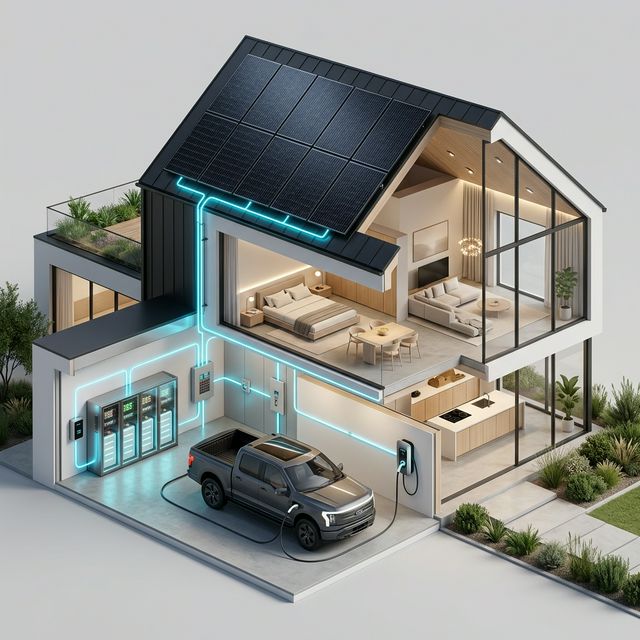
A high-tech isometric 3D cutaway of a modern 2026 home. Rooftop bifacial solar panels capture light, feeding a sleek "Logic Engine" (Smart Panel) in the mechanical room. A glass-fronted battery stack is wall-mounted, while an electric truck is plugged into a bi-directional charger, showing energy flow back into the house's main panel. Glowing blue vectors indicate the sub-perceptual movement of "Sovereign Chi" (Energy).
Energy Analysis by: Marcus V., Lead Grid Strategist, EnergyBS.com. Last Updated: March 25, 2026. Metadata: PowerResilience Schema (Validated).
Related Knowledge
- The VPP Revolution: How to Get Paid by Your Utility
- Smart panels: The Brain of the 2026 Home
- Technical Guide: Mastering Vehicle-to-Home integration
- Next-Gen Tech: The Perovskite Solar Revolution
Keywords: Grid Stress Test 2026, Smart Retrofits Canada, Home Energy ROI, Vehicle-to-Home V2H, Personal Microgrid, EnergyBS audit.
References & Citations
About the Expert
Marcus Vance
Marcus Vance is a leading authority in thermal dynamics and electromechanical system efficiency. With over 15 years in industrial systems design and a specialized focus on residential HVAC optimization, Marcus is dedicated to debunking common energy myths with rigorous, data-driven analysis. His work has been cited in numerous green-tech publications and he frequently consults for municipal energy efficiency programs.
Explore Related Deep Dives
View All ArticlesSolar Sovereignty: Distributed Energy Resilience during the 2026 Oil Shock
As oil prices hit $100, the centralized grid is becoming a liability. We analyze 'Solar Sovereignty'—the shift to localized, distributed energy as the ultimate defense against global energy instability.
The Solar Winter of 2026: Navigating the Renewable Paradox in a $100 Oil World
As Brent crude hits $97, the solar industry faces a 'frozen' supply chain and a structural consolidation phase. We explore the 'Solar Winter' paradox: why renewable growth is stalling exactly when the world needs it most, and how smart capital is preparing for the 2027 thaw.
Solar 2026: Surviving the First Annual Capacity Dip
For the first time in a decade, global solar capacity growth is projected to dip by 5% in 2026 despite record $333.7B investment. We analyze the grid bottlenecks, transformer deficits, and the shift toward 'Grid-Interactive' resilience.