Exterior Continuous Insulation Retrofit 2026 Tool
Plan exterior continuous insulation as a complete siding retrofit with verified sheathing, drainage plane, window flashing, vapor control, cladding attachment, roof edges, utilities, and inspection details.
The Hidden Weakness in Your Walls
Short Answer: Exterior continuous insulation can reduce stud bridging and keep cold-weather sheathing warmer, but it succeeds only as a full water, air, vapor, thermal, and attachment retrofit. Before ordering insulation, locate the drainage plane, choose the window plane, verify flashing and cladding fastening, check roof and utility transitions, and size exterior R-value for the climate and existing cavity—not a universal thickness.
Your home is probably insulated. Fiberglass batts or blown cellulose fill the cavities between your studs. The insulation package on the wall says R-13 (2x4 walls) or R-19 (2x6 walls).
But if you measured the actual thermal performance of your wall assembly, you'd find it dramatically underperforms that rating.
Why? Thermal bridging through the studs.
The R-value and diminishing-returns guide shows how framing-path U-factor changes the whole-wall result and how to price each added insulation increment.
Every 16 or 24 inches, a solid piece of wood runs from the bottom of the wall to the top—the structural stud. This wood has an R-value of approximately R-1 per inch. A 2x4 stud (actually 3.5 inches) provides only R-3.5. A 2x6 provides R-5.5.
In a 2x4 wall with R-13 cavity insulation:
- 75% of the wall area is insulated cavities: R-13
- 25% of the wall area is solid wood studs: R-3.5
The blended average isn't R-13. It's more like R-9 to R-10—a 25% performance penalty from thermal bridging.
And that's assuming perfect installation. Gaps, compression, and voids reduce cavity insulation performance further.
Exterior insulation reduces this bridge when the layer and attachments stay continuous. Fasteners, windows, balconies, decks, foundations, roof edges, and utilities still create transitions that need detailing.
The Concept: Wrapping the House in a Sweater
Think about how clothing works. A sweater keeps you warm because it creates a continuous layer of insulation around your body. The warmth stays inside; the cold stays outside.
Now imagine wearing a mesh jacket with a sweater underneath—where every 16 inches, a metal rod runs from your skin to the outside. Each rod is a thermal bridge, conducting body heat directly to the cold exterior. You'd freeze despite the sweater.
That's your conventionally-insulated wall. The studs are metal rods piercing your "sweater."
Exterior continuous insulation puts the insulating layer on the outside of the studs, covering them completely. No thermal bridging. The entire wall assembly—structure and all—stays on the warm side of the insulation.
Why Exterior Beats Interior
Continuous R-Value
Interior cavity insulation is interrupted every 16 inches by studs. Exterior insulation is genuinely continuous—no thermal bridges, no breaks.
2 inches of polyiso foam installed over the exterior sheathing adds R-12 to the entire wall surface, including directly over ever stud.
Warm Sheathing
In winter, the exterior sheathing (plywood or OSB) of a conventionally-insulated wall can be brutally cold—sometimes approaching outdoor temperature. When warm, humid indoor air contacts this cold surface (through inevitable air leakage), moisture condenses.
This hidden condensation causes:
- Wood rot and structural damage
- Mold growth
- Insulation degradation
With exterior insulation, the sheathing stays on the warm side. It never gets cold enough for condensation to form. The wall assembly is inherently protected from moisture damage.
Air Sealing Integration
Some rigid boards or sheathing systems can form part of a tested air or water-control layer when the product approval, seams, fasteners, edges, and penetrations are detailed for that use. Taping board faces alone doesn't prove continuity.
This is far easier and more reliable than trying to make dozens of cavity-by-cavity air barriers with caulk and foam.
Material Options
Expanded Polystyrene (EPS)
R-value: R-3.8 to R-4.2 per inch Pros: Inexpensive, vapor-permeable (allows drying), stable R-value Cons: Lower R-value per inch than alternatives
Best for: Budget projects, thicker applications where cost matters more than space
Extruded Polystyrene (XPS)
R-value: R-5 per inch Pros: Higher R-value, moisture-resistant, available in convenient sizes Cons: R-value decreases slightly over time as blowing agents dissipate; environmental concerns about blowing agents
Best for: Below-grade and high-moisture applications
Polyisocyanurate (Polyiso)
R-value: R-6.0 to R-6.5 per inch (at moderate temperatures) Pros: Highest R-value per inch, fire-resistant facer, commonly foil-faced Cons: R-value drops in cold temperatures; must be paired with vapor strategy
Best for: Maximum R-value in limited thickness, above-grade applications
Mineral Wool (Rockwool ComfortBoard)
R-value: R-4 per inch Pros: Vapor-permeable, fire-resistant, pest-resistant, excellent for drying potential Cons: Lower R-value, more expensive, requires rain screen gap
Best for: Deep energy retrofits prioritizing moisture safety and fire resistance
The Retrofit Opportunity: Siding Projects
The best time to add exterior insulation is when you're already replacing siding.
Siding replacement creates access, but exterior insulation adds design, flashing, fastening, trim, utility, roof-edge, and inspection work. Ask bidders to separate the common siding scope from the incremental control-layer scope.
Typical Project Flow
- Remove existing siding
- Repair any sheathing damage
- Install WRB (weather-resistive barrier) if not present
- Install rigid insulation boards, staggering seams
- Tape all seams for air sealing
- Install furring strips (1x3 or 1x4) through insulation into studs
- Install new siding over furring strips
The furring strips serve two purposes:
- Create a rain screen gap (allowing water to drain and air to circulate behind siding)
- Provide solid wood for siding attachment
Thickness Considerations
Choose Thickness From the Whole Wall
There is no universal 1.5- or 2-inch answer. The chosen thickness must satisfy the adopted energy and vapor-control rules for the cavity insulation and climate while remaining compatible with the material's tested R-value, fasteners, windows, cladding, fire details, and roof geometry.
Why More Isn't Always Better
Beyond 2 inches, complications multiply:
Window Extensions: Windows are installed flush with the original sheathing. Adding exterior insulation creates a recessed appearance. Window jambs must be extended to reach the new wall plane, and new exterior trim must cover the transition.
At 2 inches, commercial extension jambs work. At 4 inches, custom carpentry is required—often doubling the window-related labor.
Fastening: Siding must be attached through the insulation into the structure. Furring strips are typically attached with screws long enough to penetrate the stud by at least 1.5 inches.
With 2 inches of foam + 3/4-inch furring + sheathing + stud penetration, you need 4-5 inch screws. With 4 inches of foam, you need 6+ inch screws, special fasteners, or structural attachment solutions.
Roof Overhangs: Every inch of wall thickness is an inch less roof overhang. A 12-inch overhang becomes an 8-inch overhang with 4 inches of foam—potentially affecting water management at the wall base.
When to Go Thicker
Some deep energy retrofit projects (targeting Passive House-level performance) use 4-6 inches or more of exterior insulation. These projects accept the added complexity because they're pursuing extreme efficiency targets. They often include:
- Complete window replacement with new frames set at the new wall plane
- Roof extension to maintain overhang
- Specialized fastening systems
For ordinary projects, compare at least two code-compliant thickness options with complete window, fastening, and edge details. A thinner option that misses condensation-control requirements is not a bargain.
Vapor and Moisture Strategy
Adding exterior insulation changes the moisture dynamics of your wall. Getting this right is critical.
The Principle
Water vapor moves from warm/humid to cold/dry. In winter, this means indoor moisture tries to migrate outward through walls. If it hits a cold surface, it condenses.
Goal: Keep condensing surfaces warm enough that condensation doesn't occur.
The Ratio Rule
Building science research (particularly from the Building Science Corporation) established guidelines for safe foam thickness based on climate zone:
Use the table in the adopted residential code or an approved engineered design. Required exterior-to-cavity ratios vary with climate zone, cavity R-value, sheathing, vapor-retarder class, cladding ventilation, and code edition.
In Zone 5, if your total wall R-value is R-20 (R-13 cavity + some exterior), at least 35% of that R-value (R-7) should be on the exterior to keep sheathing warm enough to prevent condensation.
Practical Application
Do not add nominal cavity R and board R, calculate a percentage, and label the wall “safe” without checking the applicable table and material data. Framing fraction, thermal bridges, cold-weather polyiso performance, interior vapor control, indoor humidity, and air leakage affect the assembly.
Window and Door Detailing
Window integration is the most challenging aspect of exterior insulation retrofit.
Option 1: Innie Windows
The existing window stays in place (recessed). The wall builds out around it. Extended jambs and new exterior trim create a "picture frame" appearance.
Pros: No window replacement; simpler installation Cons: Deep sill collects water; can look awkward; shadow reduces solar gain
Option 2: Outie Windows
Windows are moved outward to be flush with the new wall plane. This typically requires complete window replacement or complicated re-installation.
Pros: Clean appearance; optimal solar gain; no water-collecting sills Cons: Expensive; usually requires new windows
Option 3: In-Betweenie
Windows are moved partway—sitting at the middle of the insulation layer rather than at either extreme. This can work with custom installation brackets.
Pros: Compromise between appearance and cost Cons: Every window becomes a custom project
Price each window plane with a sill-pan, jamb, head, WRB, trim, and attachment detail. The best option depends on existing window condition, opening construction, insulation thickness, exposure, and whether windows are being replaced.
Cost and Energy Comparison
Build two written scopes: code-compliant siding replacement without added insulation, and siding replacement with the complete exterior-insulation system. The incremental column should include design, sheathing repair, WRB, boards, tapes, fasteners, furring, window and door work, roof and foundation edges, utility extensions, fire details, permits, testing, and finish work.
Model wall savings from assembly U-factor, treated net wall area, local weather, indoor set point, and heating/cooling equipment. Do not apply the percentage reduction in wall conduction to the whole utility bill. Air leakage savings should be supported by test-in/test-out data rather than assumed from taped seams.
The Bottom Line
Exterior continuous insulation is the most effective way to upgrade existing wall assemblies. It solves thermal bridging, protects structural elements from moisture, and integrates air sealing in a single layer.
Siding replacement is the practical time to study the option because the wall is accessible. Choose thickness and materials only after the water, air, vapor, thermal, and attachment details are coordinated.
If you're planning to replace your siding in the next 5 years, start planning now for exterior insulation. It's a once-in-20-years opportunity to wrap your house in a proper sweater.
Don't waste it painting over a thermal bridge.
Survey the Wall Before Pricing the Retrofit
Remove representative siding or use planned investigation openings to identify what is actually present. Record sheathing type and thickness, framing, cavity insulation, existing WRB or building paper, flashing, interior vapor-control layer, cladding attachment, and signs of water or insect damage.
Map every interruption:
- windows, doors, vents, hose bibs, lights, outlets, meters, service mast, and heat-pump lines;
- decks, balconies, porch roofs, stairs, and ledgers;
- roof-wall intersections, kickout flashing, eaves, rakes, and overhangs;
- foundation ledge, sill, water table, and grade clearance;
- corners, trim bands, masonry transitions, chimneys, and attached garages;
- dryer, bath, kitchen, and combustion exhaust terminals.
The survey decides whether the existing sheathing and WRB can remain, where the new drainage plane sits, and how far the wall moves outward. A square-foot insulation quote without this map is incomplete.
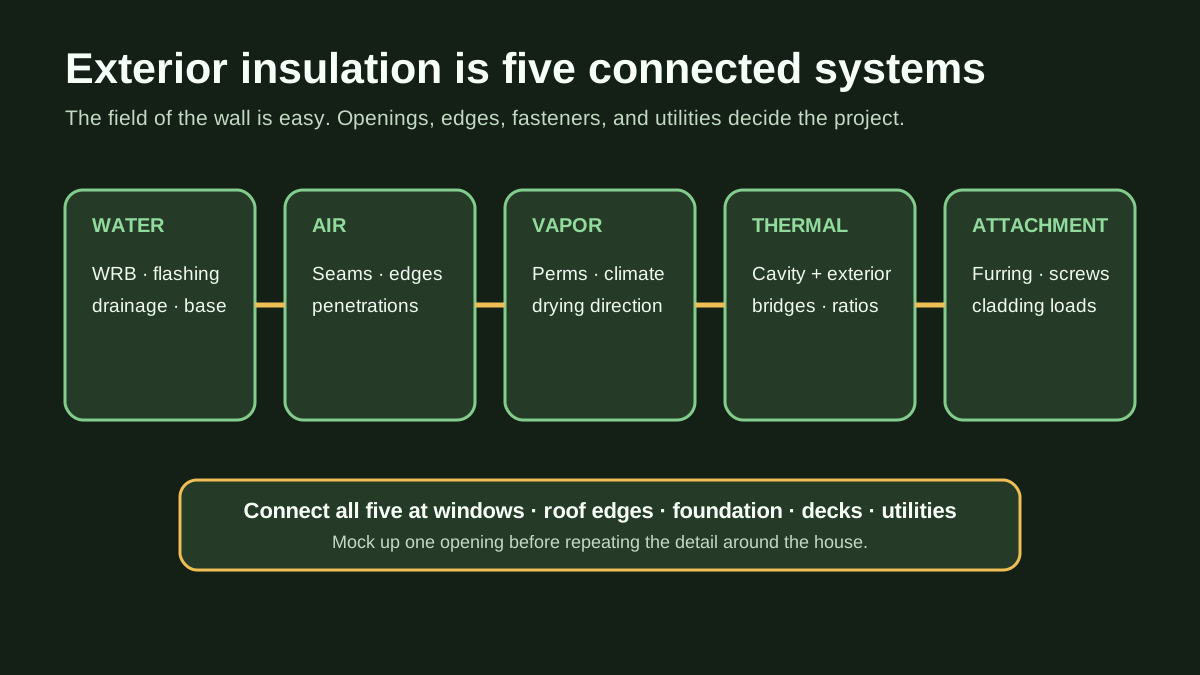
Draw the Five Control Layers
Show each function on one wall section:
- Water control: cladding drainage, flashings, WRB, openings, and base discharge.
- Air control: continuous layer plus sealed transitions and penetrations.
- Vapor control: material permeance and intended drying direction.
- Thermal control: cavity and continuous insulation across edges and openings.
- Structural/attachment: sheathing, framing, furring, cladding loads, and fastener path.
One material can perform more than one function, but the drawing must still trace each path. If taped foam is the WRB and air barrier, confirm the product is approved for both uses and detail fasteners, seams, corners, openings, and transitions. If housewrap sits behind the foam, show how window flashing reaches it.
Read the vapor barrier versus retarder guide before pairing a low-perm exterior board with an existing interior membrane.
Repair the Sheathing Before Covering It
Siding removal is the chance to see old leaks. Photograph staining, rot, delamination, insect damage, corroded fasteners, failed window flashing, and missing kickouts. Find and repair the water source before replacing sheathing.
Set a moisture acceptance method for wood sheathing and framing. The project spec should name the meter type or other method, locations, threshold or professional judgment, and who can approve cover-up. A sunny afternoon is not proof that a previously wet wall has dried.
Preserve concealed-work photos by elevation and opening. They will help with future fastening, repairs, and sales documentation.
Locate the WRB and Drainage Plane
PNNL notes that the WRB may sit behind exterior insulation, on its face, or be formed by an approved taped sheathing system. Each choice changes window, door, penetration, and base details.
The drainage path needs gravity-friendly laps from roof to foundation. Show:
- head flashing integrated behind the drainage plane;
- jamb and sill-pan transitions;
- kickout flashing at roof-wall intersections;
- deck and porch ledger water control;
- penetrations with compatible boots or flashing;
- bottom-edge drainage and insect screen;
- transition to foundation waterproofing or WRB;
- cladding cavity drainage and ventilation where designed.
Do not bury an existing failed WRB beneath new insulation. If it cannot integrate with new flashing, replace or repair enough of it to create continuity.
Choose the Window Plane Before Work Starts
Keeping windows at the original sheathing plane can avoid full replacement but creates deeper exterior returns. Moving them outward can simplify some thermal and visual details but requires a new structural, water, and attachment plan.
For every window type, provide a scaled section at sill, jamb, and head. Include:
- rough-opening preparation;
- sill pan with back dam or equivalent drainage detail;
- flange or bracket attachment to structure;
- WRB tie-in;
- head flashing and end dams where required;
- insulation return and thermal bridge;
- trim, sealant joint, and replacement access;
- drainage path below the opening.
Mock up one representative window before repeating the detail across the house. Water-test or inspect it under the specified protocol before cladding hides the work.
Engineer Furring and Cladding Attachment
Long screws through insulation are structural components, not accessories. The design must consider cladding weight, wind, fastener diameter and spacing, embedment, framing location, insulation thickness and compressive behavior, furring orientation, edge distances, corrosion resistance, and manufacturer requirements.
Ask for:
- stamped or code-supported fastening schedule where required;
- stud or structural-sheathing attachment basis;
- treatment at windows, corners, and heavy fixtures;
- rainscreen gap and drainage continuity;
- fire blocking or cavity barriers;
- cladding-specific nailing base;
- plan for future awnings, railings, lights, and hose reels.
Do not let crews find studs by guesswork after the wall is covered. Mark framing during exposure and preserve the record.
Resolve Roof, Foundation, and Utility Edges
Thicker walls change geometry. At the roof, check overhang, gutter, rake, step flashing, kickout, soffit ventilation, and roof replacement timing. Extending a roof edge after new siding is much harder.
At the base, show insulation termination, flashing, drainage, pest inspection, impact protection, grade clearance, foundation insulation, and the line where above-grade and below-grade systems meet.
Utilities may need licensed relocation or extensions. Coordinate the electric meter and service, gas meter and regulator, refrigerant lines, vents, hose bibs, exterior outlets, cameras, telecom, and exhaust terminals before boards arrive. Maintain required clearances and accessible shutoffs.
Check Fire, Pest, and Material Compatibility
Foam plastics, mineral wool, wood fiber, facers, tapes, sealants, WRBs, furring, and claddings have different fire, moisture, temperature, UV-exposure, and chemical-compatibility limits. Use tested assemblies and approved products.
The project documents should address:
- foam-plastic fire protection and cavity barriers;
- wildfire or high-wind requirements where applicable;
- termite and pest inspection zones;
- insect screens at ventilated cavities;
- compatibility of tapes and sealants with facers and WRB;
- maximum exposure time before covering;
- cold-weather installation limits;
- cladding warranty over furring or insulation.
Worked Scope: Siding Replacement With Existing Windows
Suppose a cold-climate 2x4 wall has fiberglass batts, OSB, housewrap of uncertain condition, vinyl siding, and ten serviceable flanged windows that will remain.
The project team should first open representative walls and windows. If the WRB and flashing cannot be integrated, the scope may include a new drainage plane. The designer then selects exterior R-value from the adopted condensation-control table and exact board data.
One window mockup resolves the sill pan, jamb return, head flashing, insulation, trim, and drainage. A fastening schedule connects furring to structure. Roof kickouts, meter stand-off, hose bibs, vents, and foundation termination are detailed before production work.
The energy model compares the existing and proposed assembly U-factors over net wall area. A blower-door test-in/test-out can measure air-leakage change if air control is part of the scope. Costs are split between siding-only work and the added insulation/control-layer work.
This is slower than ordering “two inches of foam.” It is also a buildable, inspectable project.
Quote Normalization Worksheet
| Scope item | Bid A | Bid B | Bid C |
|---|---|---|---|
| Investigation openings and design | |||
| Sheathing repair allowance/unit price | |||
| WRB and air-control layer | |||
| Insulation product, thickness, and R basis | |||
| Furring and fastening schedule | |||
| Window/door details and mockup | |||
| Roof, deck, and foundation transitions | |||
| Utilities and penetrations | |||
| Fire, pest, and cavity details | |||
| Cladding and trim | |||
| Testing, inspections, and photos | |||
| Gross price and exclusions |
Compare the insulation payback by climate guide using the incremental insulation scope, not the entire siding project or a generic house value.
Installation Hold Points
- after siding removal and sheathing investigation;
- after water-source repairs;
- after WRB and window flashing mockup;
- after air-barrier transitions;
- after insulation and seam treatment;
- after furring/fastener inspection;
- before cladding covers openings and base details;
- after final sealants, drainage paths, and penetrations;
- at blower-door test-out when specified.
Each hold point needs photos and an assigned reviewer. The final package should include product data, permits, approved details, change orders, inspection records, test results, warranties, and elevations showing concealed framing and utilities.
Frequently Asked Questions
Is exterior insulation worth adding during siding replacement?
It is the best time to price it because the wall is exposed. Value depends on climate, existing wall, incremental scope, energy model, comfort, moisture risk, and how much flashing and geometry work is needed.
How thick should exterior insulation be?
Use the adopted code or approved design for the climate and cavity R-value, then check material performance, fasteners, windows, fire, roof edges, and cladding. There is no universal thickness.
Can rigid foam be the WRB?
Only when the exact product and taped/sealed installation are approved for that use and every seam, fastener, edge, opening, and transition is detailed.
Do windows need to be replaced?
Not always. Existing windows can remain if condition, attachment, flashing integration, sill drainage, trim, and deeper returns are resolved.
Is a rainscreen required?
Requirements depend on climate, code, cladding, wall layers, and manufacturer. A drained and sometimes ventilated cavity often improves water management, but its dimensions and fire details are assembly-specific.
Will exterior insulation eliminate condensation?
It can keep sheathing warmer, but rain, air leakage, indoor humidity, thermal bridges, construction moisture, and insufficient exterior R-value can still cause wetting.
Can siding attach through foam?
Use an approved fastening design. Cladding and furring loads must transfer through insulation to suitable structure without excessive movement or compression.
What to Read Next
Read the vapor-retarder assembly audit before finalizing material permeance, then use the thermal-bridging guide to find transitions the field of insulation does not cover.
Sources and Method
This refresh uses PNNL Building America guidance for existing-wall code compliance, condensation control, WRB/window integration, and insulated siding, plus DOE high-R wall moisture research. Final details must follow the adopted code, listed products, cladding requirements, structural fastening design, and site-specific water exposure.
About the Editorial Team EnergyBS reviews public program rules, product specifications, utility rates, and reader-facing cost assumptions. Treat savings figures as estimates until you verify local prices, permits, rebates, and contractor quotes.
Sources and Verification
Editorial Review
EnergyBS Editorial Team
EnergyBS publishes practical homeowner guides. Important program, product, and cost claims should be checked against the linked source and local project documents before you commit to work.
Related Guides
View All ArticlesInsulation Payback by Climate: A Homeowner's Savings and Quote Worksheet
A climateaware method for estimating attic and envelope insulation payback without applying a generic savings percentage to the entire utility bill.
Ice Dam Prevention
Find the heat and moisture paths behind recurring ice dams, choose a durable attic or compactroof repair, and verify the work instead of treating icicles alone.
Attic Frost and Condensation 2026 Tool (Guide & Data)
Separate roof leaks from winter condensation, trace indoorair and exhaust paths, assess wet sheathing and insulation, and commission a safe attic repair.