Hempcrete & Straw Bale: Building Carbon Negative Homes
Building with plants. How hemp and straw can create fireresistant, superinsulated, carbonnegative walls.
The overlooked cost of Modern Insulation: Why Your Walls Have a "Carbon Debt"
Short Answer: Building with plants. How hemp and straw can create fire-resistant, super-insulated, carbon-negative walls.
We often obsess over "Operational Carbon"—the energy used to heat and cool our homes. But we frequently ignore "Embodied Carbon"—the energy used to manufacture the building materials themselves.
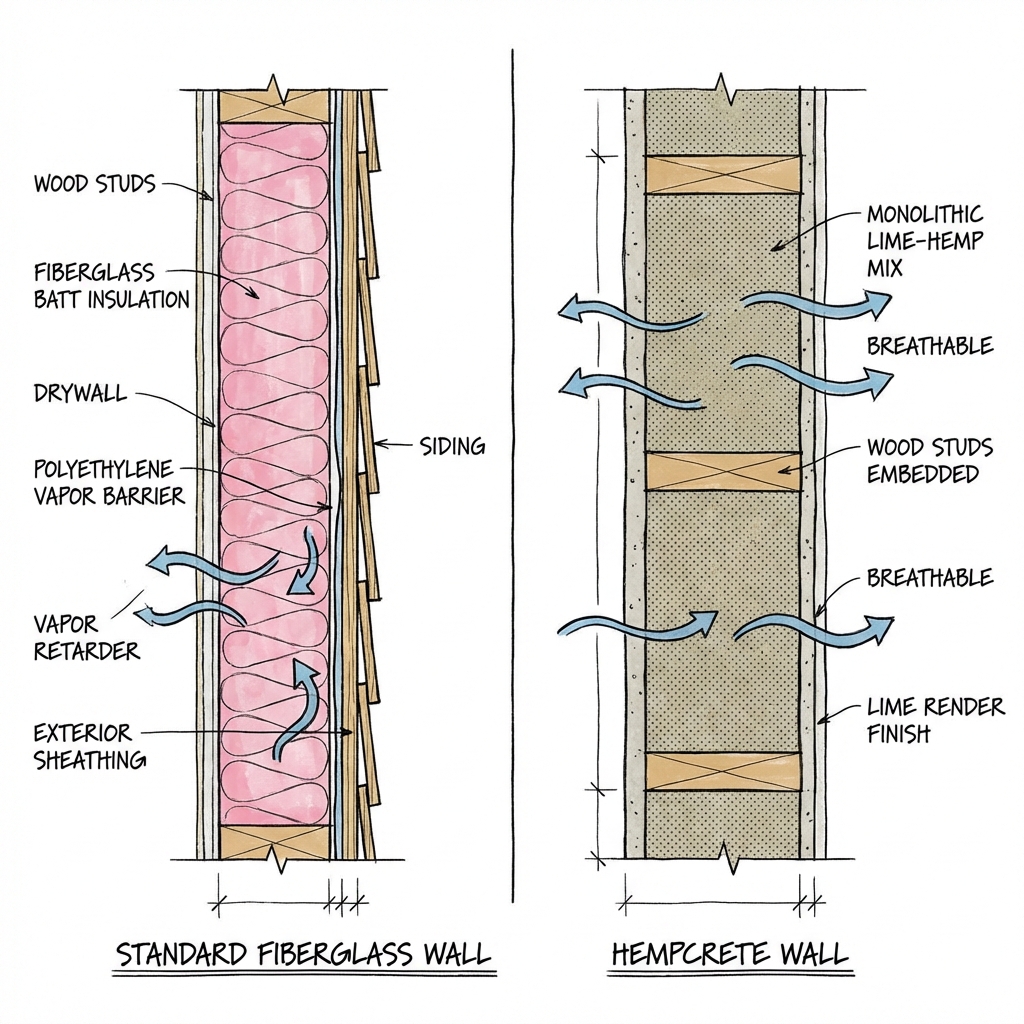
Spray foam, XPS rigid board, and fiberglass are miracles of insulation performance, but they come with a heavy ecological price tag.
- Spray Foam: Often uses HFC blowing agents (Super-Greenhouse Gases) and petroleum feedstock.
- XPS Foam: Requires massive energy to extrude.
The Irony: You can build a "Passive House" that saves tons of heating oil over its life, but if you wrapped it in high-carbon petroleum foam, you started with a "carbon debt" that accounts for 20-30 years of operations.
The solution? Biogenic Materials. Materials that grew from the earth, absorbed CO2 while growing, and lock that carbon into your walls forever. The two champions of this movement are Hempcrete and Straw Bale.
Part 1: Hempcrete (Hemp-Lime Masonry)
It sounds like a hippie experiment from the 1970s. In reality, it is one of the most sophisticated, high-performance building materials in existence, used extensively in France and the UK for decades.
What is It?
Hempcrete is a bio-composite material made of three simple ingredients:
- Hemp Shiv (Hurd): The woody inner core of the hemp stalk. It is highly silica-rich (it doesn't rot) and extremely absorptive.
- Lime Binder: Hydrated lime (and sometimes hydraulic lime or pozzolans).
- Water: The catalyst.
When mixed, a chemical reaction occurs. The lime mineralizes the hemp stalk, turning it from a plant into a stone-like fossil (Petrification).
The "Magic" Properties
1. The Hygric Buffer (Breathability) Modern code-built homes are wrapped in plastic (vapor barriers) to keep moisture out. If moisture gets in, it gets trapped, leading to "sick building syndrome" and mold. Hempcrete is "Vapor Open." It acts like a massive humidity sponge.
- It absorbs excess humidity from the room (up to decent percentages of its weight).
- It releases it when the air is dry.
- Result: A home that stabilizes its own humidity between 40-60% naturally, requiring no mechanical humidifiers or dehumidifiers, and creating a mold-proof environment.
2. Thermal Mass + Insulation Hempcrete has a modest R-value (about R-2.4 per inch). A 12-inch wall is ~R-29. This looks lower than spray foam (R-7/inch) on paper. However, Hempcrete has high Thermal Mass. It stores heat. A dynamic simulation shows that an R-20 Hempcrete wall often outperforms an R-40 foam wall because the Hempcrete creates a "thermal flywheel," smoothing out temperature spikes.
3. Fire & Pest Proof Because the hemp is coated in lime (stone), it cannot burn. You can take a blowtorch to a hempcrete block; it will just glow red but not support a flame. Termites and mice hate lime. It is caustic to them. They won't eat it.
4. Carbon Negative Hemp grows 12-15 feet high in 4 months, absorbing massive amounts of CO2 (more than a forest of trees per acre). When mixed with lime, the lime also absorbs CO2 as it "cures" (carbonation) over decades.
- The Math: A typical 2,000 sq ft hempcrete home can sequester 10-15 tons of CO2 within its walls.
Part 2: The Acoustic Sanctuary (Silence)
One of the most immediate things people notice when walking into a Hempcrete home is the Silence. Standard drywall homes are hollow drums. They vibrate. You hear the TV from the next room. You hear the traffic outside. Hempcrete is a dense, fibrous matrix. It absorbs sound waves rather than reflecting them.
- Noise Reduction Coefficient (NRC): Highly effective at dampening mid-to-high frequencies (speech, wind, traffic).
- The "Library Effect": It creates a calm, muted interior environment that many owners describe as "spiritual" or "grounding." For home offices or bedrooms, this acoustic isolation is a premium feature that standard insulation cannot match without expensive acoustic paneling.
Part 3: Installation Methods
Method A: Cast-in-Place (The Purist Approach)
- Build a standard timber frame skeleton (structural).
- Set up temporary plywood forms around the frame.
- Mix hemp, lime, and water in a mortar mixer.
- Hand-pack the mixture into the forms (tamping it lightly).
- Remove the forms the next day.
- Pros: Beautiful, monolithic, organic, no gaps.
- Cons: Extremely labor-intensive. Takes weeks to dry before you can plaster.
Method B: Hemp Blocks (The Modern Approach)
- Buy pre-cured blocks (like giant Lego bricks) from a factory (e.g., HempBlock USA, IsoHemp).
- Stack them with thin-set mortar.
- Pros: Fast installation (like CMU blocks). No drying time. Standard dimensions.
- Cons: Shipping blocks is expensive. You lose the "monolithic" aspect.
Method C: Spray Application (The Commercial Approach)
- Use a specialized "Spray Cannon" (like shotcrete) to blast the mix onto a permanent backer board.
- Pros: Very fast for large commercial walls.
- Cons: High equipment rental cost.
Part 4: Straw Bale Construction
If Hempcrete is "Biocomposite Science," Straw Bale is "Brute Force Physics."
The Logic
Agricultural straw (wheat, rice, oat, rye) is a massive waste product. Millions of tons are burned in fields every year. Straw is essentially a cellulose tube full of air. Air is the insulator.
- The Method: You take standard 50lb rectangular bales. You stack them in a "Running Bond" pattern (like big bricks). You compress them with straps. You plaster both sides with 1-2 inches of lime or clay.
Performance Stats
- Insulation: Incredible. A typical bale wall is 18-24 inches thick. It yields R-30 to R-50. (Code minimum is R-20).
- Fire Rating: Counter-intuitive. A loose pile of straw burns fast. A compressed, plastered bale has no oxygen inside. It has a 2-hour Fire Rating (better than wood framing). It smolders; it doesn't flame.
- Aesthetics: Deep window sills (perfect for reading nooks), rounded bullnose corners, and thick, quiet walls. It feels like a Hobbit hole or a Tuscan villa.
The "Truth Window"
Tradition dictates that every straw bale house must have a "Truth Window"—a small, unplastered, glass-covered viewing port on an interior wall that reveals the straw inside, proving to visitors that the house is indeed made of grass.
Part 5: The Cost Reality Check (2026)
Building naturally is not necessarily cheaper. It replaces Material Cost with Labor Cost.
Comparative Costs (Finished Wall Assembly):
- Standard 2x6 Wood Frame + Fiberglass: ~$15/sq ft (wall surface area).
- Double Stud Wall + Cellulose: ~$22/sq ft.
- Straw Bale (DIY Labor): ~$12/sq ft. (Cheapest material, high sweat equity).
- Straw Bale (Contractor): ~$35/sq ft.
- Hempcrete (Cast-in-Place): ~$45 - $60/sq ft. (Premium product).
The ROI Argument: You don't build with Hempcrete to save money on Day 1. You build with it to:
- Eliminate HVAC bills: The R-50 walls mean you can heat the house with a candle.
- Eliminate Health Risks: Zero VOCs, zero formaldehyde, natural air purification.
- Create Legacy: These walls petrify into stone. They will last 300 years. A fiberglass-filled stick house lasts 50 years before the insulation sags and the studs rot.
Part 6: Building Codes & Permits
"Will the inspector let me do this?" In 2026? Yes.
- Straw Bale: It is now part of the International Residential Code (IRC) as Appendix S. It is fully prescriptive code law. You don't need an engineer if you follow the appendix.
- Hempcrete: Included in the IRC as Appendix BA.
- The Barrier: Most local inspectors have never read these appendices. You will need to print them out, bring them to the permit office, and act as an educator. Patience is required.
Summary Verdict
Choose Hempcrete If:
- You want precise, sharp corners.
- You have humidity issues.
- You value the "Stone" aesthetic.
- You have a higher budget.
Choose Straw Bale If:
- You want maximum R-value (R-50).
- You want the cozy, rounded "Adobe" look.
- You are willing to do DIY labor (stacking bales is fun and unskilled).
- You are on a budget.
Both materials represent a shift from "building to isolate nature" (Plastic Box) to "building with nature." If you walk into a Hempcrete room, the acoustics are dead silent. The air smells clean. It feels different. It feels permanent.
About the Editorial Team EnergyBS reviews public program rules, product specifications, utility rates, and reader-facing cost assumptions. Treat savings figures as estimates until you verify local prices, permits, rebates, and contractor quotes.
Common Questions
What should I check first before using this insulation advice?
Start with the numbers that apply to your home: climate, utility rate, equipment age, contractor quote, and local program rules. Building with plants. How hemp and straw can create fireresistant, superinsulated, carbonnegative walls.
How should I verify rebates, tax credits, rates, or savings before spending money?
Treat program amounts, utility rates, and tax rules as date-sensitive. Check the named government, utility, or manufacturer source before you sign a contract, and keep screenshots or PDFs of eligibility rules for your records.
What is the next useful step after reading this?
Compare this with Insulation Payback by Climate: A Homeowner's Savings and Quote Worksheet so you can check the cost, rebate, installation, or operating-risk angle before making a decision.
What to Read Next
Insulation Payback by Climate: A Homeowner's Savings and Quote WorksheetUse this next to compare the cost, incentive, installation, or operating-risk angle before you make a home energy decision.Sources and Verification
Editorial Review
EnergyBS Editorial Team
EnergyBS publishes practical homeowner guides. Important program, product, and cost claims should be checked against the linked source and local project documents before you commit to work.
Related Guides
View All ArticlesInsulation Payback by Climate: A Homeowner's Savings and Quote Worksheet
A climateaware method for estimating attic and envelope insulation payback without applying a generic savings percentage to the entire utility bill.
Ice Dam Prevention
Find the heat and moisture paths behind recurring ice dams, choose a durable attic or compactroof repair, and verify the work instead of treating icicles alone.
Attic Frost and Condensation 2026 Tool (Guide & Data)
Separate roof leaks from winter condensation, trace indoorair and exhaust paths, assess wet sheathing and insulation, and commission a safe attic repair.