Electricity Rate Plans Explained 2026 Tool (Guide & Data)
A billfirst framework for comparing flat, tiered, timeofuse, criticalpeak, realtime, demand, EV, and retailsupplier plans without relying on headline cents per kWh.
The Short Answer
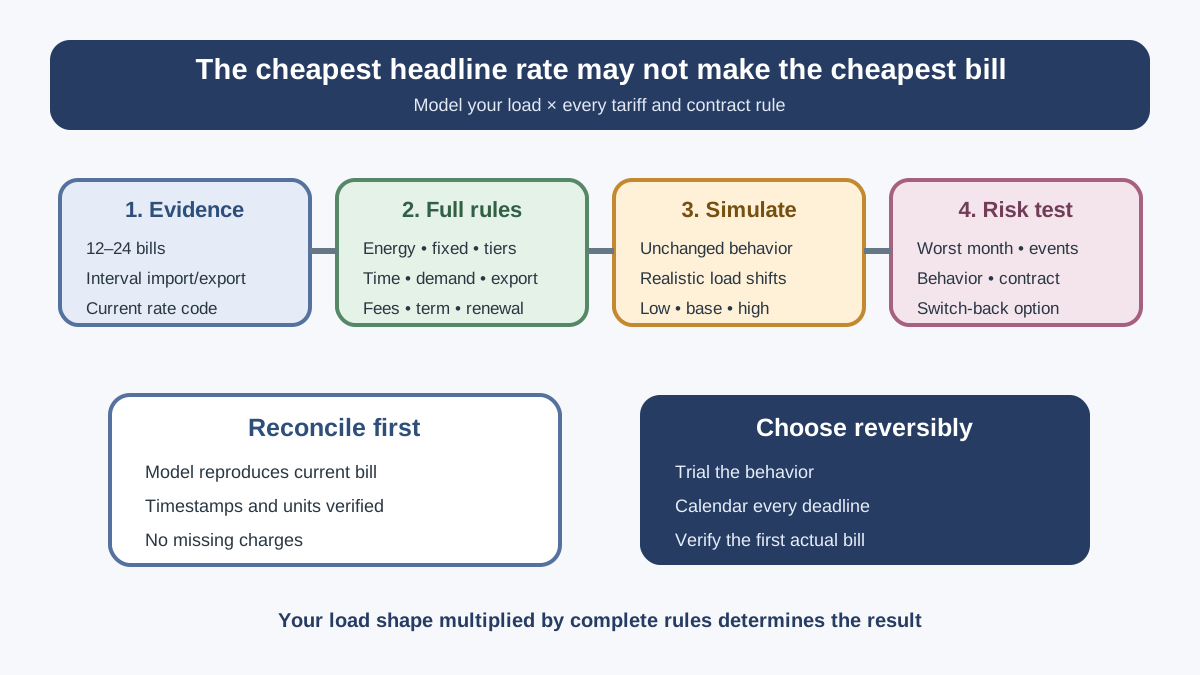
Short Answer: Do not choose an electricity plan from its lowest advertised cents per kilowatt-hour. Download the official tariff or contract, collect at least 12 months of bills and interval data, and price your actual load under every eligible option. Include fixed charges, delivery, supply, tiers, seasons, time blocks, demand charges, minimum bills, credits, taxes, export compensation, contract renewal, and cancellation terms. Then test only the behavior changes your household can sustain.
A flat plan can beat a low overnight rate when evening HVAC and cooking dominate. A time-of-use plan can beat flat pricing when EV charging, water heating, laundry, or cooling can shift reliably. A retail supplier's low introductory rate can lose after fees or renewal. The answer is your load shape multiplied by the complete rules.
The Rate-Plan Decision Ledger
Create one column per plan:
| Input | Current | Option A | Option B |
|---|---|---|---|
| Official plan/rate code | |||
| Effective date | |||
| Fixed monthly charges | |||
| Energy prices and tiers | |||
| Time periods/seasons | |||
| Demand charge | |||
| Minimum bill | |||
| Riders/adjustments/taxes | |||
| Export credits | |||
| Equipment/enrollment conditions | |||
| Contract, renewal, cancellation | |||
| Modeled annual cost: unchanged load | |||
| Modeled annual cost: realistic shift | |||
| High-weather/high-use stress case | |||
| Switch-back or trial protection |
Do not leave a blank charge out because it looks similar. A small monthly fee can outweigh months of modest shifting savings.
Separate Utility, Delivery, and Supplier Roles
The company that owns the meter and wires may be different from the company selling energy. Depending on location, a bill can include:
- utility delivery or distribution;
- electricity supply or generation;
- transmission;
- regulated riders and adjustments;
- public-purpose or program charges;
- taxes and fees;
- credits, export compensation, or demand-response payments;
- a third-party supplier contract.
Some charges vary with kWh, some with time, some with peak kW, and some are fixed. A supplier may change only the supply line while utility delivery remains. When comparing an offer, mark each bill component as changes, does not change, or uncertain.
DOE's rate-evaluation guidance distinguishes energy charges based on kWh, demand charges based on a peak kW interval, and fixed charges that usually cannot be reduced through consumption. That separation should anchor the model.
Rate Types You May Encounter
Flat energy rate
One energy price applies across hours, sometimes with seasonal differences or tiers. Flat pricing reduces scheduling complexity but does not mean the total bill is simply kWh × one number. Fixed charges, riders, demand features, and taxes can remain.
Tiered or block rate
The price changes after monthly consumption crosses one or more thresholds. Confirm whether blocks reset by calendar month or billing cycle, vary by season, depend on household baseline, or use declining rather than increasing prices.
An efficiency project near a threshold can save at the highest marginal tier, not the bill's average rate. Conversely, a modeled EV load can push some use into a higher tier.
Time-of-use rate
TOU uses predetermined price blocks by hour, season, weekday, weekend, or holiday. DOE describes it as a common form of time-variable pricing. Peak and off-peak hours are not universal; copy them only from the current official rate.
Critical-peak pricing
The plan applies a very high price during a limited number of called events, often paired with lower normal prices. Model event notification, maximum event count/duration, override, weather exposure, and what happens if the household cannot respond.
Peak-time rebate
Instead of charging a critical-peak price, a program may pay for reducing use against a calculated baseline. Understand how the baseline is set, whether participation is voluntary, and whether a payment is guaranteed.
Real-time or hourly pricing
Prices follow hourly or shorter market-linked schedules. Historical savings do not guarantee future results. Model price volatility, notification, automation failure, extreme events, and the household's ability to curtail safely.
Demand charge
A fee is based on the highest average kW over a defined interval, sometimes only within peak hours. One simultaneous EV, dryer, range, water heater, and HVAC interval can set a monthly charge. Model kW, not just total kWh.
EV, heat-pump, or equipment-specific rate
These may require qualifying equipment, a dedicated meter, connected control, enrolment, or different whole-home peak prices. Include meter/electrical cost and whether the tariff changes other household energy.
Retail supplier offer
In competitive markets, third-party suppliers may offer fixed, variable, indexed, renewable-content, free-period, or bundled plans. Read the contract and regulator's disclosures. The utility may still deliver electricity and handle outages.
Collect the Official Documents
For a utility tariff, save:
- plan/rate schedule and revision number;
- effective date and regulator approval if relevant;
- all price tables and definitions;
- seasonal and holiday calendar;
- eligibility and meter requirements;
- riders, fuel/power adjustments, and taxes;
- enrollment, minimum term, and switch-back rules;
- export tariff for solar/storage;
- demand-response or load-control terms.
For a supplier contract, add:
- initial and renewal price;
- fixed versus variable/index formula;
- contract length and start date;
- enrollment, monthly, minimum-use, and termination fees;
- automatic renewal and notice process;
- deposit or credit terms;
- green-energy/REC claim and what it means;
- dispute and cancellation process;
- who bills and who handles outages.
Save the exact document used in the decision. Web summaries can change while your enrollment remains governed by an older version.
Build a 12-Month Baseline
Collect at least 12 bills to capture heating, cooling, occupancy, and season changes. Twenty-four months is helpful when weather or household use changed.
From each bill, record:
| Field | Why it matters |
|---|---|
| Service dates | Aligns with intervals and seasons |
| Billed kWh import/export | Reconciliation target |
| Peak demand kW, if any | Demand-charge model |
| Rate code | Confirms current plan |
| Supply/delivery/fixed charges | Separates changing components |
| Adjustments and taxes | Completes bill reproduction |
| Estimated/actual read status | Flags weak baseline data |
| Weather and major changes | Explains non-rate variance |
Do not compare two monthly bills without adjusting for days, weather, occupants, EV miles, equipment changes, solar production, or estimated reads.
Download Interval Data
Hourly or 15-minute data reveals load shape. Green Button Download My Data is an industry standard for utility customers to download energy or water usage data, commonly in structured XML. Utilities may also provide CSV or another portal export.
Download:
- import energy by interval;
- export separately where applicable;
- timestamp, time zone, and interval duration;
- quality/estimated-reading flags;
- demand channels if present;
- matching bills.
Treat the file as sensitive. Energy timing can reveal occupancy routines. Remove account identifiers before sharing and prefer a local spreadsheet for basic arithmetic.
Reconcile before comparing plans
Sum intervals inside each billing period and compare with billed kWh. Investigate:
- missing or duplicated intervals;
- daylight-saving transitions;
- UTC versus local time;
- estimated/corrected readings;
- meter multiplier;
- net versus separate import/export;
- billing-period boundary times;
- interval reported as kWh versus average kW.
If the model cannot reproduce the current bill's energy components within a documented tolerance, do not trust its alternative-plan result.
Reproduce the Current Bill First
Build the model in layers:
- fixed charges;
- interval or monthly energy charges;
- tiers/baseline allowance;
- demand charges;
- riders and adjustments;
- export credits;
- taxes/fees;
- minimum-bill logic;
- supplier charges.
For an interval plan:
Interval energy cost = interval kWh × applicable price for that timestamp
Then sum intervals and add other components.
Do not apply a price in dollars per kWh to a kW demand value. A 15-minute interval averaging 4 kW contains 1 kWh. The demand charge may use that 4 kW peak while the energy charge uses 1 kWh.
Model Every Eligible Plan With Unchanged Behavior
First compare plans using the exact historic load. This answers: “What would each tariff have charged if nothing changed?” It avoids assuming perfect behavioral response.
Report by month:
- current-plan modeled bill;
- alternative-plan modeled bill;
- difference;
- peak-period kWh share;
- highest demand interval, if relevant;
- event exposure;
- fixed-charge difference.
A plan that wins annually but loses heavily in the hottest or coldest month deserves a cash-flow and risk discussion.
Then Model Realistic Load Shifts
Inventory flexible loads with constraints:
| Load | Energy per event | Earliest start | Latest finish | Safety/service constraint |
|---|---|---|---|---|
| EV charging | departure reserve, circuit/load management | |||
| Dishwasher | noise, leak supervision, manufacturer guidance | |||
| Clothes washer/dryer | wet clothes, noise, dryer safety | |||
| Water heating | hot-water service, controls, hygiene/safety | |||
| Pool/spa pump | water quality, freeze protection, local rules | |||
| Cooling/heating | comfort, health, humidity, equipment limits | |||
| Battery | reserve, warranty, efficiency, export rules |
Model sustainable operation. If the household will not routinely move laundry after 10 p.m., do not count it. If pre-cooling raises humidity, noise, or discomfort, reduce or remove the strategy.
Pre-cooling and pre-heating
A building can shift some HVAC work by adjusting temperature before a high-price period, but savings are not guaranteed. The enclosure, thermal mass, solar gain, humidity, equipment capacity, weather, and rebound determine the result.
Use a cautious trial:
- protect health and equipment;
- change the setpoint modestly;
- log temperature and humidity in occupied rooms;
- compare interval kWh and peak cost under similar weather;
- watch for rebound after the event;
- stop if comfort or moisture deteriorates.
Do not prescribe a universal 70°F pre-cool or promise the AC will remain off for five hours.
Model a Demand Charge Correctly
Demand is typically the maximum average power in a stated measurement interval. Read whether the tariff uses:
- non-coincident monthly maximum;
- maximum only during peak periods;
- several seasonal windows;
- a ratchet based on prior peaks;
- coincident system peaks;
- minimum billed demand.
If a 7.2 kW EV begins while a 4.5 kW dryer, 3 kW water heater, and cooling equipment operate, the coincident peak may be far more important than monthly kWh. A lower-rate EVSE schedule or listed load management can reduce coincidence.
Do not infer demand from monthly kWh. Use interval data at the tariff's measurement length.
Evaluate Retail Supplier Contract Risk
A fixed rate can reduce price uncertainty but may carry a term or exit fee. A variable or indexed price can fall or rise. “Free nights” or “free weekends” can be paired with a high paid-period price or usage condition.
Model:
- your actual kWh in free and paid periods;
- fixed and minimum-use fees;
- renewal price after the offer;
- early termination under a move or sale;
- what happens when the contract expires;
- whether utility delivery charges differ;
- billing disputes and payment method;
- renewable claim documentation.
Never give a door-to-door representative account information or authorization merely to receive a quote. Verify supplier licensing and comparison resources through the official state/provincial regulator or consumer office.
Solar and Battery Customers Need a Two-Way Model
Separate:
- grid imports;
- on-site solar serving load;
- battery charge source;
- grid exports;
- export credit by time;
- non-bypassable charges;
- minimum bills;
- demand charges;
- battery round-trip losses and reserve.
A TOU plan with a high evening price can increase battery value, but only after accounting for energy lost in charging/discharging, foregone export credit, warranty throughput, control, reserve, and capital. Do not multiply battery capacity by the peak/off-peak spread and call it savings.
Build Low, Base, and High Cases
Vary the assumptions that matter:
| Input | Low | Base | High |
|---|---|---|---|
| Annual kWh | mild/low use | historical normal | severe weather/high use |
| Peak-period share | best sustainable shift | measured realistic | no shift / disruption |
| EV miles | low | normal | high |
| Rate changes | current | published scheduled | stress case, if defensible |
| Critical events | few | expected rule | maximum allowed |
| Demand peak | managed | observed | coincident stress |
| Contract renewal | favorable | disclosed | adverse permitted case |
Do not invent rate escalation to make a technology pay. If future rates are unknown, show a break-even spread or range.
Run a Reversible Trial
When the utility offers a trial or switch-back protection, record exact terms. Before changing plans, simulate one month of the proposed behavior on the current plan:
- schedule EV and appliances as intended;
- log overrides;
- test HVAC shifts during representative weather;
- verify all household members can sustain the routine;
- protect safety, sleep, food, health, and accessibility.
After enrollment, compare actual bill and interval results with the model. Separate tariff savings from weather or consumption changes. Set a review date before any trial, contract, or renewal deadline.
Common Rate-Plan Errors
Using average bill price as marginal price
Total bill ÷ kWh includes fixed charges and blended tiers. Use the charge that changes for the next shifted or saved kWh.
Copying peak hours from another utility
TOU periods vary by rate, season, day, and location. Use the current official schedule.
Counting every flexible load twice
If an EV is already modeled overnight, do not also count its kWh as a general household shift.
Ignoring rebound
Pre-cooling, water heating, or battery control may create later demand. Simulate the complete day.
Treating an incentive as permanent
Demand-response credits, EV discounts, and introductory supplier prices can change or expire. Model the full term and renewal.
Ignoring behavior failure
A plan that saves only under perfect daily compliance is fragile. Include an unchanged-behavior case.
A Plan-Selection Scorecard
| Criterion | Weight | Current | Option A | Option B |
|---|---|---|---|---|
| Annual modeled cost, unchanged load | ||||
| Annual modeled cost, realistic shift | ||||
| Worst-month bill | ||||
| Price/event volatility | ||||
| Behavior burden | ||||
| Health/comfort resilience | ||||
| Contract and renewal risk | ||||
| Data/privacy/control burden | ||||
| Switch-back flexibility |
Choose weights before scoring. A household with medical equipment or heat-sensitive residents may weight resilience higher than a small modeled saving.
Work Through a Three-Plan Example
Consider a household with 9,600 annual kWh, 38% of use in the proposed TOU peak period, and no demand charge today. Its official options are:
- Plan F: flat energy price plus $14 monthly fixed charge;
- Plan T: off-peak, shoulder, and peak energy prices plus $18 fixed charge;
- Plan D: TOU energy plus a monthly maximum-demand charge and $11 fixed charge.
Do not average the three prices. The spreadsheet should assign every interval to a plan-specific rule. First run historic load unchanged. Suppose the modeled annual totals are $2,210, $2,295, and $2,470. Plan F wins without behavior change.
Next model only documented shifts: 2,000 kWh of annual EV charging moves from mixed hours to off-peak, 220 dishwasher cycles move from peak to off-peak, and HVAC does not shift because the trial caused uncomfortable rooms. Suppose the revised totals are $2,210, $2,065, and $2,240. Plan T now wins. Plan D remains vulnerable because several EV-plus-cooking intervals set demand.
Finally stress test a schedule failure that leaves half the EV energy in peak hours. If Plan T rises to $2,225, the apparent $145 saving becomes a $15 cost. This example is intentionally illustrative; the method matters:
- reproduce current billing;
- compare unchanged load;
- model each flexible load once;
- stress realistic noncompliance;
- examine worst months and peak intervals;
- choose only if the result survives.
Do not copy the example's prices or load. Replace them with official rules and reconciled household intervals.
When the Household Is Changing
Historical data needs adjustment when a major load is added or removed. Build the future load explicitly for:
- an EV and expected miles;
- heat-pump space heating and backup operation;
- heat-pump or electric-resistance water heating;
- induction/electric cooking;
- solar generation and exports;
- battery charging and discharge;
- a pool, hot tub, workshop, accessory dwelling unit, or home business;
- changed occupancy or work-from-home schedule.
Add each new load as a separate interval series or documented profile. Do not multiply annual kWh by an average price when the load has a strong schedule. EV charging may be flexible; winter heat-pump load may coincide with a high-priced morning period; solar may reduce midday imports but not evening peaks.
Run a before, after, and after with controls model. This shows whether a rate switch is valuable only because of the new equipment and whether load management is required to preserve it.
Moving, Renting, and Multiunit Buildings
A renter or condominium resident may not control the meter, tariff, parking circuit, thermostat, central water heating, or building load. Confirm who is the utility customer and whether electricity is individually metered, submetered, allocated, or included in rent/fees.
Before enrolling or installing equipment, document:
- authority to change the rate or supplier;
- lease/condo rules and approval;
- ownership of meter and electrical infrastructure;
- shared-load billing method;
- EV charging price and idle/network fees;
- move-out, contract transfer, and early termination;
- responsibility for demand-response overrides;
- accessibility for residents who cannot shift essential use.
When moving, do not assume a supplier contract or tariff follows automatically. Close or transfer service through verified contact channels, save the final meter reading/bill, revoke third-party data access, and cancel automations tied to the old address.
Audit the Result Every Quarter
Rate selection is not permanent optimization. Set a quarterly review and an immediate review trigger for:
- published tariff or rider changes;
- contract renewal notice;
- new EV/HVAC/water-heating equipment;
- solar or battery commissioning;
- occupancy or schedule change;
- repeated critical events or demand peaks;
- unexplained bill-model variance;
- failure of a connected scheduler or utility program.
Reconcile one actual bill each quarter and compare peak-period share, demand, and shifted-load completion with the decision case. If the plan stops winning, check switching rules early rather than waiting for an annual surprise.
Frequently Asked Questions
Is time-of-use always cheaper if I charge an EV at night?
No. Overnight EV charging helps, but higher peak prices, fixed charges, cooling, cooking, and other loads can offset it. Price the whole household under the complete tariff.
How much data do I need?
At least 12 months of bills and interval data is a strong baseline. More history helps when weather, occupancy, equipment, solar, or EV use changed.
Are weekends always off-peak?
No. Day definitions vary by tariff and season. Use the official calendar, including holidays.
Is a fixed supplier price safer than a variable price?
It reduces some price volatility but can include contract, fee, or renewal risk. Read the complete disclosure and compare the total bill.
Does shifting load reduce energy?
Not necessarily. It can reduce cost while kWh stays equal; pre-conditioning or storage losses can increase kWh. Track both energy and dollars.
What is Green Button?
Green Button Download My Data is an industry standard for customers to obtain usage data from participating utilities. Availability and file details vary.
Should I buy a battery for TOU arbitrage?
Model capital, efficiency losses, warranty throughput, reserve, export compensation, controls, and tariff risk. A price spread alone is not an investment case.
What if the model and first bill disagree?
Reconcile timestamps, rate code, seasons, riders, taxes, demand, estimated reads, export treatment, and billing dates. Do not declare savings until the current bill can be reproduced.
What to Read Next
Build the interval-by-interval comparison with the TOU strategy guide, decode line items with the electric bill guide, measure safe plug loads using the smart-plug protocol, and test storage assumptions with the solar battery economics guide.
Sources and Verification
Rate components, demand, and comparison methods use DOE FEMP rate-evaluation guidance and its time-variable pricing guidance. Demand-response context uses FERC. Data export uses Green Button; U.S. rate discovery can start with NREL's Utility Rate Database but must be checked against the current utility tariff. EV program discovery uses DOE AFDC. The current tariff, regulator orders, supplier contract, meter data, time zone, taxes, and account eligibility govern a household result.
About the Editorial Team EnergyBS reviews public program rules, product specifications, utility rates, and reader-facing cost assumptions. Treat savings figures as estimates until you verify local prices, permits, rebates, and contractor quotes.
Sources and Verification
Editorial Review
EnergyBS Editorial Team
EnergyBS publishes practical homeowner guides. Important program, product, and cost claims should be checked against the linked source and local project documents before you commit to work.
Related Guides
View All ArticlesAre TimeofUse Rates Worth It? Model Your Bill From
Use a year of interval data and current tariff rules to compare flat and timeofuse electricity plans. Includes a bill model, loadshift inventory, demandcharge check, and trial scorecard.
How to Read Your Electric Bill 2026 Tool (Guide & Data)
Your electric bill is full of confusing charges, fees, and acronyms. Here's a linebyline breakdown of what you're actually paying for—and where to find savings.
Smart Plug Energy Monitoring 2026 Tool (Guide & Data)
Measure appliance watts, standby power, cycling, and kWh safely with a smart plug or plugin meter, then convert results into an evidencebased keep, schedule, repair, or replace decision.