Gas vs Electric Water Heater Operating Cost Comparison
Compare gas, electric resistance, propane, and heat pump water heater operating costs using 2026 energyprice assumptions and practical installation tradeoffs.
Gas vs Electric Water Heater Operating Cost Comparison 2026
Short Answer: A heat pump water heater usually has the lowest operating cost, electric resistance is usually the most expensive, and natural gas can still be competitive where gas prices are low. The right choice depends on local electricity rates, gas or propane prices, household hot-water use, venting, available space, and rebate rules.
Many homeowners compare purchase price and miss the operating-cost gap. A cheap electric resistance tank can cost far more over ten years than a higher-priced heat pump water heater. A gas tankless unit can save space and deliver long showers, but its installation cost, venting, and cold-climate flow rate need to be part of the comparison.
| Water heater type | Typical operating-cost position | Best fit | Watch out for |
|---|---|---|---|
| Electric resistance tank | Highest in many markets | Low-use cabins or low upfront budget | High annual electricity cost |
| Natural gas tank | Moderate where gas is cheap | Existing gas homes with simple venting | Combustion venting and future gas-price risk |
| Gas tankless | Moderate fuel use, high install cost | Large households needing long hot-water draws | Gas-line and venting upgrades |
| Propane tank | Often expensive | Rural homes without better options | Volatile fuel delivery cost |
| Heat pump water heater | Usually lowest operating cost | Basements, garages, utility rooms with enough air volume | Space, condensate drain, noise, and recovery rate |
Water-heating share varies with climate, occupancy, fuel, equipment, fixtures, and other household loads. That is why this page uses a repeatable local-cost method instead of one national bill estimate.
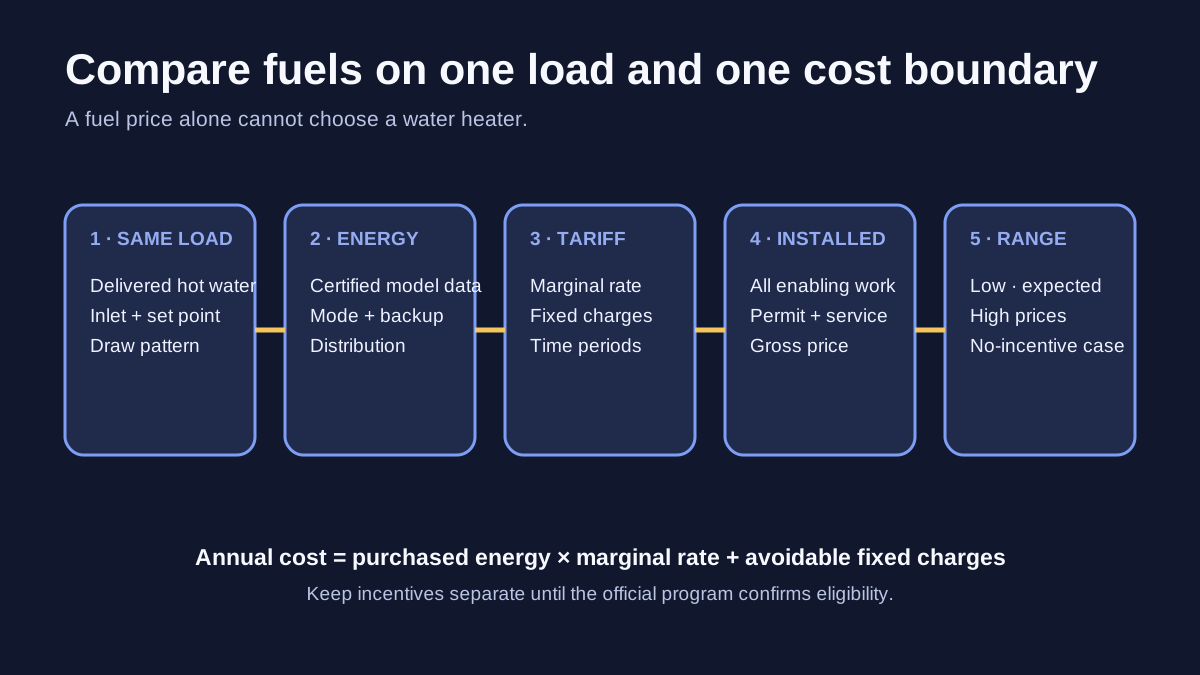
The comparison covers electric resistance, natural-gas and propane storage, gas tankless, and heat pump water heaters. Each option must be tested against the same delivered hot-water load and installed boundary.
Part 1: The Physics (UEF and The Recovery Rate)
Before we talk dollars, we must talk physics. When shopping for a water heater, ignore the marketing fluff (like "Hybrid" or "Glacier Bay"). Look for two specific numbers on the yellow EnergyGuide label:
1. UEF (Uniform Energy Factor)
This is the "MPG" rating for water heaters.
- UEF 0.60: A standard gas tank. (60% efficient). For every $1.00 of gas you buy, $0.40 warms the birds outside via the chimney.
- UEF 0.95: An electric resistance tank or high-efficiency condensing gas tankless. (Near 100% efficient).
- UEF 3.50+: A Heat Pump Water Heater. This is the key efficiency number: it can deliver about 3.5 units of heat for every 1 unit of electricity purchased.
2. First Hour Rating (FHR)
This matters more than tank size. It measures how much hot water the unit can deliver in the first hour of heavy use (e.g., 6 AM when everyone showers).
- Standard 50-Gallon Tank: ~65 Gallons FHR.
- Tankless: Limitless (technically), but limited by flow rate (GPM).
Part 2: The Contenders (Pros, Cons, and Costs)
Collect current marginal rates from your own bills. Record electricity per kWh, natural gas per therm or equivalent billing unit, propane per delivered gallon or litre, and every fixed charge that would remain or disappear after a fuel switch.
Option A: The Old Standard (Electric Resistance)
- The Tech: Giant copper coils (heating elements) sit inside the water and get hot, like a giant electric kettle.
- UEF: 0.93 - 0.95
- Pros: Cheap to buy ($500). Silent. Reliable. No venting required.
- Cons: The most expensive way to heat water.
- Cost method: Listed or modeled annual kWh multiplied by the marginal electricity rate.
- Best fit: Low first cost, simple electric replacement, quiet operation, or an intermittent-use property where the lifecycle case supports it.
Option B: The Gas Tankless (On-Demand)
- The Tech: A high-powered gas burner (199,000 BTU) fires only when you turn on the tap, heating water instantly as it flows through a heat exchanger.
- UEF: 0.81 (Standard) to 0.97 (Condensing).
- Pros: Infinite hot water (never runs out). Wall-mounted (saves space). 20+ year lifespan.
- Cons: "The Cold Sandwich" (burst of cold water during short uses). Requires massive gas lines (often ¾") and expensive stainless steel venting. Expensive installation ($4,000+).
- Cost method: Annual fuel input multiplied by the local gas rate, plus electricity and applicable fixed charges.
- Best fit: Measured long-duration demand, limited storage space, and a site that supports the required gas, vent, condensate, electrical, and maintenance scope.
Option C: The Heat Pump Water Heater (Hybrid)
- The Tech: It looks like a standard tank, but with a small air conditioner on top. It pulls ambient heat from the surrounding air (basement/garage), compresses it, and dumps it into the water.
- UEF: 3.50 - 4.00.
- Pros: The cheapest operating cost of all options. Dehumidifies the basement.
- Cons: Makes noise (50db fan). Cools the surrounding room (great in FL, bad in MN winters, though the waste cold is minimal compared to the savings). Requires a condensate drain.
- Cost method: Listed or modeled annual kWh multiplied by the local rate, adjusted in scenarios for resistance backup and space-conditioning interaction.
- Best fit: Suitable installation air, condensate, sound location, electrical path, and an operating-cost advantage under local tariffs.
Part 3: Build a Ten-Year Ownership Range
Use installed quotes, annual energy under the same load, maintenance, expected component work, fixed fuel-account charges, financing, and residual value. Run low, expected, and high tariff cases. Verify current incentives independently and show them as a separate line rather than reducing the signed price.
Part 4: The Tankless Myth ("Infinite Hot Water")
"I'm going tankless so I never run out!" Hold on. Tankless units have a real limiting factor: Flow Rate (GPM).
A standard tankless unit is rated for ~9 GPM (Gallons Per Minute). But that is only if your groundwater is warm (e.g., Florida). If you live in Chicago where groundwater is 40°F, that burner has to work extremely hard to lift the temp to 120°F (an 80° rise). Result: The unit throttles down to 4 GPM. If someone is showering (2.5 GPM) and the dishwasher starts (1.5 GPM), the tankless unit maxes out. The shower goes lukewarm.
The Fix: You essentially need a tankless unit sized for a hotel if you have 3+ bathrooms in a cold climate.
Part 5: The "Electrification" Strategy
Why is the government pushing Heat Pumps so hard? Because water heaters act as Thermal Batteries.
An electric resistance tank turns on instantly during peak hours (6 PM when everyone showers), straining the grid. A Heat Pump tank runs slowly and steadily during the day (when solar is abundant) to heat the water, storing it like a battery for evening use. Modern units have CTA-2045 ports (EcoPort) that let the utility company pay you to heat your water during off-peak hours.
The Solar Synergy: A heat pump water heater may be scheduled toward solar-production hours where controls and the tariff support it. Value that electricity at the avoided import or forgone export rate. Solar does not make the heater, maintenance, distribution loss, or backup energy free.
Part 6: Installation "Gotchas"
Before you buy, check these constraints:
For Heat Pump (HPWH):
- Air Volume: It needs breathing room (~700 cubic feet, or a 10x10 room). If putting it in a closet, you need louvered doors.
- Height: The compressor on top adds 12-18 inches. Make sure it fits.
- Noise: Put it in the basement or garage. Do not put it in a hall closet next to a bedroom.
- Drain: It produces water (condensate) like an AC unit. You need a floor drain or a condensate pump.
For Tankless:
- Gas Line: Your old ½" gas pipe is likely too small. You may need to upgrade to ¾" back to the meter. ($$$).
- Venting: You cannot use the existing metal chimney. You must bore two new holes in the side of the house for PVC intake/exhaust.
Part 7: Summary Recommendation
Which one should you buy?
- Best fit for high operating costs: If you have electric resistance or propane, price a heat pump water heater first. The savings can be meaningful when fuel costs are high.
- Existing gas home: Compare the marginal gas rate, fixed charge, vent and safety scope, electric conversion cost, and whether other gas loads keep the account open.
- Solar home: Compare midday load shifting with export value and hot-water capacity. Solar ownership alone does not decide the heater type.
Action Item: Check your existing tank's age today. If it is 10+ years old, plan your replacement now. Do not wait for it to leak on a Saturday night when your only option is whatever the emergency plumber has in his truck (which will be an inefficient standard tank).
Define One Delivered Hot-Water Load
Fuel comparisons fail when each product uses a different household assumption. Set one annual delivered-water load, inlet-temperature profile, outlet set point, distribution condition, and usage pattern. Then calculate the energy each technology must purchase to serve it.
The most defensible starting points are:
- measured annual energy from a dedicated meter;
- an existing unit's fuel use isolated from bills;
- a product-specific EnergyGuide or certified annual-use value adjusted with care;
- a documented engineering model;
- a draw estimate based on measured fixtures and household routines.
Do not treat UEF as a direct conversion from one fuel bill to another without checking draw pattern and load. ENERGY STAR explains that UEF comes from DOE's test method and that higher values mean higher tested efficiency. Products should be compared within appropriate categories and draw patterns.
Normalize Every Fuel Unit
Keep the utility's billing unit in the final cost formula. If you convert, show the factor and source. Common planning relationships include:
- electricity billed in kilowatt-hours;
- natural gas billed in therms, cubic feet, cubic metres, or gigajoules;
- propane billed in gallons or litres;
- fuel oil billed in gallons or litres.
The simplest cost formulas are:
Electric annual cost = annual kWh × marginal $/kWh
Gas annual cost = annual billed fuel units × marginal $/unit + relevant annual fixed charges
Delivered-fuel annual cost = annual delivery quantity × delivered $/unit + tank rental, delivery, or minimum-use charges
Use the marginal energy rate for energy saved. Fixed charges are avoidable only when the whole account or service is actually removed. A home that keeps gas for space heating will usually keep the gas customer charge after replacing the water heater.
Reconstruct Electricity Cost From a Tiered or Time-Varying Tariff
One average bill rate can misprice an electric water heater. Separate energy, delivery, taxes where relevant, tiers, time periods, demand charges, and fixed fees.
For time-of-use pricing, build a schedule:
| Period | Heater kWh | Import rate | Cost |
|---|---|---|---|
| Off-peak | |||
| Mid-peak | |||
| On-peak | |||
| Solar self-use | Avoided import or export opportunity cost |
A storage unit can move some heating time, but it cannot shift an unlimited amount. Tank volume, set point, mixing valve, standby loss, controls, and hot-water demand constrain the schedule. Resistance backup during the evening peak can erase part of an HPWH time-of-use benefit.
Use the utility rate-plan guide to identify the right marginal rate before calculating savings.
Compare Gas by Marginal Cost and Account Status
Add the commodity, delivery, riders, and taxes that change with consumption. Keep fixed charges separate. Then run two cases:
- Gas account remains: fixed charges stay because another appliance uses gas.
- Water heater is the last gas load: include service retirement or capping cost, any account closure requirements, and the fixed charge that disappears.
Do not use wholesale gas prices or a national residential average when the decision is tied to one utility bill. If the bill uses cubic volume, its heat content can vary and the utility may already convert or adjust the billed amount.
For propane and oil, use actual delivered invoices. Include tank rental, minimum delivery, membership, seasonal pricing, and the risk of a small emergency delivery. A headline per-gallon price may omit those costs.
Use Certified Product Data Carefully
Record the exact model, fuel, storage volume, draw pattern, UEF, FHR for storage, and rated GPM at the stated rise for instantaneous equipment. ENERGY STAR's current criteria show why the categories are not directly interchangeable: integrated HPWHs, 120-volt HPWHs, gas storage, and gas instantaneous products have different thresholds and delivery metrics.
For annual-cost planning, collect:
- listed annual energy consumption and test assumptions;
- local inlet-water temperature range;
- household draw pattern;
- selected operating mode;
- recirculation energy and pipe loss;
- standby or pilot behavior;
- resistance backup or auxiliary energy;
- space-conditioning interaction;
- maintenance energy such as pumps or freeze protection.
The yellow label is a common comparison point. It is not a prediction of your household bill.
Add Space-Conditioning Interaction Without Double Counting
An HPWH moves heat from intake air into water. In a conditioned room during heating season, the space-heating system may replace some of that heat. In cooling season, localized cooling and dehumidification may help. The effect depends on climate, room connection, operating hours, and the efficiency and fuel of the space-conditioning system.
Run three cases:
- no interaction adjustment;
- reasonable winter penalty based on the actual heating system;
- summer benefit only where it displaces useful cooling or dehumidification.
Do not claim the exhaust is “free air conditioning” unless it serves a real cooling load. And do not subtract a full HPWH heat output from heating savings if the unit sits in an unconditioned garage.
Gas equipment also interacts with the building. Account for combustion air, vent losses, conditioned-air depressurization where relevant, and any heat released to the room only when a supported model includes it.
Build the Installed-Cost Boundary
Use the same boundary for each quote:
| Cost line | Electric resistance | HPWH | Gas storage | Gas tankless | Electric tankless |
|---|---|---|---|---|---|
| Equipment and delivery | |||||
| Plumbing and disposal | |||||
| Electrical work | |||||
| Fuel line or service | |||||
| Vent and combustion air | |||||
| Condensate | |||||
| Drain pan and leak protection | |||||
| Mixing/recirculation | |||||
| Permit and inspection | |||||
| Finish repair | |||||
| Verified incentive |
Keep the gross installed price visible. Incentives can depend on address, income, tax liability, product list, contractor, preapproval, and installation date. IRS material cited on this page should be checked again for the tax year and project; do not assume a prior-year credit remains available.
Worked Scenario With Local Inputs
Assume three quoted replacements serve the same modeled load:
| Option | Annual purchased energy | Local rate | Annual energy cost |
|---|---|---|---|
| Resistance tank | 3,600 kWh | $0.17/kWh | $612 |
| HPWH | 1,050 kWh | $0.17/kWh | $178.50 |
| Gas option | 180 therms + 40 kWh | $1.35/therm + $0.17/kWh | $249.80 before fixed charges |
These are hypothetical inputs, not national averages. The HPWH energy difference versus resistance is $433.50 per year in this scenario. Against gas, the difference is $71.30 before space interaction and fixed charges.
Now add installed-price differences. If HPWH costs $2,400 more than resistance before verified incentives, simple payback in the expected energy case is about 5.5 years. If the price difference is $800, it is about 1.8 years. If electricity rises or the unit uses more resistance backup, recalculate.
For gas conversion, show both account cases. If gas remains for the furnace, do not count fixed-charge removal. If water heating is the last gas use, add the avoidable annual charge and service closure cost.
Run Sensitivity Cases
At minimum, vary:
- electricity and fuel prices;
- annual hot-water demand;
- HPWH resistance-backup share;
- maintenance and component allowance;
- analysis period;
- financing rate;
- incentive approval;
- remaining fixed gas charge;
- major enabling work;
- replacement timing and residual life.
Do not hide uncertainty inside one 10-year total. A reader should be able to see which input changes the winner.
Regional Decision Notes
In the United States, use the serving utility tariff, official state and utility program sites, ENERGY STAR product data, and current IRS instructions. In Canada, use the provincial or territorial utility rates, delivered fuel invoices, NRCan-recognized product information where applicable, and current federal/provincial programs. In Europe and the UK, compare local electricity and gas tariffs, standing charges, hot-water system type, cylinder compatibility, building regulations, and national support programs.
Fuel availability and installation practice differ. A North American gas tankless retrofit, a UK combi boiler, and a Canadian electric storage replacement are not the same project even when all provide domestic hot water.
Quote and Worksheet Checklist
- Same delivered hot-water load for every option
- Exact model and certified efficiency data
- FHR or GPM at design temperature rise
- Local marginal tariff by billing unit
- Fixed charges separated
- Installed scopes normalized
- Space-conditioning and recirculation treated once
- Maintenance and service access included
- Incentives verified and separated from gross price
- Low, expected, and high rate cases
- Payback and ownership period calculated from incremental cost
Frequently Asked Questions
Is gas always cheaper than electricity for water heating?
No. Fuel price per unit is only one input. Equipment efficiency, fixed charges, hot-water load, installation cost, and HPWH performance can change the result.
How do I compare therms and kWh?
Keep each option in its billed unit and calculate cost from modeled annual input. If converting energy units, show the factor and do not ignore efficiency.
Should I use the average rate on my electric bill?
Use the marginal rate that changes with added or saved kWh. A blended average can include fixed charges that will not change.
Does UEF equal real efficiency in my home?
UEF is a standardized comparison metric under a test draw pattern. Installation, mode, inlet temperature, usage, and distribution change actual consumption.
Should incentives be included in payback?
Run both approved-incentive and no-incentive cases. Keep the gross contractual price visible until eligibility and payment are confirmed.
What if my current water heater is still working?
Compare planned replacement with early replacement. Include remaining life, failure risk, avoided emergency premium, and the energy difference during the early-replacement period.
What to Read Next
Read the heat pump water heater readiness guide for site and sizing constraints, or the tankless versus storage guide when peak flow and first-hour delivery control the decision.
Sources and Method
This worksheet uses DOE water-heating guidance, current ENERGY STAR product criteria and product information, EIA residential-price context, and the IRS page for time-sensitive U.S. credit verification. The worked numbers are labeled scenarios; users must replace them with current bills, certified model data, and written local quotes.
About the Editorial Team EnergyBS reviews public program rules, product specifications, utility rates, and reader-facing cost assumptions. Treat savings figures as estimates until you verify local prices, permits, rebates, and contractor quotes.
Sources and Verification
Editorial Review
EnergyBS Editorial Team
EnergyBS publishes practical homeowner guides. Important program, product, and cost claims should be checked against the linked source and local project documents before you commit to work.
Related Guides
View All ArticlesWhy Hot Water Runs Out Fast 2026 Guide & Data
A homeowner diagnostic for short hotwater supply that separates fixture flow, overlapping draws, tank firsthour capacity, recovery, thermostat/mode, diptube and element faults, mixing valves, leaks, piping loss, and sediment.
Water Heater Leaking? Find the Source Before You Repair
A safetyfirst leaksource map for water around a tank or tankless heater, separating plumbing connections, condensate, relief discharge, drain valve, appliance leaks, recirculation, venting moisture, and tankshell failure.
Water Heater Anode Rod and Maintenance 2026 Tool
A modelspecific waterheater maintenance plan covering anode type and depletion, water chemistry, access, flushing, relief and leak checks, heatpump filters/condensate, tankless scale service, records, and replacement contingencies.