Tankless vs. Tank Water Heaters 2026 Tool (Guide & Data)
Compare tankless and storage water heaters using peak flow, inletwater temperature, firsthour rating, fuel and electrical capacity, venting, distribution delay, maintenance, and installed cost.
The Dream of Infinite Hot Water vs. The Reality of Maintenance (2026 Edition)
Short Answer: Choose tankless when the unit can meet your cold-weather peak gallons per minute and the home can support its fuel, electrical, venting, condensate, and maintenance needs. Choose storage when first-hour rating covers the busiest hour and a simpler retrofit, lower peak input, or stored hot water matters more. Compare installed scope and local fuel cost; neither design wins every house.
In 2010, Tankless (On-Demand) water heaters were the cutting edge. The "Future of Hot Water" had arrived. The sales pitch was irresistible: "Why heat a big tank of water at 2:00 AM when you're sleeping? Heat it only when you need it! Save space! Save money! Never run out!"
In 2026, the narrative has shifted. Tankless isn't dead, but a new technology—the Heat Pump Water Heater (HPWH)—has stolen the "Efficiency Crown." Meanwhile, many homeowners who switched to tankless have discovered the hidden irritations of the "Endless Shower."
This guide compares Gas Tankless, Standard Gas Tank, and Electric Heat Pump Tanks to see which one actually belongs in a modern smart home.
Part 1: The Tankless Reality Check
Gas Tankless units are marvels of engineering. They blast 199,000 BTUs of fire (enough to heat three whole houses) into a copper coil to flash-heat water in seconds. But they have quirks that drive people crazy.
1. The "Cold Water Sandwich"
You jump in the shower. It's hot. You turn the water off to soap up. You turn it back on. ICE COLD. Then hot again.
- Why? When you turned it off, the fire went out. When you turned it back on, it took 3 seconds for the unit to sense flow, purge the combustion chamber, ignite the burner, and heat the heat exchanger. That 3-second slug of unheated water hits you right in the face.
- The Fix: Modern "Premium" tankless units now include a built-in recirculation pump and a tiny buffer tank (0.5 gallons) to solve this, but it adds $500 to the cost.
2. The "Minimum Flow" Problem
You turn on the faucet just a tiny bit to shave or rinse a razor. The water runs cold forever.
- Why? The heater has a safety sensor. It won't fire up unless it sees at least 0.5 Gallons Per Minute (GPM). If you trickle the water, the computer assumes it's a leak or a mistake and keeps the fire off.
3. Water Quality and Heat-Exchanger Service
Mineral scale can reduce heat transfer and flow. The required inspection, flushing method, and interval depend on water hardness, temperature, use, model, and manufacturer instructions. Ask the installer to test or document water quality and quote any treatment and service ports. Do not rely on one universal annual vinegar routine or assume a warranty covers scale damage.
Part 2: The New Champion - Heat Pump Water Heaters (Hybrid)
While Tankless was fighting Gas Tanks, a new electric contender entered the ring. It uses an air conditioner in reverse to pull heat from the surrounding air (basement/garage) and pump it into the tank.
The Math of Efficiency (UEF)
- Standard Electric Tank: 0.95 UEF. (You pay for 100% of the heat).
- Gas Tankless: 0.95 UEF. (You pay for 100% of the heat, minus exhaust loss).
- Heat Pump Tank: 3.50 - 4.00 UEF.
- Translation: For every $1.00 of electricity you buy, you get $4.00 of heat.
- How? It doesn't create heat; it moves heat. It is 400% efficient.
Compare Ownership With One Set of Local Inputs
Use written installed prices and the same hot-water load, fuel tariffs, analysis period, maintenance allowance, and replacement assumptions for every option. Do not subtract a tax credit until the official program confirms the product, taxpayer, project date, and application sequence. The water-heater fuel-cost worksheet provides the normalized formulas.
Part 3: The "Unlimited Hot Water" Myth
"But I have 3 teenagers! A tank will run out!" Not necessarily.
The Recovery Rate
- Standard Electric Tank: 20 gallons per hour recovery. (Slow).
- Gas Tank: 40 gallons per hour. (Medium).
- Tankless: Infinite. (Fast).
Using a Heat Pump Tank Strategically: Modern HPWHs have Mixing Valves. You can crank the tank temp up to 140°F (scalding hot) but the mixing valve blends it down to 120°F at the output.
- Result: That 50-gallon tank now acts like an 80-gallon tank because you are diluting the hot water with more cold.
- High Demand Mode: If guests are visiting, you hit the "High Demand" button on the app. It turns on both the Heat Pump AND the Electric Elements (Hybrid Mode). The recovery rate soars to match a gas tank.
Part 4: Installation Nightmares (Retrofitting Tankless)
Switching from a Tank to Tankless is rarely a simple swap.
- Fuel supply: The designer must calculate pipe capacity from meter to appliance using connected loads, pressure, fuel type, length, fittings, and local code. Pipe diameter alone does not prove capacity.
- Venting and combustion air: The exact category, material, length, termination, condensate handling, and clearances come from the listed appliance and local rules. Existing venting may not be reusable.
- Electrical: Gas tankless controls, ignition, freeze protection, and pumps need a suitable circuit. Confirm voltage, load, outage behavior, and any backup-power plan.
Retrofitting a Heat Pump Tank:
- Requires a condensate drain (like an AC unit).
- Requires 240V (same as an old electric tank).
- New Tech: 120V "Plug-in" Heat Pump tanks (like Rheem ProTerra Plug-in) now exist for gas-replacement scenarios. They plug into a standard wall outlet.
Part 5: The "Space Saving" Argument
Tankless wins here. A tankless unit is the size of a suitcase mounted on the wall. A tank is, well, a tank. It takes up 9 sq ft of floor space.
- If you live in a condo where the utility closet is tiny -> Go Tankless.
- If you have a basement -> The space savings are irrelevant.
Summary Decision Matrix
Which one fits your lifestyle?
Scenario A: Several Back-to-Back Draws
Measure peak simultaneous GPM and the busiest-hour volume. A correctly sized tankless unit, a high-FHR storage unit, multiple heaters, or load scheduling may work. Household size alone does not decide.
Scenario B: Electric Home With Flexible Load
A heat pump storage unit can shift heating toward lower-price or solar-rich hours when the controls, tank size, and tariff support it. Solar generation is not “free hot water”; include the value of exported or displaced electricity.
Scenario C: Limited Maintenance Access
Compare the manufacturer's actual tank and tankless maintenance schedules, water quality, anode or heat-exchanger service, drain access, and local technician availability. Neither design is maintenance-free.
Scenario D: Intermittent-Use Property
Tankless reduces storage standby loss, but freeze protection, outage behavior, well flow, winterization, remote leak protection, and minimum flow may control the choice. A storage unit with a verified vacation mode is another option.
Decision: Select the unit that meets the measured load and site constraints at the lowest supported lifecycle cost. No water-heater type is the right answer for a fixed percentage of homes.
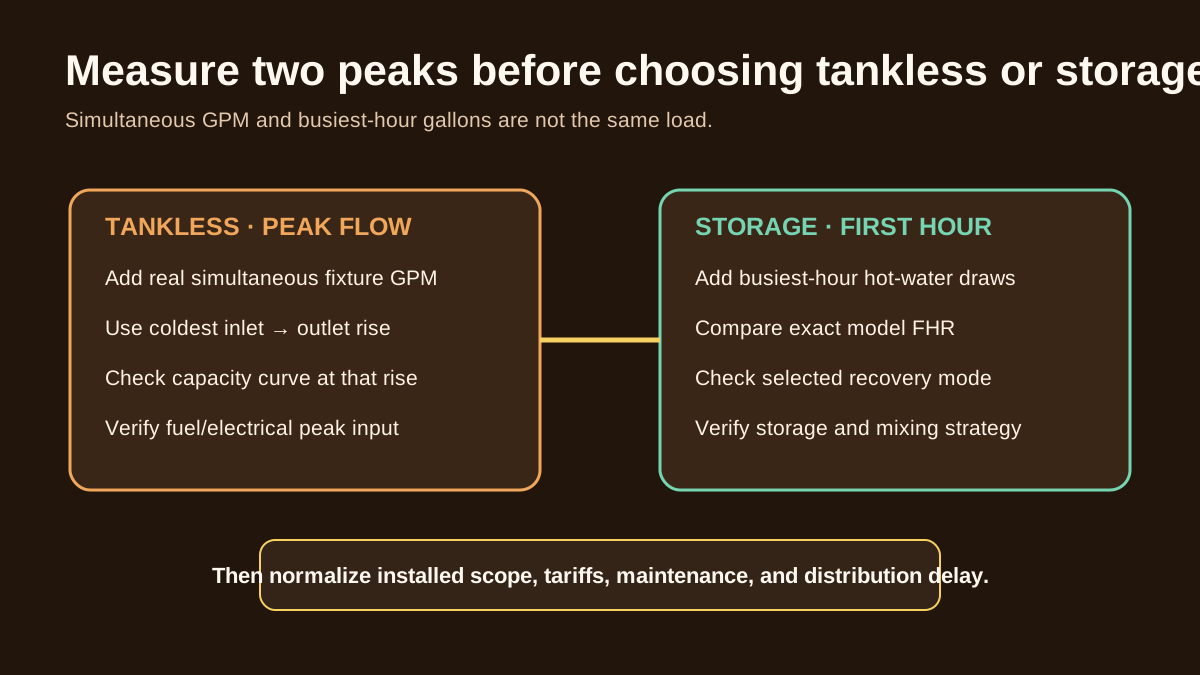
Separate Peak Flow From Hourly Volume
Tankless and storage systems solve two different capacity problems.
- Peak flow asks how many gallons per minute must be heated at the same time.
- Busiest-hour volume asks how much hot water the household draws over an hour.
Tankless capacity is limited by flow at a stated temperature rise. Storage capacity is described by first-hour rating. A household can have low simultaneous flow but high hourly volume, or one short high-flow event with modest daily use.
Make a fixture schedule:
| Fixture or appliance | Measured mixed flow | Likely overlap | Duration | Required delivery temperature |
|---|---|---|---|---|
| Primary shower | ||||
| Second shower | ||||
| Tub filler | ||||
| Kitchen sink | ||||
| Dishwasher | ||||
| Clothes washer |
Do not add every fixture in the house unless they truly run together. But do include real overlap—such as two showers and a kitchen draw during the morning peak.
Size Tankless at the Cold Design Inlet Temperature
DOE's tankless transition guidance says sizing must use maximum simultaneous flow and the required temperature rise. Manufacturer headline GPM often corresponds to a specific rise that may be smaller than a cold-climate winter condition.
Temperature rise = desired outlet temperature − incoming water temperature
Worked scenario: the home needs 5.0 GPM during overlap. Winter inlet water is 42°F and the target outlet is 120°F, so the rise is 78°F. Use the manufacturer's capacity table at about that rise. A rating shown at a 35°F or 45°F rise is not the right comparison.
For a planning heat-input check:
Approximate Btu/h delivered to water = 500 × GPM × temperature rise in °F
At 5.0 GPM and 78°F, that is about 195,000 Btu/h delivered. This simplified water-side formula is not the appliance input rating and does not replace manufacturer sizing, altitude correction, fuel characteristics, efficiency, code, or professional design. It shows why cold-water temperature has such a large effect.
Electric tankless units face the same physics. A large whole-house unit may create a major coincident electrical load. Confirm calculated demand, circuit count, conductor and breaker requirements, panel capacity, service capacity, and utility rules before purchase. Use the electrical panel capacity guide rather than assuming an upgrade from the catalog kW alone.
Size Storage by First-Hour Rating and Recovery Strategy
ENERGY STAR defines first-hour rating as the gallons a fully heated storage unit can supply during the first hour. Compare FHR, not just nominal gallons. The rating combines stored heat and recovery under a standardized test.
Build a busiest-hour estimate, then add a margin for reasonable uncertainty. Check whether the chosen operating mode changes recovery. A heat pump water heater may show a product FHR that uses available resistance backup, while the homeowner intends to run heat-pump-only mode. Ask how the selected mode performs for your peak.
Storage temperature and a listed thermostatic mixing valve can increase usable mixed-water capacity. That approach needs scald protection, commissioning, and an honest assessment of standby loss and scale. It is not permission to set a tank hotter without design.
Read the heat pump water heater sizing and installation guide before comparing an HPWH tank with gas or electric tankless.
“Endless” Still Has System Limits
A tankless heater can operate as long as fuel, power, water, exhaust, and condensate systems remain available. It cannot exceed its flow-versus-rise curve. Controls may reduce flow or delivered temperature when demand exceeds capacity.
The plumbing system adds other limits:
- well and pump flow;
- pressure-reducing valve capacity;
- pipe size and pressure drop;
- fixture flow controls;
- cross-connections or failing mixing valves;
- recirculation design;
- water quality and inlet filtration.
If a large tub needs a fast fill, calculate that event directly. If the concern is four sequential showers, compare both continuous tankless delivery and storage FHR. “Large family” is not a design input.
Include Distribution Delay and Recirculation
Switching the heater does not shorten a long pipe run by itself. The wait at a distant fixture depends on pipe volume and flow. A rough estimate is:
Wait time = water volume in the hot-water path ÷ fixture flow
Recirculation can reduce waiting and water waste, but it may increase heat loss and heater cycling if it runs continuously. Compare demand-controlled, occupancy, timer, temperature, and learned controls. Insulate accessible hot-water piping and define the return path.
Some tankless products need a buffer tank or specific recirculation controls to avoid short cycling or cold slugs. Some storage systems can support recirculation more simply but still incur loop losses. Obtain the listed piping arrangement for the exact model.
Price the Complete Retrofit Boundary
Ask every bidder to separate equipment from enabling work.
Gas tankless scope
- connected-load and gas-pipe calculation;
- meter or regulator coordination if needed;
- listed vent and combustion-air system;
- sidewall or roof termination and clearances;
- condensate drain and neutralization for condensing units;
- electrical circuit and surge protection if recommended;
- isolation/service valves and water treatment;
- recirculation and controls;
- permits, gas inspection, combustion setup, and commissioning;
- old tank, vent, chimney, and finish disposition.
Electric tankless scope
- calculated electrical demand;
- service, panel, breaker spaces, conductors, and disconnects;
- utility coordination where required;
- flow and temperature-rise capacity;
- water treatment and service access;
- permits and electrical inspection.
Storage scope
- fuel or circuit connection;
- vent and combustion air for gas;
- drain pan, shutoff, and leak protection;
- thermal expansion and relief discharge;
- condensate for HPWH or condensing gas;
- mixing valve and recirculation;
- structural support and seismic restraint where required;
- access for anode, filter, drain, and replacement.
A $1,000 equipment difference can be irrelevant if one option requires major utility, vent, electrical, or finish work. Compare signed scope, not retail shelf price.
Account for Outages and Failure Modes
Most modern gas tankless heaters require electricity for controls, ignition, fans, valves, and freeze protection. They usually do not provide hot water during an outage without a compatible backup-power plan. An electric tank stores hot water and may provide some remaining volume after power fails. A naturally vented gas storage unit may operate differently, but exact controls and safety systems matter.
Ask what happens during:
- electrical outage;
- frozen intake, exhaust, condensate, or water piping;
- low well pressure;
- gas interruption;
- sensor or control fault;
- scale or filter restriction;
- leak detection and automatic shutoff;
- loss of internet or app service.
Resilience is not the same as efficiency. Give it an explicit value only if outages or remote-property risks make it important.
Build a Maintenance and Service Budget
For tankless, check inlet filter cleaning, scale inspection or flushing, condensate risk and neutralizer service, vent inspection, combustion checks, recirculation components, and freeze protection. For storage, check anode strategy, sediment drain guidance, relief valve inspection, venting or combustion, condensate and filter service for HPWHs, and leak protection.
Use the manufacturer's schedule and local water-quality evidence. Ask who can obtain parts and how warranty labor works. A long heat-exchanger or tank warranty may exclude labor, shipping, scale, installation defects, or required maintenance.
Worked Decision: Cold-Climate Two-Bath Home
Assume the measured morning overlap is two 1.8 GPM showers plus 0.7 GPM at a sink: 4.3 GPM mixed. Winter inlet is 40°F, target output is 120°F, and the home has an existing gas tank, limited electrical capacity, and a long run to the far bathroom.
The homeowner should compare:
- gas tankless capacity at an 80°F rise, including gas, vent, condensate, electrical, and recirculation scope;
- high-FHR gas storage with compatible venting;
- HPWH storage with electrical, air, condensate, sound, and FHR scope;
- distribution improvements common to all options.
The answer cannot be inferred from UEF alone. The quote matrix should show installed cost, annual fuel scenario, peak capacity, outage behavior, maintenance, expected service, and unresolved site risk.
Quote Checklist
- Winter inlet temperature and target outlet
- Measured simultaneous GPM and busiest-hour volume
- Tankless capacity at design rise or storage FHR
- Exact UEF and applicable draw pattern
- Fuel, electrical, vent, air, condensate, and drain scope
- Distribution and recirculation plan
- Water-quality and service requirements
- Permit and commissioning responsibility
- Warranty exclusions and local service path
- Installed price before conditional incentives
- Annual-cost case using local tariffs
Define the Acceptance Test Before Installation
A commissioned water heater should prove delivery, temperature, safe operation, and controls under the agreed conditions. Put the checks in the contract instead of relying on “hot water at the tap” as the only standard.
For tankless, record inlet temperature, set point, measured flow at representative fixtures, simultaneous-flow test, gas or electrical commissioning data available under the product procedure, vent and condensate inspection, recirculation operation, fault history, and delivered temperature stability. Confirm isolation valves, filters, neutralizer where used, shutoffs, and service access.
For storage, record first fill and purge, leak inspection, relief discharge, expansion control, vent or electrical checks, delivered temperature, recovery mode, mixing-valve setting where installed, drain pan and sensor operation, recirculation control, and access for future service. For an HPWH, also verify airflow, condensate, filter access, sound placement, and selected mode.
The homeowner should receive:
- approved permit and inspection records;
- exact model and serial number;
- installation and operating manuals;
- startup or commissioning record;
- warranty registration and exclusions;
- service schedule tied to local water conditions;
- shutoff and emergency instructions;
- app credentials or local-control instructions;
- photos of concealed piping, wiring, venting, and drains before finish repair.
Run the household's real peak within safe fixture limits after handoff. If delivered temperature falls or flow is restricted, compare the observed condition with the design inputs. A catalog maximum measured at a smaller temperature rise is not evidence that the installed system met the agreed cold-weather load.
Recheck the Decision After One Billing Season
Save pre-install bills, fuel quantities, set points, and household notes. After installation, track energy, water-heater mode, maintenance events, occupancy, and unusual draws. Compare similar seasons and tariffs.
If energy cost exceeds the plan, check actual hot-water use, recirculation schedule, set point, resistance backup, gas fixed charges, equipment faults, pipe losses, and changes in utility rates. If comfort is worse, revisit peak flow, FHR, distribution, crossover, mixing controls, and commissioning. The diagnosis should follow measurements, not a debate about which technology is supposed to win.
Frequently Asked Questions
Does tankless mean instant hot water?
No. It means on-demand heating. Water already in the pipe must still travel to the fixture unless a compatible recirculation system changes the distribution delay.
Can tankless run two showers at once?
Only if the exact model can deliver their combined flow at the coldest design inlet-to-outlet temperature rise, with adequate fuel or electrical capacity.
Is tankless always cheaper to operate?
It can reduce standby loss compared with storage using the same fuel, but lifecycle cost depends on tariffs, load, installed scope, maintenance, and alternative technologies such as HPWHs.
Is a larger storage tank less efficient?
It can have more surface area and standby loss, but an upsized HPWH may avoid inefficient resistance backup and support load shifting. Compare listed annual energy and the real operating mode.
Which system is better with hard water?
Both need a water-quality plan. Tankless heat exchangers can scale; storage tanks can accumulate sediment and have anode needs. Follow model-specific guidance.
Will gas tankless work during a blackout?
Most current units need electricity. Confirm the exact model and any listed backup-power approach.
What to Read Next
Use the heat pump water heater readiness guide for storage electrification details, then compare fuel scenarios with the water-heater operating-cost worksheet. For an existing tank, use the anode and model-specific maintenance guide to distinguish a serviceable system from one that needs replacement planning.
Sources and Method
The sizing framework follows DOE's tankless transition guidance and ENERGY STAR's current definitions for GPM, UEF, and FHR. Exact fuel piping, electrical demand, venting, water treatment, safety, and code decisions require the listed product instructions and qualified local trades.
About the Editorial Team EnergyBS reviews public program rules, product specifications, utility rates, and reader-facing cost assumptions. Treat savings figures as estimates until you verify local prices, permits, rebates, and contractor quotes.
Sources and Verification
Editorial Review
EnergyBS Editorial Team
EnergyBS publishes practical homeowner guides. Important program, product, and cost claims should be checked against the linked source and local project documents before you commit to work.
Related Guides
View All ArticlesWhy Hot Water Runs Out Fast 2026 Guide & Data
A homeowner diagnostic for short hotwater supply that separates fixture flow, overlapping draws, tank firsthour capacity, recovery, thermostat/mode, diptube and element faults, mixing valves, leaks, piping loss, and sediment.
Water Heater Leaking? Find the Source Before You Repair
A safetyfirst leaksource map for water around a tank or tankless heater, separating plumbing connections, condensate, relief discharge, drain valve, appliance leaks, recirculation, venting moisture, and tankshell failure.
Water Heater Anode Rod and Maintenance 2026 Tool
A modelspecific waterheater maintenance plan covering anode type and depletion, water chemistry, access, flushing, relief and leak checks, heatpump filters/condensate, tankless scale service, records, and replacement contingencies.