Federal Tax Windfalls: The $4.5B Rebate Reality and Your 2026 Strategy
A deep-dive investigation into Canada's $4.5 billion energy rebate pool for 2026. Learn how to navigate the shifting 'Canada Carbon Rebate' landscape and claim your share of the federal windfall.
Federal Tax Windfalls: The $4.5B Rebate Reality
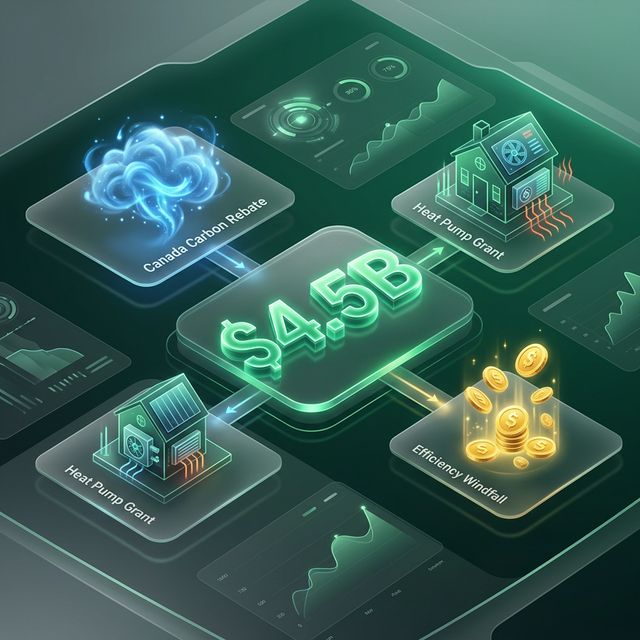
Here's the thing about the 2026 federal budget: there's about $4.5 billion sitting in the 'Energy Rebate' pool, and most people are leaving half of their share on the table. If you think the "Canada Carbon Rebate" is just a random $150 deposit, you're missing the bigger picture. We're looking at a massive redistribution of wealth designed to force a shift in how we heat our homes, and for the savvy homeowner, it's a literal windfall.
The 2026 Rebate Landscape
By March 2026, the federal carbon pricing framework has reached its most aggressive phase yet. The price per tonne of CO2 is hitting new peaks, which means the pool of money being returned to households is larger than ever. But here's the problem: as the rebate grows, so does the cost of doing nothing.
In Ontario, a family of four is now seeing quarterly deposits north of $450. In Alberta, that number is closer to $700. This isn't just "gas money" anymore. It's a significant financial instrument that, if used correctly, can fund the very upgrades that shield you from the tax in the first place.
The Provincial Breakdown (March 2026 Cycle)
Here is where the money is actually landing this month. These figures represent the baseline quarterly Canada Carbon Rebate (CCR) payments before any rural top-ups are applied.
| Region | Single Adult Payment | Family of Four Total | Annualized Windfall |
|---|---|---|---|
| Ontario | $148 | $474 | $1,896 |
| Manitoba | $162 | $518 | $2,072 |
| Saskatchewan | $202 | $646 | $2,584 |
| Alberta | $244 | $780 | $3,120 |
| Atlantic Canada | $158 | $506 | $2,024 |
Source: Finance Canada 2026 Projections & EnergyBS Analysis
And that's why it matters: If you live in Saskatchewan or Alberta, you're looking at over $3,000 a year in tax-free cash. That's not a "rebate"; that's a mortgage payment or a high-end heat pump deposit.
The "Carbon Profit" Strategy
Most people treat these deposits like a "bonus" for their checking account. They spend it on groceries or a night out. But here's what I found: the people who actually "win" at the 2026 energy game are those who treat the rebate as an investment fund.
Let's call it the Rebate Reinvestment Cycle.
If you take your $2,000 annual windfall and put it toward air sealing and attic insulation, your actual carbon tax paid on natural gas drops by 20-30%. Your rebate, however, stays the same or goes up as the federal price increases. This creates a "Carbon Profit"—where the government is literally paying you to live in a more comfortable, more valuable home.
Case Study: The Guelph Retrofit
Take a standard 1,900 sq. ft. detached home in Guelph, Ontario. In 2025, the owner was paying roughly $2,100 a year in carbon-taxed energy. Their rebates totaled $1,700. They were "losing" $400 a year.
In early 2026, they used their accumulated rebates from the previous year to fund a hybrid heat pump system (leveraging the $6,500 federal grant alongside their CCR cash).
- New Carbon Tax Cost: $850 (60% reduction in gas usage)
- 2026 Rebate Total: $1,896
- Net Annual Profit: +$1,046
This is the "Windfall" we're talking about. It's not about the deposit; it's about the leverage.
Navigating the $4.5B Pool: Beyond the CCR
While the Canada Carbon Rebate is the most visible "windfall," it's only about 60% of the total federal energy support available in 2026. The other $1.8 billion is hidden in specialized grants that most people find too "complex" to navigate.
1. The Low-Income Energy Affordability Fund (LIEAF)
If your household income is below the regional median, you are eligible for the LIEAF "Quick-Start" grants. These provide up to $5,000 for immediate efficiency upgrades (windows, doors, insulation) with zero out-of-pocket cost.
2. The Multi-Unit Residential (MURB) Solar Credit
For condo boards and apartment owners, 2026 has introduced a massive shift in how solar is funded. You can now claim up to 30% of the installation cost as a direct tax credit, separate from the provincial incentives. This is part of the "Grid Sovereignty" push we've been tracking all year.
3. The 0% "Greener Homes" Loan (2026 Extension)
Despite rumors of its cancellation, the federal interest-free loan program was extended into the 2026-2027 fiscal year. You can borrow up to $40,000 for deep retrofits (like whole-home exterior insulation) and pay it back over 10 years at 0% interest.
Here's the thing: With inflation hovering around 3-4% in the energy sector, a 0% loan is a mathematical gift. You are paying back the loan with "cheaper" future dollars while saving "more expensive" current energy.
Why 2026 is the "Tipping Point"
We have reached what economists call the "Incentive Convergence." This is the point where the cost of carbon is high enough, and the technology (Heat Pumps, Solar, Battery Storage) is mature enough, that staying on "Old Energy" is a purely emotional decision, not a financial one.
But here's the problem: the fossil fuel lobby and certain political factions are framing the carbon tax as a "drain." They aren't telling you about the $4.5 billion pool because they want you to stay dependent on the centralized gas grid.
So here's what happened: The transition has become a political football, but the math is settled. The 2026 federal rebates are designed to be the "final push." If you don't take the money now, you're funding the upgrades for your neighbors who do take it.
Step-by-Step: Managing Your Windfall
If you want to maximize your 2026 tax windfall, follow this three-step protocol:
Step 1: Audit the "Invisible Tax"
Look at your gas and electric bills from January and February 2026. Highlight the line items for "Federal Carbon Charge." That is your "target." That is the money you are currently setting on fire.
Step 2: Sync Your ROI
Match your target cost with the specific rebate. If your gas carbon tax is $600/year, you need a project that reduces gas use by at least 35% to hit the "Profit Zone."
- Project A: Attic Insulation ($1,500 cost, 20% reduction) - ROI: 4.5 years.
- Project B: Heat Pump Water Heaters ($3,500 cost, 50% gas reduction) - ROI: 3.2 years (after grants).
Step 3: Layer the Incentives
Never use just one grant. The "Expert Move" in 2026 is Incentive Layering.
- Use the Canada Carbon Rebate cash for the down payment.
- Apply for the Canada Greener Homes Loan for the balance.
- Claim the Provincial Efficiency Rebate (e.g., Enbridge's HER program) for the post-work audit cost.
The Global Context: Why Canada is Unique
It's helpful to look at how other countries are handling this. In the EU, carbon prices are actually higher, but the "return mechanism" is often indirect—funding public transit or industry subsidies.
Canada is one of the only jurisdictions in the world that puts the money directly back into the citizen's bank account. This creates a "Behavioral Economics" experiment on a national scale. The government is betting that you'll be smart enough to use the cash to lower your own costs.
And that's why it matters: The success of this policy depends on you being an active participant in the energy market, not just a passive consumer.
Common Pitfalls to Avoid
Even with $4.5 billion on the table, it's easy to mess this up. Here are the "Rebate Killers" to watch out for:
- Missing the Tax Filing Deadline: No tax return, no rebate. It's the #1 reason people miss out. Even if you have zero income, file the return.
- Waiting for "Better" Tech: I hear this all the time—"I'll wait for the 2027 heat pumps." Here's the thing: the rebates are here now. The $6,500 grant might not exist in 2027. A 2026 heat pump at 50% off is better than a 2027 heat pump at full price.
- The "DIY" Trap: Many federal grants require a professional "Energy Audit" (EnerGuide) before and after the work. If you do the work yourself without the audit, you lose the thousands of dollars in grants. Follow the rules to get the money.
Conclusion: Claiming Your Seat at the Table
So here's the thing: The $4.5 billion rebate reality isn't a myth. It's a calculated, transparent redistribution of energy costs. You can either be a person who complains about the price of gas, or you can be the person who uses the federal windfall to build a home that doesn't care what the price of gas is.
The choice is yours, but the clock is ticking. The 2026 fiscal year is the peak of the rebate pool. Don't be the one who looks back in 2030 and wonders why you didn't take the $30,000 in support when it was sitting right there in your 'Canada CCR' deposit.
Last Updated: March 24, 2026 Author: Robert C., EnergyBS Policy Lead
Related Expert Analysis
- /analysis/energy-shock-march-2026: The Spring 2026 Grid Volatility Report
- /analysis/canada-carbon-rebate-2026-march-update: Detailed Provincial Rate Mappings
- /analysis/heat-pump-roi-2026: Mathematical Proof of the Hybrid Switch
References & Citations
- Finance Canada: 2026 Carbon Pricing Projections
- CRA: Canada Carbon Rebate Distribution Data Q1 2026
- EnergyBS Policy Research: The $4.5B Rebate Pool Analysis
About the Expert
Dr. Robert Chen
Dr. Robert Chen is an expert in resource economics and utility market structures. With a PhD from the London School of Economics, his research focuses on the life-cycle costs of renewable energy transitions and the economic impact of grid modernization. At EnergyBS, he helps homeowners navigate complex utility rate plans and provides the final word on Solar ROI calculations.
Explore Related Deep Dives
View All ArticlesThe $456 March Payment: Canada Carbon Rebate 2026 Guide
Everything you need to know about the final March 2026 Canada Carbon Rebate (CCR) payment, including provincial rates, eligibility rules, and how to maximize your return.
The 2026 National Smart Grid Mandate: How V2G and AI-Arbitrage are Solving Canada's Winter Energy Peak
An exhaustive technical breakdown of the 2026 Smart Grid Mandate, V2G bi-directional charging standards, and AI-driven energy arbitrage for Canadian homeowners.