LED Flicker and Health
Do your LED lights trigger headaches or show stripes on phone camera? Cheap drivers cause invisible strobeflicker that affects health. Here's what to do.
The Light That Flickers (Even When You Can't See It)
Short Answer: Do your LED lights trigger headaches or show stripes on phone camera? Cheap drivers cause invisible strobe-flicker that affects health. Here
You upgraded to LED lighting because it was the right thing to do—energy savings, longevity, better for the planet. But lately something feels off in certain rooms. Eyestrain after working at your desk. Headaches that appear mid-evening. A vague sense of fatigue you can't quite explain.
You probably blamed screens, stress, or allergies. But the cause may be directly overhead: invisible LED flicker.
Many LED bulbs—especially inexpensive ones—don't produce steady light. They pulse on and off at frequencies your conscious mind can't detect but your nervous system absolutely does. This imperceptible strobing can cause:
- Eyestrain and visual fatigue
- Headaches and migraines (for susceptible individuals)
- Difficulty concentrating
- Discomfort or unease you can't identify
The good news: once you understand the problem, the solutions are straightforward. Here's everything you need to know about LED flicker, how to detect it, and how to fix it.
The Physics of LED Flicker
Why Incandescent Didn't Flicker
Traditional incandescent bulbs produced light by heating a tungsten filament until it glowed. Even though electricity alternates at 60 Hz (60 cycles per second in North America), the thermal mass of the filament kept it hot continuously—it didn't cool down between AC cycles. Light output was essentially constant.
Why LEDs Can Flicker
LEDs work completely differently. They're semiconductor devices that emit light when electrical current flows through them. Unlike filaments, LEDs respond almost instantaneously to electrical changes—they can turn on and off in nanoseconds.
When driven directly by 60 Hz AC power (which reverses direction 60 times per second), a bare LED would flash 120 times per second as current peaks twice per cycle (once in each polarity).
The Solution (In Theory): LED drivers—the power supply circuitry in every LED bulb—are supposed to convert AC to smooth DC power, eliminating flicker entirely.
The Reality: Quality drivers do this well. Cheap drivers do it poorly—producing "ripple" in the output that causes the LED to pulse.
Measuring Flicker: The Technical Standards
The lighting industry uses two key metrics to quantify flicker:
Flicker Percentage
The difference between maximum and minimum light output divided by the maximum:
Flicker % = (Max - Min) / Max × 100
- 0%: Perfectly steady light (incandescent, quality LEDs)
- 100%: Complete on-off cycling (strobe light)
- Cheap LEDs: Often 20-80%
- Quality LEDs: <5%
Flicker Index
A more sophisticated metric that accounts for the shape of the light waveform, not just the peaks and valleys. Scale of 0 to 1:
- <0.01: Essentially flicker-free
- 0.01-0.05: Low flicker (quality LEDs)
- 0.05-0.10: Moderate flicker
0.10: High flicker (problematic)
IEEE Standard 1789-2015
The IEEE published guidelines for LED flicker safety:
| Flicker Frequency | Risk at High Flicker % |
|---|---|
| <80 Hz | High risk of seizures, visible flicker |
| 80-160 Hz | Moderate risk of headaches, fatigue |
| 160-400 Hz | Low risk, but sensitive individuals affected |
| >400 Hz | Generally safe for most people |
Most problematic LEDs flicker at 100-120 Hz—squarely in the zone that causes headaches and eyestrain for sensitive individuals.
Who Is Affected?
Not everyone reacts to LED flicker, but a significant minority does:
Migraine sufferers: Flickering light is a well-documented migraine trigger. People with migraines are often more sensitive to visual stimuli generally.
Individuals with photosensitive epilepsy: Severe flicker (below 60 Hz, high percentage) can trigger seizures. Above 80 Hz, seizure risk is minimal, but other symptoms may occur.
Those with autism spectrum conditions: Often report higher sensitivity to sensory stimuli including lighting quality.
Anyone doing sustained visual work: Reading, computer work, detailed crafts—activities requiring sustained focus amplify flicker discomfort.
Children: May not articulate discomfort but can be affected by poor lighting quality in schools and homes.
The Dimmer Problem
Flicker issues are dramatically worse with dimmed LED lighting.
How Cheap LED Dimming Works
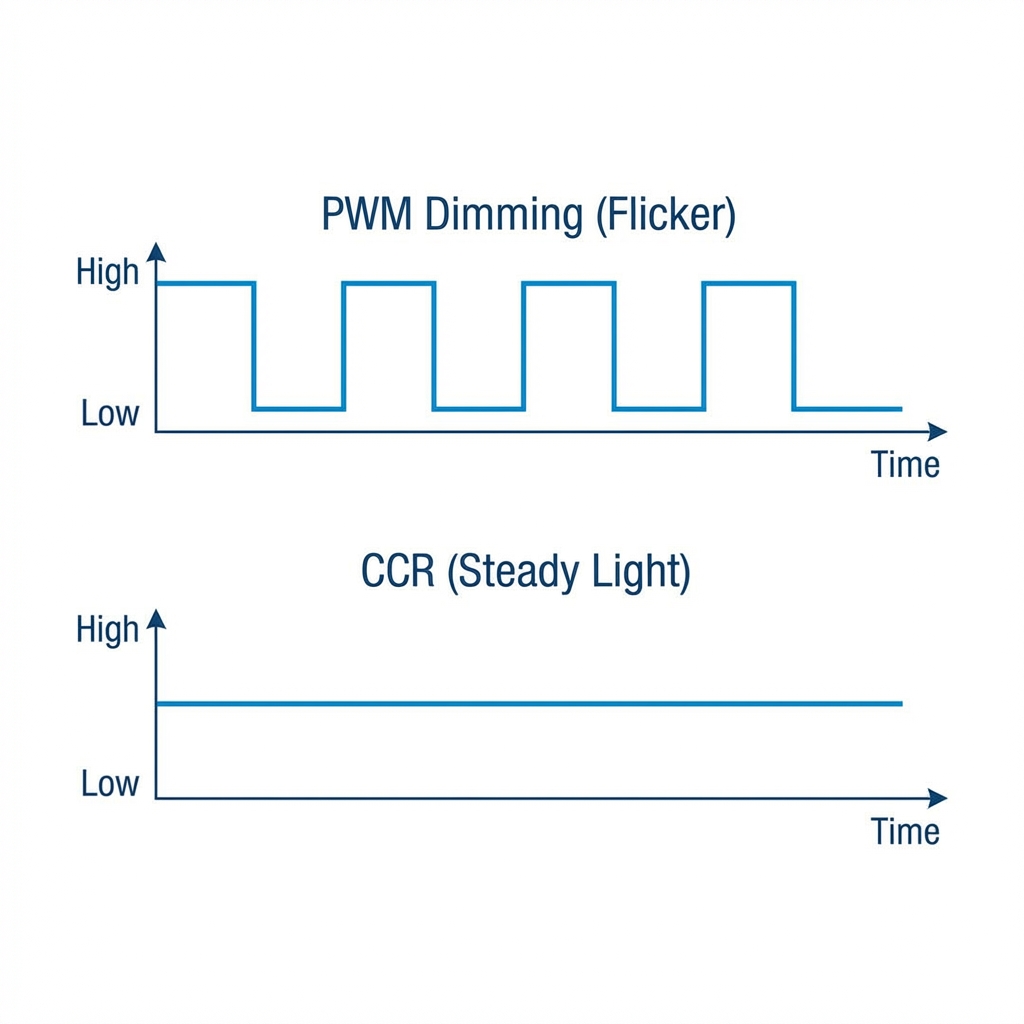
The simplest way to dim an LED is Pulse Width Modulation (PWM): rapidly switching the LED on and off and varying the ratio of on-time to off-time.
- 100% brightness: LED stays on continuously
- 50% brightness: LED is on 50% of the time, off 50%
- 10% brightness: LED is on 10% of the time, off 90%
When PWM operates at very high frequencies (2-20 kHz), it's fine—the on-off cycling is far too fast to perceive.
But cheap LED drivers often use PWM at lower frequencies (100-400 Hz) because it's simpler and cheaper to implement. At 50% brightness, you're now exposed to a light that's pulsing 100-400 times per second at 50% flicker percentage.
Dimmer Compatibility
Traditional incandescent dimmers (TRIAC dimmers) work by "chopping" the AC waveform—cutting off part of each cycle to reduce power. These dimmers can cause severe flicker with LEDs:
- Mismatched dimmer/LED combinations buzz, flicker visibly, or don't dim smoothly
- Some combinations work at 100% but flicker horribly at 50%
- The electrical "noise" from TRIAC dimming interacts poorly with cheap LED drivers
Solution: LED-specific dimmers (ELV dimmers, 0-10V dimmers) or smart dimmers designed for LED loads work far better.
How to Test for Flicker
You don't need expensive equipment to detect LED flicker. Here are DIY methods:
Method 1: The Phone Camera Test
Open your phone's camera and point it at the light source (don't look directly at bright lights through the camera—just frame them).
What to look for:
- Dark bands scrolling across the screen: This indicates flicker at a frequency similar to your camera's frame rate
- Visible pulsing or flashing: Indicates severe flicker
Note: This test works better with some phones than others, and slow-motion video mode often reveals flicker invisible in regular mode.
Method 2: The Hand Wave Test
In a room lit only by the suspect LED, wave your hand rapidly back and forth in front of your face.
Smooth, blurred motion: Light is steady (low flicker) Choppy, stroboscopic, multiple distinct hand images: Light is flickering
This works because flicker creates a "stop motion" effect—your brain perceives distinct images at each flash rather than smooth motion.
Method 3: The Pencil Test
Hold a pencil vertically and wave it rapidly back and forth under the light.
Smooth arc: Low flicker Multiple distinct pencil images (like a fan blade): High flicker
This is a more sensitive version of the hand wave test.
Method 4: Purchase a Flicker Meter
If you're serious about lighting quality, dedicated flicker meters are available:
- Lighting Passport (UPRtek): Detailed, $1,000+
- Hopoocolor Flicker Meter: ~$300-500
- Smartphone apps (variable quality, but some are decent for screening)
Solutions: Fixing Flicker in Your Home
Solution 1: Replace Problematic Bulbs
The most direct fix is replacing high-flicker bulbs with quality alternatives.
Brands with strong flicker-free reputations:
| Brand | Product Lines | Flicker Performance |
|---|---|---|
| Philips | EyeComfort, Hue | Excellent, specifically marketed as flicker-free |
| Waveform Lighting | FilmGrade, Centric | Premium quality, very low flicker, high CRI |
| Soraa | Vivid, Brilliant | High-end, excellent flicker and color |
| Cree | True White | Generally good, check specific models |
| GE | Reveal, Relax | Mid-tier, better than budget brands |
What to look for on packaging:
- "Flicker-free" or "Low flicker" claims
- IEEE 1789 compliance mentioned
- Higher prices generally (but not always) correlate with better drivers
Solution 2: Use Constant Current Reduction (CCR) Dimming
Instead of PWM, which chops the signal, CCR dimming reduces the actual current flowing to the LED continuously. The LED dims smoothly without pulsing.
Products with CCR or analog dimming:
- Lutron Caseta (when paired with compatible bulbs)
- Ketra lighting systems
- Some architectural LED fixtures
- Smart bulbs with built-in drivers (Hue, LIFX)
Solution 3: Smart Bulbs with Quality Drivers
Smart LED bulbs (Philips Hue, LIFX, Nanoleaf) handle dimming internally using high-quality drivers and high-frequency PWM (16+ kHz). They receive full power from the socket and manage brightness digitally.
Advantages:
- Bypass wall dimmer issues entirely
- High-frequency PWM produces imperceptible flicker
- Many have excellent color quality as well
- Work with standard on/off switches
Cost: $15-50 per bulb (vs. $2-5 for budget LEDs)
Solution 4: Replace Incompatible Dimmers
If your existing LEDs are acceptable at full brightness but flicker when dimmed, the dimmer may be the problem:
Upgrade to:
- LED-compatible TRIAC dimmers (check manufacturer compatibility lists)
- ELV (Electronic Low Voltage) dimmers
- 0-10V dimming systems (more common in commercial)
- Smart dimmers from Lutron, Leviton, or Legrand
Cost: $20-60 per dimmer switch
The Brightness-Flicker Trade-off
Here's an important insight: flicker perception is stronger at lower brightness levels.
At 100% brightness, even moderate flicker may be tolerable. At 20% brightness (evening ambient lighting), the same bulb becomes noticeably uncomfortable.
Practical implication: Test bulbs at the brightness levels you'll actually use. A bulb that seems fine at full power may be problematic dimmed.
Beyond Flicker: Total Lighting Quality
While troubleshooting flicker, consider other LED quality factors:
Color Rendering Index (CRI)
How accurately a light source renders colors compared to sunlight:
- 100: Perfect (sunlight, incandescent)
- 90+: Excellent (high-end LEDs)
- 80-90: Good (average LEDs)
- <80: Poor (avoid for living spaces)
Color Temperature
Measured in Kelvin (K):
- 2700K: Warm white (like incandescent)
- 3000K: Slightly cooler warm
- 4000K: Neutral white
- 5000K+: Daylight/cool white
Beam Quality
Cheap LEDs often have uneven beam patterns, visible "hot spots," or color inconsistencies across the beam.
Quality indicators that often correlate:
- Higher CRI = better drivers = lower flicker
- Established brands = better quality control = lower flicker
- Higher prices = better components = lower flicker
Action Plan: Fixing Your Home's Lighting
1. Identify problem rooms: Where do you or family members experience headaches, eyestrain, or unexplained fatigue?
2. Test those lights: Use phone camera and hand wave tests to identify high-flicker sources.
3. Replace worst offenders: Start with home office, reading areas, and bedrooms—places with sustained visual focus.
4. Upgrade dimmers if needed: Replace incompatible dimmers with LED-specific models.
5. Document improvements: Note whether symptoms improve. This feedback helps future decisions.
The Bottom Line
LED flicker is a real phenomenon with measurable health effects for sensitive individuals. It's caused by poor-quality drivers in cheap LED bulbs and incompatible dimming equipment.
The fix is straightforward: invest in quality bulbs from reputable manufacturers, use smart bulbs or LED-compatible dimmers for dimming, and test before committing to whole-house installations.
The $10 difference between budget LEDs and quality LEDs is tiny compared to chronic headaches, eyestrain, and the productivity losses they cause.
Your lighting should make you feel better, not worse. If something feels off, trust your instincts—and check your bulbs.
About the Editorial Team EnergyBS reviews public program rules, product specifications, utility rates, and reader-facing cost assumptions. Treat savings figures as estimates until you verify local prices, permits, rebates, and contractor quotes.
Common Questions
What should I check first before using this lighting advice?
Start with the numbers that apply to your home: climate, utility rate, equipment age, contractor quote, and local program rules. Do your LED lights trigger headaches or show stripes on phone camera? Cheap drivers cause invisible strobeflicker that affects health. Here
How should I verify rebates, tax credits, rates, or savings before spending money?
Treat program amounts, utility rates, and tax rules as date-sensitive. Check the named government, utility, or manufacturer source before you sign a contract, and keep screenshots or PDFs of eligibility rules for your records.
What is the next useful step after reading this?
Compare this with Laser Lighting Technology: The Fiber Optic Future (2026) so you can check the cost, rebate, installation, or operating-risk angle before making a decision.
What to Read Next
Laser Lighting Technology: The Fiber Optic Future (2026)Use this next to compare the cost, incentive, installation, or operating-risk angle before you make a home energy decision.Sources and Verification
Editorial Review
EnergyBS Editorial Team
EnergyBS publishes practical homeowner guides. Important program, product, and cost claims should be checked against the linked source and local project documents before you commit to work.
Related Guides
View All ArticlesLaser Lighting Technology: The Fiber Optic Future (2026)
BMW uses laser headlights. Kyocera is bringing them to homes. Fiber optic distribution from a single laser source could transform residential lighting forever.
Dark Sky Lighting Guide: Reduce Light Pollution (2026)
Your floodlights are blinding neighbors and disrupting ecosystems. Here's how to light your home effectively while protecting the night sky.
Landscape Lighting Guide (2026 Guide & Data)
Those $5 solar stakes are landfill waste in disguise. Professional lowvoltage landscape lighting lasts decades and transforms your property. Here's how to do it right.