The Myths of HVAC Zoning (2026 Guide & Data)
Closing vents kills furnaces. Zone dampers increase static pressure. How to zone your home correctly without destroying equipment.
The Zoning risk: Why "More Zones" Isn't Always Better
Short Answer: Closing vents kills furnaces. Zone dampers increase static pressure. How to zone your home correctly without destroying equipment.
HVAC Zoning sounds like common sense. "Why cool the guest bedroom to 72°F if nobody is in there? Put a thermostat in every room! Save money!" In theory, yes. In practice, improper zoning is the #1 killer of high-efficiency blowers and compressors.
Zoning is not a magic wand; it is a fluid dynamics problem. This guide explains the physics of airflow, the danger of static pressure, and how to zone correctly without destroying your furnace.
If you are considering motorized replacement registers rather than trunk or branch dampers, use the smart-vent safety and commissioning guide. It treats retrofit room control as a separate decision with measured minimum-open and fail-safe requirements.
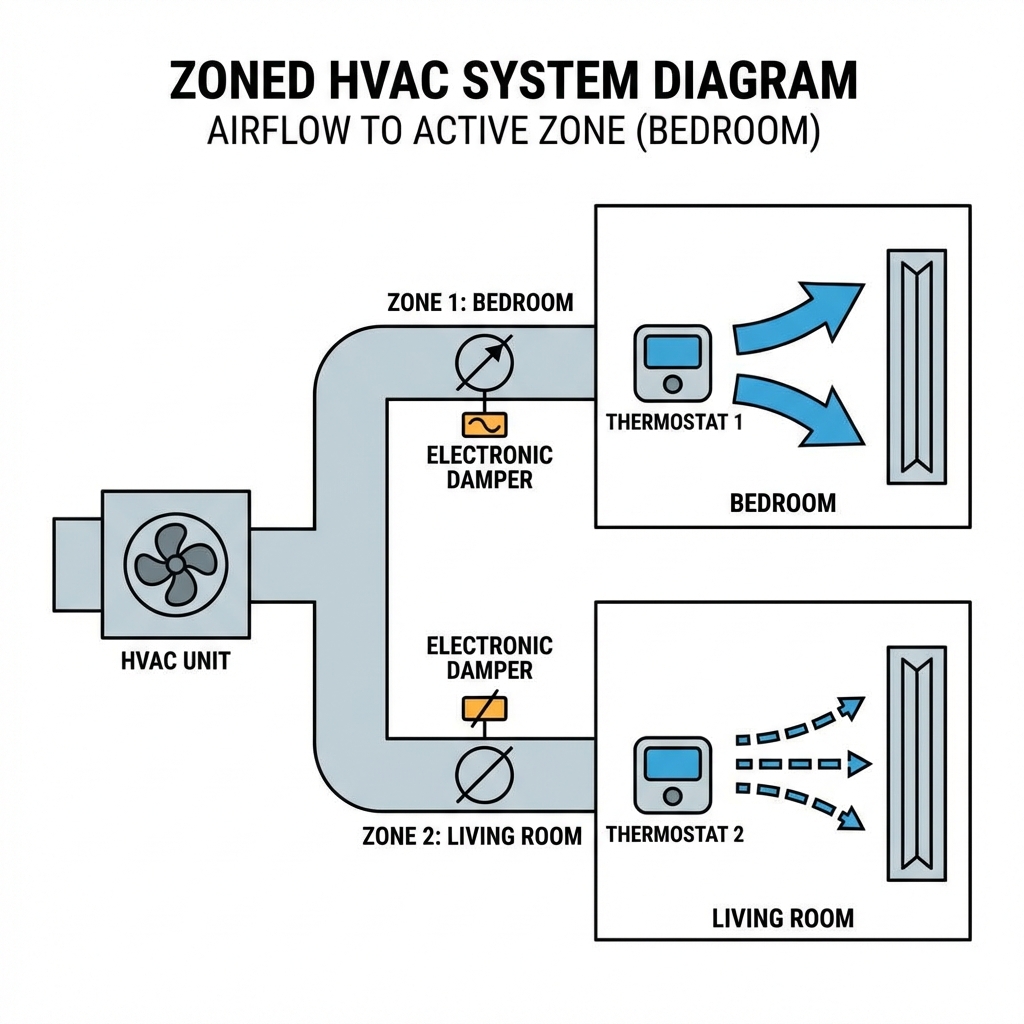
Part 1: The Physics (Trying to Scream Through a Straw)
Imagine you have big lungs (Your Furnace Blower). You are blowing into a large tuba (Your Ductwork). Everything flows nicely. Now, imagine you block 70% of the tuba's exit (Closing zone dampers). But you keep blowing just as hard.
What happens?
- Pressure Spike: The pressure inside the mouth/ducts skyrockets.
- Backfire: The air has nowhere to go. It turbulence. It creates noise.
- Motor Death: Your blower motor (ECM) senses the resistance and ramps up (tries harder) to overcome it. It consumes huge wattage, overheats, and burns out.
The Myth: "Closing vents saves energy." The Reality: In a modern ECM system, closing vents (or aggressive zoning) increases static pressure, power consumption, and equipment wear.
Part 2: The Equipment (ECM vs PSC Motors)
The type of motor you have dictates if you can zone.
1. PSC Motor (Permanent Split Capacitor)
- Old School (Pre-2010).
- Stupid motor. It runs at one speed.
- If you close dampers, airflow slows down. The coil freezes (turns into a block of ice). The compressor dies.
- Verdict: Do NOT zone a PSC system heavily without a massive bypass.
2. ECM Motor (Electronically Commutated Motor)
- Modern standard.
- Smart motor. It targets a specific CFM (airflow).
- If you close dampers, it detects resistance and speeds up (RPM) to force the air through.
- Verdict: Can handle zoning better, but is at higher risk of burnout from high static pressure.
Part 3: The Danger of the "Bypass Damper"
Lazy HVAC installers solve the pressure problem with a Barometric Bypass Damper.
- What it is: A short-circuit duct connecting the Supply (Output) directly back to the Return (Input).
- How it works: When Zone 2 closes, the pressure builds. A weighted door swings open, dumping the excess cold air right back into the furnace intake.
- The Problem: You are taking 55°F air and putting it back into the cooling coil to be cooled again. The air temp drops to 40°F... 30°F... Freeze up.
- Efficiency: Terrible. You are recycling cold air instead of cooling the house.
The Fix: Modulating Dampers + Capacity Unloading. True zoning requires a Variable Speed Compressor (Inverter) and Variable Speed Fan.
- If only 1 zone is calling (25% demand), the compressor slows down to 25% capacity. The fan slows down to 25%. No pressure spike. No bypass needed.
- Rule: Never install 4 zones on a generic "Single Stage" AC unit.
Part 4: The "Dump Zone" Strategy
If you don't have a fancy variable speed inverter unit, how do you zone safely? Use a Dump Zone.
Instead of a Bypass Damper (recycling air), you designate a hallway or large open area as the "pressure relief valve."
- This zone has no damper. It is always open along with the calling zone.
- If the master bedroom calls for cooling, the bedroom damper opens. The Dump Zone is also open.
- Excess air goes into the hallway.
- Result: Equipment stays safe, pressure stays low, and you simply "over-cool" the hallway a bit. It is much healthier for the system than a bypass.
Part 5: Smart Thermostat Integration (Ecobee/Nest)
Don't use old 1990s zone boards. Modern setup zoning (like Ecobee + Smart Sensors) is often superior to mechanical dampers for comfort.
- The Logic: Instead of closing ducts (mechanical), the system averages the temperature based on occupancy.
- Scenario: You are in the bedroom. The living room is empty. The Ecobee sensor sees you. It runs the AC until the bedroom hits 72°F, ignoring the living room temp.
- Result: You get comfort where you are. The living room might get to 70°F (waste), but you avoided the $4,000 cost and risk of mechanical zoning dampers.
Summary Verdict
Good Zoning:
- Variable Capacity Equipment (Inverter AC / Modulating Furnace).
- Modulating Dampers (open 0% to 100%, not just Open/Shut).
- Designed Ductwork (oversized trunks).
Bad Zoning:
- Single Stage Equipment (On/Off).
- Bypass Dampers.
- Trying to create "Micro-Zones" (like a small powder room).
The Rule of Thumb: Never create a zone smaller than 25% of the total system airflow capacity. If your equipment can't ramp down, don't choke down the ducts.
About the Editorial Team EnergyBS reviews public program rules, product specifications, utility rates, and reader-facing cost assumptions. Treat savings figures as estimates until you verify local prices, permits, rebates, and contractor quotes.
Common Questions
What should I check first before using this hvac advice?
Start with the numbers that apply to your home: climate, utility rate, equipment age, contractor quote, and local program rules. Closing vents kills furnaces. Zone dampers increase static pressure. How to zone your home correctly without destroying equipment.
How should I verify rebates, tax credits, rates, or savings before spending money?
Treat program amounts, utility rates, and tax rules as date-sensitive. Check the named government, utility, or manufacturer source before you sign a contract, and keep screenshots or PDFs of eligibility rules for your records.
What is the next useful step after reading this?
Compare this with Heat Pump Sizing Guide so you can check the cost, rebate, installation, or operating-risk angle before making a decision.
What to Read Next
Heat Pump Sizing GuideUse this next to compare the cost, incentive, installation, or operating-risk angle before you make a home energy decision.Sources and Verification
Editorial Review
EnergyBS Editorial Team
EnergyBS publishes practical homeowner guides. Important program, product, and cost claims should be checked against the linked source and local project documents before you commit to work.
Related Guides
View All ArticlesHeat Pump Sizing Guide
A homeownerfocused guide to Manual J loads, Manual S equipment selection, coldweather capacity, balance points, duct constraints, and the documents a defensible heatpump quote should include.
Ductless MiniSplit Head Placement 2026 Tool
A homeowner planning method for locating ductless indoor units by room load, air throw, doors, sensors, noise, condensate, line routes, service access, and wholehome comfort—not wall convenience alone.
Portable Dehumidifier Sizing and Placement 2026 Analysis
Size and place a portable dehumidifier using space area, uncontrolled moisture condition, temperature, air connection, drainage, electrical supply, sound, filtration, energy, heat release, commissioning, and sourcecontrol evidence.