The Death of the SingleThermostat Home 2026 Tool
Heating a whole house when you're only in one room is a thermodynamic disaster. Discover how automated predictive modeling and thermal sensors are fixing the 'single thermostat' problem.
The "Standard Hallway" Failure
Short Answer: Heating a whole house when you're only in one room is a thermodynamic disaster. Discover how AI driven predictive modeling and thermal sensors are fixing the 'single thermostat' problem.
For decades, the average home has been controlled by a single thermostat, usually located in a central hallway. This is arguably the worst place for a sensor: it's a transient space where nobody actually spends time. This 'one-size-fits-all' approach is why your upstairs is sweltering in the summer while your basement is a walk-in freezer.
In 2026, automated 'Virtual Zoning' is turning this blunt instrument into a precision surgical tool.
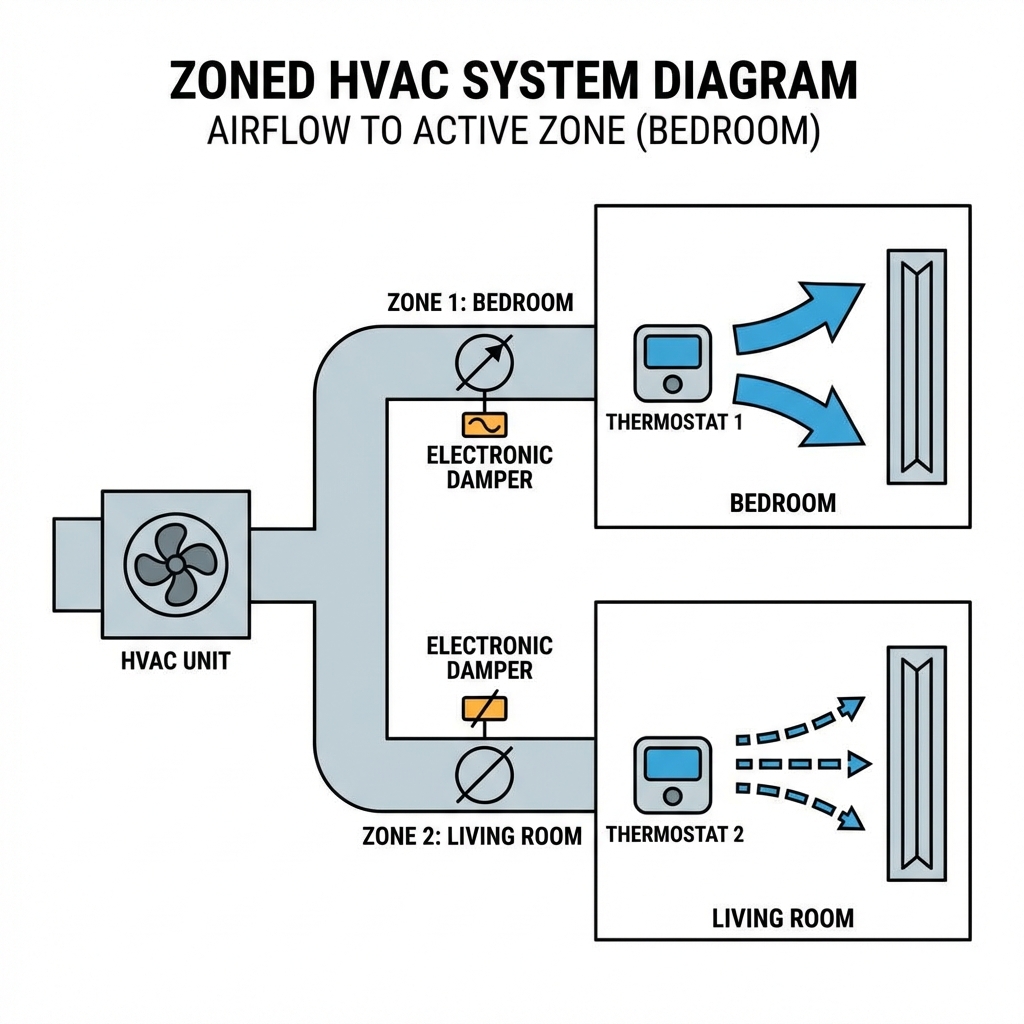
Visual Analysis: The Distributed Controls
The diagram above illustrates the 'Mesh' approach to indoor climate:
- Sensor Proliferation: Instead of one sensor, every inhabited room (Office, Bedroom, Kitchen) has its own PIR (Passive Infrared) occupancy sensor and hygrometer.
- The AI Brain: The thermostat isn't just a switch; it's a computer running Predictive Thermal Modeling. It knows that the Sun hits the home office at 2 PM, and it begins pre-cooling that specific zone 20 minutes earlier.
- Virtual Dampers: The system balances airflow by monitoring real-time occupancy. If the Guest Room is empty, airflow is throttled to 10%, diverting that 'free' capacity to the rooms that are actually occupied.
Part 1: From Reaction to Prediction
A traditional thermostat is Reactive. It waits for the temperature to drop, then kicks on the furnace. AI Zoning is Predictive. It uses:
- Solar Gain Mapping: The system knows your home's orientation and window Surface-to-Air ratio.
- Weather Integration: If a cold front is hitting at 5 PM, the AI calculates the 'Thermal Inertia' of your walls and begins a slow, efficient ramp-up rather than a panic-burst of heat.
- Occupancy Learning: It learns that you usually leave the gym at 7 AM. It doesn't need to heat the gym all night; it just timed the 'Warm-Up' perfectly for your arrival.
Part 2: The "Pressure Balance" Problem
Closing registers changes system resistance, but no product label makes the result automatically safe or unsafe. The smart-vent commissioning guide explains the required load, room-airflow, return-path, total-static-pressure, temperature, and fail-open checks.
An automated zoning controller may monitor pressure and preserve a tested minimum-open configuration. That feature is useful only when the sensor location, pressure limit, equipment-stage awareness, and failure response have been commissioned against the indoor unit's blower data. Opening a relief room cannot repair undersized returns, damaged ducts, or a compressor whose minimum capacity is too large for the calling zone.
Part 3: The Runtime ROI
How much does AI actually save? The math is based on Runtime Reduction.
- Single-Sensor House: HVAC runs at 100% until the hallway hits 70F. This often takes 45 minutes because the hallway has no heat sources.
- AI-Zoned House: HVAC runs at 100% for only 15 minutes to satisfy the occupied Office, then drops to a low-stage "Maintenance" mode or shuts off entirely.
- The Data: Real-world 2025 pilot studies showed a 22% to 35% reduction in total HVAC electrical consumption in homes over 2,500 square feet.
Part 4: The "Leak Detection" Bonus
Because the AI has a sensor in every room, it can perform Differential Thermal Analysis. If the Master Bedroom is losing heat 4x faster than the identical Spare Bedroom next to it, the AI sends a notification to your phone: "Abnormal heat loss detected in Master Bedroom. Check window latches." This detailed-level monitoring catches failed seals and unlatched attic hatches that would otherwise leak money for years.
The Verdict: Targeted Comfort
In 2026, heating your entire house because you are cold in the office is the equivalent of leaving every faucet in the house running because you want to wash your hands. It is a wasteful relic of a low-tech era. Virtual AI Zoning is the mandatory upgrade for the modern, high-performance home.
About the Editorial Team EnergyBS reviews public program rules, product specifications, utility rates, and reader-facing cost assumptions. Treat savings figures as estimates until you verify local prices, permits, rebates, and contractor quotes.
Common Questions
What should I check first before using this hvac advice?
Start with the numbers that apply to your home: climate, utility rate, equipment age, contractor quote, and local program rules. Heating a whole house when you're only in one room is a thermodynamic disaster. Discover how AI driven predictive modeling and thermal sensors are fixing the 'single thermostat' problem.
How should I verify rebates, tax credits, rates, or savings before spending money?
Treat program amounts, utility rates, and tax rules as date-sensitive. Check the named government, utility, or manufacturer source before you sign a contract, and keep screenshots or PDFs of eligibility rules for your records.
What is the next useful step after reading this?
Compare this with Heat Pump Sizing Guide so you can check the cost, rebate, installation, or operating-risk angle before making a decision.
What to Read Next
Heat Pump Sizing GuideUse this next to compare the cost, incentive, installation, or operating-risk angle before you make a home energy decision.Sources and Verification
Editorial Review
EnergyBS Editorial Team
EnergyBS publishes practical homeowner guides. Important program, product, and cost claims should be checked against the linked source and local project documents before you commit to work.
Related Guides
View All ArticlesHeat Pump Sizing Guide
A homeownerfocused guide to Manual J loads, Manual S equipment selection, coldweather capacity, balance points, duct constraints, and the documents a defensible heatpump quote should include.
Ductless MiniSplit Head Placement 2026 Tool
A homeowner planning method for locating ductless indoor units by room load, air throw, doors, sensors, noise, condensate, line routes, service access, and wholehome comfort—not wall convenience alone.
Portable Dehumidifier Sizing and Placement 2026 Analysis
Size and place a portable dehumidifier using space area, uncontrolled moisture condition, temperature, air connection, drainage, electrical supply, sound, filtration, energy, heat release, commissioning, and sourcecontrol evidence.