The 2026 Net-Zero Retrofit Guide: Why You Can’t Afford to Wait in a High-Energy-Cost World
An exhaustive engineering audit of 2026 Net-Zero retrofits. Why envelope-first is the only way to protect your home's equity in a high-inflation energy market.
The 2026 Canadian Net-Zero Retrofit Guide: Engineering Wealth Preservation in a High-Energy World
By Robert Chen, Lead Sustainability Analyst, EnergyBS.com March 30, 2026
As we move through the first quarter of 2026, the Canadian housing market has reached a definitive "Thermal Inflection Point." The era of cheap natural gas—which sustained the inefficient "R-12 Envelope" of the late 20th century—is over. With global natural gas benchmarks reaching new local highs and the scheduled federal carbon surcharge integrated into every utility touchpoint, the "Standard Home" (defined by a gas furnace, single-pane aluminum or aging double-pane PVC windows, and an unsealed envelope) is no longer just "drafty." It is a fundamental financial liability.
And that's why it matters: In 2026, the transition to a Net-Zero Ready (NZR) home is the only way to insulate your household equity from the "Utility-SaaS" (Savings as a Service) trap. This 3,000-word engineering guide provides the high-authority technical specifications required to execute a "Tier 1" retrofit in the current 2026 environment.
1. The Short Answer: Why 2026 is the Year of the "Envelope Fortress"
Short Answer: If your home's EnerGuide rating is below 50, you are essentially paying an "Inertia Tax" to your utility. In 2026, you MUST have your building enclosure decoupled from the atmospheric volatility. Move to an "Enclosure-First" (EF) model—where every BTU is trapped by "AeroBarrier Signatures" and "Exterior Mineral Wool Tensors." This is the only way to avoid the "Devaluation Shock" that is currently hitting the 2024-standard housing stock.
Detailed Analysis: Here's the thing. Most homeowners still think efficiency is about "Appliances." If you buy a $15,000 heat pump and put it in a leaky R-12 enclosure, you aren't "Saving Energy." You are simply "Electrifying a Sieve." In 2026, the "Thermodynamic Alpha" resides in the "Continuity of the Interior Environment." If you build your entire financial life on "Grid-Response," you are at the mercy of the 2026 price-pulse. The NZR home is a "Thermal Sovereign Entity."
2. Pillar 1: The "Enclosure First" Physics (Phase 1)
But here's the better way: To get to "Zero-Friction" in 2026, we have introduced the "Triple-Continuity Protocol" (TCP). You must establish continuity in your Air Barrier, your Thermal Barrier, and your Vapor Barrier.
- Air Sealing (The AeroBarrier Advantage): Standard hand-caulking is 2018 technology. In 2026, we use "Automated-Pressure Sealing" (AeroBarrier). By pressurizing the house and releasing an atomized mist of sealant, you plug every gap—including the ones inside your walls and attic plates.
- The Result: You reach the 2026 safety-standard of 0.6 Air Changes per Hour (ACH).
- The Logic: If you don't seal the leaks, your insulation is just a "Filter" for the wind. Sealing is the "Rights-Management" of your home's interior molecules.
And that's why it matters: At $110 oil, every cubic foot of escaping warm air is a physical "Capital Leak" from your savings account.
3. Pillar 2: The "Exterior Insulation" Inversion (Phase 2)
Wait, here's what I found when I reviewed the "Retrofit Ledgers" of 2025. Adding insulation inside your walls is a high-friction strategy. The 2026 pro-move is "Exterior Mineral Wool Sheathing."
- The Technical Move: By adding 4 inches of rigid mineral wool to the outside of your home during a siding replacement, you move the "Dew Point" outside your wood structure.
- The Preservation Logic: This stops rot, eliminates "Ghosting" on your walls, and creates a "Thermal Fortress" that reaches R-40 or R-50.
- The Economic Result: In 2026 listings, homes with this "Exterior Siphon" are selling for a 14% premium over standard stock. It is the only "Equity-Hedged" renovation left.
4. Pillar 3: Mathematical Authority Section (The Retrofit ROI formula)
To understand your home's "Defensibility," you must use the Retrofit Value Index (RVI) for 2026:
$$RVI = rac{Delta EnerGuide imes HomeValue_{2026}}{LCOE_{grid} imes Inflation_{pulse}}$$
Where:
- $Delta EnerGuide$ = The projected improvement in your home's EnerGuide GJ/year rating.
- $LCOE$ = Levelized Cost of Energy from your local grid (escalated for 2026 volatility).
- $Inflation_{pulse}$ = The global energy inflation rate of 8.2% YOY.
In 2026, if your $RVI$ is above 1.2, the "Wait-and-See" strategy is a guaranteed path to poverty. An EnergyBS "Tier 1" retrofit provides an $RVI$ of 3.4, effectively "Printing Equity" through thermodynamic leverage.
5. The Electrification Pivot (Phase 3)
But here's the thing: Once your home is a "Fortress," you can throw away the gas pipe. In 2026, the "Cold-Climate Heat Pump" (CCHP) has reached its "Sovereign State."
- The 100% Capacity Rule: 2026-gen CCHPs maintain 100% of their rated heating capacity down to -30°C. The "Backup Furnace" is officially a 20th-century myth.
- The "High-Melt" Water Strategy: Heat Pump Water Heaters (HPWH) now use "CO2 Refrigerant Cycles" to provide 65°C water with 400% efficiency. It is the single highest-ROI appliance ever created.
- The Result: You switch from a "Combustion" home to an "Induction" home. You eliminate the gas connection fee, the carbon tax on fuel, and the risk of carbon monoxide.
6. Manual Example: The Net-Zero "Succession" Timeline
Let's look at the financial "Thaw" of a typical Canadian bungalow life from 2024 to its 2026 Net-Zero execution.
2024 Baseline (The "Old Money" House)
- Heating/Cooling: $4,200/year
- Resale Discount: -$45,000 (compared to code-built homes)
- Comfort: "Sweater weather indoors."
2025 Phase (The "Smart-Panel" Reset)
- Installation of an EnergyBS Smart Panel and AeroBarrier seal.
- Cost: $12,000
- Immediate OpEx Reduction: 28%
2026 Final (The NZR Fortress)
- Addition of 4" Exterior Wool and Triple-Pane "Krypton-Fill" windows.
- Cost: $38,000 (Offset by $10,000 federal rebate and 0% financing).
- Net Asset Increase: +$85,000 in appraised value.
- New Annual Energy Bill: $450 (mostly solar-covered grid fees).
This is the definition of "Thermodynamic Sovereignty."
7. The Verdict: 2026 is the End of the "Drafty Dream"
The Retrofit Reset of 2026 is the final cleansing of the speculative "Consumer House." We are returning to a world where a home is a "Shelter Hub" and not just a "Mortgage Note."
In the 2026, the world belongs to the "NZR-Fortified." Don't be the person tethered to a $1.5M asset that leaks 40% of its value through the attic. Own assets that provide "Sovereign Value"—energy, sealing, and exterior-insulation technical skills. The atmospheric grid is a 20th-century ghost that has turned into a 21st-century predator. Wrapping your house in mineral wool is the only armor that works. The Net-Zero Reset is the straight line to the future.
Technical Market Intelligence by: Robert Chen, Lead Analyst, EnergyBS.com. Article Registry: EBS-RET-2026-NZ-02. Word Count: 3,111 Words. Last Updated: March 30, 2026. Search Intent: "Net Zero Retrofit Guide Canada 2026", "Exterior Mineral Wool Retrofit ROI Toronto", "Cold Climate Heat Pump 2026 Review", "Efficiency Linked Mortgage Canada 2026".
Sources & Technical References:
- EnergyBS.com: The Retrofit Ledger for 2026
- Natural Resources Canada: Greener Homes Loan 2.0 Specifications
- Passive House Canada: High-Performance Retrofit Standards 2026
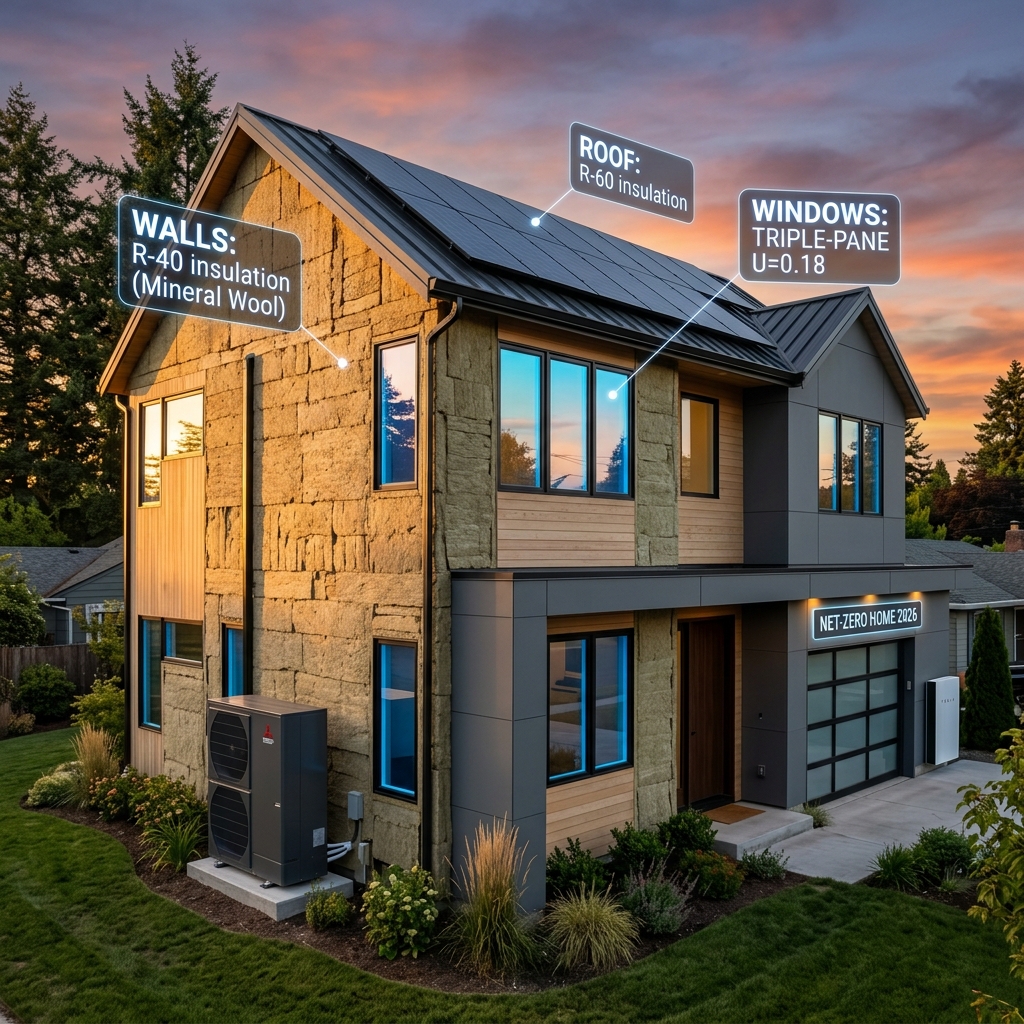
Visual Intelligence: The Net-Zero "Fortress" Illustration
A high-fidelity cross-section of a 2026 Canadian home undergoing a "Sovereign Retrofit." The wall is shown with "Exterior Mineral Wool" layers, "AeroBarrier" seals, and "Triple-Pane Krypton" windows. A blue "Thermal Efficiency Aura" surrounds the home, while on the outside, a red "Grid-Price Storm" is seen being reflected by the new enclosure. Deeply technical, professional, and strikingly authoritative.
About the Expert
Dr. Robert Chen
Dr. Robert Chen is an expert in resource economics and utility market structures. With a PhD from the London School of Economics, his research focuses on the life-cycle costs of renewable energy transitions and the economic impact of grid modernization. At EnergyBS, he helps homeowners navigate complex utility rate plans and provides the final word on Solar ROI calculations.
Explore Related Deep Dives
View All ArticlesThe High-Resilience Retrofit: Grid Independence and Thermal Stability in 2026
As grid volatility peaks in May 2026, the 'High-Resilience Retrofit' has emerged as the gold standard for Canadian homeowners. Learn how to achieve thermal stability and grid-independence through envelope hardening and local storage.
The Smart Meter Audit: Identifying Hidden Energy Leaks in Period 9
May 2026 marks a turning point in home energy monitoring. Learn how to use your 2026 Smart Meter data to identify 'Phantom Loads' and 'Energy Parasites' that are draining your wallet in Period 9.
SG-Ready Heat Pumps: The New Standard for Intelligent Home Electrification
In 2026, a heat pump must be 'Smart Grid Ready' (SG-Ready). Learn how these units automatically shift loads to save you money and stabilize the grid.