HighPerformance Windows (2026 Guide & Data)
Specify replacement windows by wholeproduct NFRC ratings, climate and orientation, comfort, durability, and roughopening installation. Includes a label decoder and quote scorecard.
Direct Answer
Specify replacement windows by wholeproduct NFRC ratings, climate and orientation, comfort, durability, and roughopening installation. Includes a label decoder and quote scorecard.
Buy the Rated Window and the Installed Opening
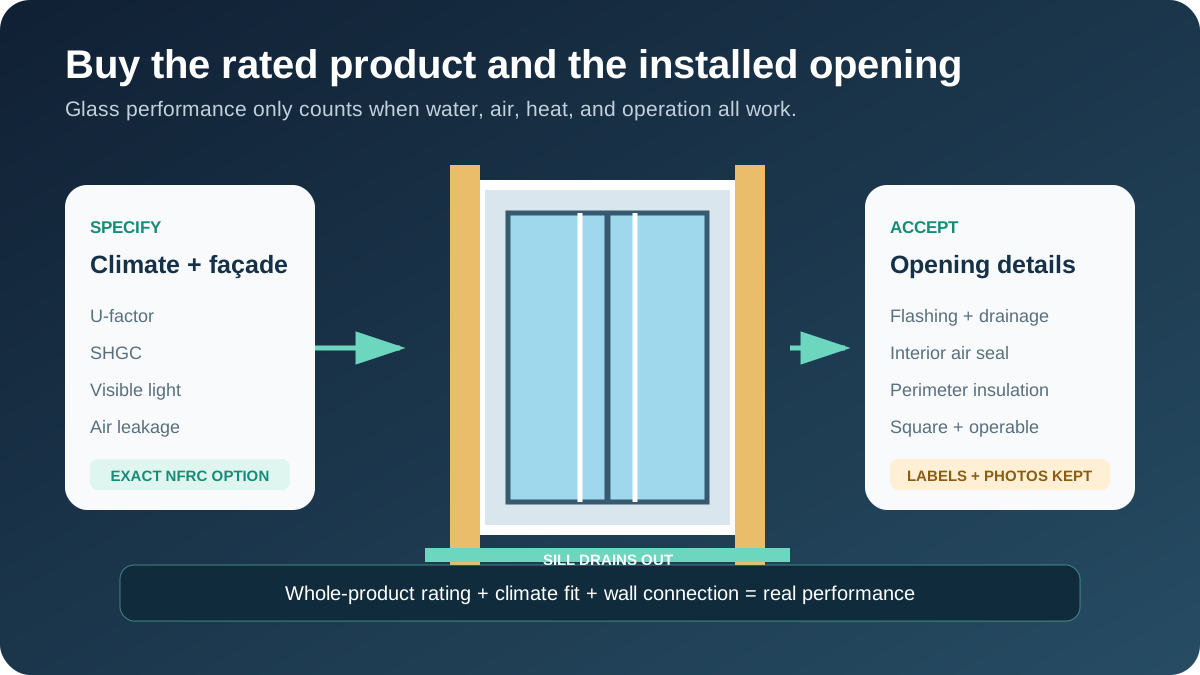
Short answer: Compare whole-product NFRC ratings for the exact size and configuration: U-factor, solar heat gain coefficient (SHGC), visible transmittance, and air leakage where reported. Match U-factor and SHGC to climate, orientation, shading, and heating/cooling priorities. Then make water management, air sealing, structural fastening, and interior/exterior seal details part of the contract. A high-performance glass package cannot rescue a leaky, wet, or distorted rough-opening installation.
Window decisions are unusually easy to reduce to a pane count or frame material. Neither is enough. A triple-pane casement and a triple-pane double-hung can have different whole-unit ratings and air leakage. Two low-e coatings can admit very different amounts of winter sun. An insert replacement can leave the old frame and flashing in place; a full-frame replacement exposes them. The project is a combined product-and-installation system.
First Decide Whether Replacement Is the Right Measure
Replacement is most defensible when the existing unit has structural decay, failed hardware that cannot be repaired, recurring water entry tied to the assembly, inaccessible operation, severe performance problems, or a renovation that already exposes the opening. Energy savings alone may not repay a whole-house replacement quickly, especially when sound existing windows can be weatherstripped or paired with rated storm panels.
Before requesting quotes, inspect:
- sash, frame, sill, and trim condition;
- operability, locks, and emergency-egress requirements;
- visible water stains, rot, or insect damage;
- condensation location—room side, between panes, or exterior;
- drafts and their actual source;
- existing storm windows and weatherstripping;
- lead paint risk in pre-1978 U.S. housing;
- wall and cladding condition around the opening;
- comfort, noise, security, and daylight goals;
- whether the project must preserve historic fabric.
A blower-door-guided inspection can separate window leakage from nearby trim, wall penetrations, top plates, or other envelope leaks. Fogging between insulated-glass panes indicates a failed glazing seal but does not prove the frame must be removed. Water staining below a window needs diagnosis of flashing, cladding, roof runoff, interior humidity, or plumbing before the replacement scope is chosen.
For intact primary windows, compare the interior storm-window versus replacement guide. It covers attachments, condensation, egress, fit, and reversible retrofit economics.
Decode the Whole-Product Ratings
NFRC labels report standardized product performance. Ask for the exact certified configuration, not a center-of-glass brochure value.
U-factor
U-factor measures heat transfer through the window assembly. Lower is better at resisting heat flow. It includes glass, edge spacer, sash, and frame under the rating procedure. R-value is the inverse in consistent units, but window specifications and programs normally use U-factor.
A U-0.20 whole window corresponds conceptually to R-5; that does not mean every part of the unit is R-5. Center-of-glass may perform better than the frame and edge. Avoid comparing one company's center-of-glass R-value with another company's whole-product U-factor.
Solar heat gain coefficient
SHGC is the fraction of incident solar radiation admitted through the entire product, directly and as absorbed heat released inward. Lower SHGC reduces solar heat gain. Higher SHGC can support passive winter heating where orientation, shading, climate, and design make that gain useful.
The lowest SHGC is not automatically best. In a heating-dominated climate, an unshaded south-facing window may benefit from a different glazing option than a west-facing bedroom that overheats. In a hot climate, low SHGC and exterior shading are often central priorities.
Visible transmittance
Visible transmittance (VT) describes the fraction of visible light admitted. Higher VT can support daylight but may create glare depending on opening size and interior layout. Compare VT with SHGC: a spectrally selective product can admit useful daylight while limiting more solar heat than ordinary tinted glass.
Air leakage
Air leakage measures infiltration through the tested product at a specified pressure difference. Lower is better. Operator type matters: compression-seal casements and awnings often have different leakage behavior from sliding or hung products. Field installation leakage around the frame is separate from laboratory product leakage.
Condensation resistance
Some labels or product data include condensation resistance. Higher values indicate better resistance under the rating conditions, but indoor condensation still depends on outdoor temperature, indoor humidity, air movement, shades, and installation. No rating guarantees a dry window under every condition.
Match the Product to Climate and Orientation
ENERGY STAR Version 7 criteria vary by climate zone and use U-factor and SHGC combinations. Check the current criteria and the address's zone rather than copying a national value. ENERGY STAR's consumer guidance advises asking that exact U-factor and SHGC be written into the contract and verifying the NFRC label at delivery.
Orientation refines the selection:
| Exposure | Heating-dominated design question | Cooling-dominated design question |
|---|---|---|
| North | How low can U-factor reasonably go? | How much conductive gain and daylight matter? |
| South | Can winter sun be admitted and summer sun shaded? | Is low SHGC plus exterior shading preferable? |
| East | Will low morning sun cause glare or cooling load? | Can exterior shading control early heat gain? |
| West | Is overheating already a comfort problem? | Usually a strong solar-control priority |
Do not specify each façade from orientation alone. Trees, neighboring buildings, overhang geometry, interior shades, snow reflection, glazing area, and room use change the result. Energy modeling is useful for large areas of glass or competing heating and cooling priorities.
The north-versus-south shortcut can backfire
A high-SHGC south window supports winter gain only when sun reaches it and the house can absorb the heat without overheating. A shaded urban south wall may receive little useful gain. A west wall often receives low-angle summer sun that an overhang cannot block well. Exterior shutters, awnings, vegetation, or screens can be more effective than relying only on glass.
Glass Technologies: What Each Layer Does
Multiple panes and gas gaps
Adding a pane creates another sealed cavity and surface. Gas fills such as argon or krypton can reduce heat transfer when used in an appropriate gap. More panes can lower U-factor but increase weight, cost, embodied material, and frame requirements.
Thin-triple units use a thin center lite to fit additional glazing into a slimmer package. Vacuum insulated glazing removes most gas from a narrow cavity and uses small support pillars to resist atmospheric pressure. These technologies can offer strong center-of-glass performance, but the purchase decision still needs whole-window ratings, edge performance, sizes, safety glazing, visible artifacts, warranty, repairability, and local installer experience.
Do not assume a technology label yields U-0.10 or R-10. Ask for the exact rated product.
Low-emissivity coatings
Low-e coatings reduce long-wave radiative heat transfer. Different coating surfaces and formulations change U-factor, SHGC, VT, exterior appearance, and interior reflectance. Request a physical sample in daylight and at night; a low-e package that looks neutral in a small showroom can appear different across a large façade.
Edge spacers
The perimeter of an insulated glass unit can be more conductive than its center. Warm-edge spacer systems aim to reduce edge heat transfer and raise interior edge temperature. Compare whole-unit ratings and condensation data rather than accepting “warm edge” as a quantified result.
Laminated and different-thickness glass
Laminated glass can improve safety, security, ultraviolet control, and some acoustic performance. Sound reduction depends on the entire assembly, air gaps, glass thicknesses, seals, vents, walls, and installation. Pane count alone does not guarantee a stated STC or OITC rating; ask for tested product data relevant to the noise spectrum.
Frame and Operator Choices
Frame material affects thermal transfer, expansion, durability, maintenance, profiles, and cost. There is no universal winner.
| Frame family | Useful questions |
|---|---|
| Wood | How is exterior weather exposure protected? What maintenance and rot details apply? |
| Vinyl/cellular composite | Are dimensions, reinforcement, color, movement, and temperature exposure appropriate? |
| Fiberglass | What are the whole-product rating, corner details, finish, and repair options? |
| Aluminum | Is there an effective thermal break? Is condensation performance suitable for the climate? |
| Wood-clad | How are cladding joints, end grain, drainage, and interior maintenance handled? |
Operator type can affect air leakage, egress, cleaning, screens, wind exposure, and accessibility. Casements project outside; awnings can shed light rain while open; sliders and hung units may be easier in some locations; fixed glazing usually leaks less but provides no ventilation or egress. Match function before optimizing one metric.
Insert Versus Full-Frame Replacement
Insert or pocket replacement
The new unit fits inside the existing frame. It can reduce demolition and preserve exterior trim, but loses some glass area and leaves the old frame, sill, flashing, and rough-opening interfaces largely in place. It is unsuitable if those components are decayed, wet, distorted, or poorly flashed.
Full-frame replacement
The old frame is removed, exposing more of the rough opening. This permits inspection and repair, new flashing connections, and potentially more glass area, but increases labor, disturbance, trim work, and lead-paint controls.
Require the quote to state which approach is included for each opening. “Replacement window” is not enough.
The Rough Opening Has Three Control Jobs
The wall-to-window transition must manage water, air, and heat while allowing the assembly to drain and move as designed.
Water control
Exterior flashing should direct water to the drainage plane and outward, with a sill strategy appropriate to the wall and product. Sealant alone should not be the only water-management concept. Head flashing, pan/sill details, jamb transitions, cladding clearances, and weep paths must coordinate.
Air control
The interior-side perimeter commonly forms the primary air seal using compatible sealant, backer rod, membrane, gasket, or approved foam detail. The product and wall determine the method. The seal should be continuous and serviceable; trim is not an air barrier.
Thermal control
The gap around the frame needs insulation without bowing the frame or blocking drainage. Low-expansion product intended for windows and doors may be part of the detail. Stuffed fiberglass alone does not reliably stop air.
Ask the installer to draw the layers from indoor finish to outdoor cladding. A drawing exposes gaps that the phrase “foam and caulk” conceals.
Installation Acceptance Checklist
Before removal:
- verify model, size, operator, color, glass package, grid, hardware, and screens;
- photograph and retain NFRC/ENERGY STAR labels;
- confirm safety glazing and egress requirements;
- protect interiors and establish lead-safe containment where applicable;
- identify hidden-water-damage change-order rates.
Before trim hides the opening:
- inspect sill and framing condition;
- photograph pan/sill, jamb, and head flashing;
- verify shims and fasteners follow product instructions;
- check the frame is level, plumb, square, and not bowed;
- inspect perimeter insulation and continuous interior air seal;
- preserve weeps and drainage paths.
Before final payment:
- operate, lock, tilt, and clean every unit;
- confirm even reveals and gasket contact;
- inspect sealant continuity and exterior drainage;
- test screens and limiters;
- check for glass scratches, debris between panes, and finish damage;
- receive labels, warranties, care instructions, photos, and permit sign-off.
Comfort: Interior Surface Temperature Matters
People exchange radiant heat with nearby surfaces. A cold interior pane can make a seated person feel uncomfortable even when room air reaches the thermostat setpoint. Lower U-factor generally raises interior glass temperature in winter, reducing radiant asymmetry and downdraft potential. This comfort gain can be more noticeable than the utility-bill change.
Interior surface temperature also affects condensation. If the glass or edge falls below the indoor-air dew point, water can form. Improving the window raises surface temperature, but high indoor humidity during severe cold can still condense. Closely fitted shades can reduce warm-air circulation at the glass and create colder local conditions.
Use condensation as a diagnostic signal. The winter window-condensation guide provides a seven-day temperature/RH log and separates room-side water, between-pane fog, exterior dew, and rain leakage:
- room-side water: check indoor humidity, surface temperature, airflow, and installation;
- between sealed panes: likely glazing-seal failure;
- exterior condensation: can occur on high-performing glass under clear humid conditions because the outer pane stays cooler;
- staining around frame: investigate water entry and drainage, not just humidity.
Energy and Payback Without Sales Math
Energy savings depend on existing U-factor, leakage, window area, climate, orientation, shading, HVAC efficiency, utility rates, and installation. ENERGY STAR's savings methodology uses modeled representative homes and explicitly says actual savings vary.
Estimate annual conductive change with an energy model or a screening calculation:
annual heat-transfer change ≈ window area × change in U-factor × climate degree-hours
Then include solar gains and air leakage; those can be large and directionally different. Convert heating/cooling load change using actual equipment efficiency and marginal energy prices.
Separate project benefits:
- avoided repair of decayed units;
- comfort and usable perimeter space;
- noise or security improvement;
- easier operation/accessibility;
- maintenance reduction;
- energy savings.
Do not assign the entire replacement cost to energy when the project also buys necessary repair or remodeling value. Conversely, do not claim resale value as guaranteed payback.
Quote Scorecard
| Requirement | Bid A | Bid B | Bid C |
|---|---|---|---|
| Exact NFRC product/configuration | |||
| Whole-product U-factor | |||
| SHGC by orientation | |||
| VT and air leakage | |||
| Condensation/acoustic data if needed | |||
| Insert or full-frame scope | |||
| Sill/jamb/head water detail | |||
| Interior air-seal detail | |||
| Perimeter insulation detail | |||
| Lead-safe and disposal scope | |||
| Interior/exterior trim and finish | |||
| Product and labor warranties | |||
| Permit and final inspection |
Compare openings, not just totals. One rotten bay window may need a different scope from ten sound bedroom windows.
Three Openings, Three Different Specifications
A whole-house “one glass package” order is easy for the seller. It may be wrong for the rooms.
West bedroom that overheats
The room has a large west opening, no exterior shade, and late-afternoon cooling complaints. The quote should compare a lower-SHGC option, exterior shading, and the effect on visible light. A very low U-factor helps winter comfort but does not by itself control summer sun.
Record indoor temperature before sunset on several clear days. Add exterior shade geometry to the quote. If replacing the window, keep the SHGC option tied to that opening ID so the factory order cannot substitute the house-wide default.
South living room in a cold climate
The room has roof overhangs that block high summer sun but admit lower winter sun. A low U-factor remains useful. A higher SHGC may provide winter gain if the opening is truly unshaded and the room can absorb it.
Model overheating risk before choosing the highest-gain glass. Large south glazing can exceed the room's ability to store heat on a sunny winter day. Interior shades control glare but do not stop all solar energy before it enters.
North bathroom with winter condensation
The opening receives little direct sun and sits in a humid room. Priorities may include low U-factor, warm-edge performance, low air leakage, durable finishes, exhaust-fan operation, and correct perimeter sealing.
Replacing the unit will not solve an undersized or unused bath fan. Measure humidity and confirm the fan exhausts outdoors. If condensation persists after the project, compare glass-edge temperature, indoor dew point, shade position, and air movement before assuming product failure.
Put the opening schedule in the contract
Use a line for every window:
| Opening ID | Room/exposure | Size/operator | U-factor | SHGC | VT | Glass/safety option | Installation scope |
|---|---|---|---|---|---|---|---|
| W-01 | West bedroom | ||||||
| W-02 | South living | ||||||
| W-03 | North bath |
The schedule prevents a verbal orientation strategy from disappearing into a purchase order. Match each delivered NFRC label to its opening before removal begins.
Warranty Terms That Change the Value
Read both the product and installation warranties. They may cover different failures and different labor.
Check:
- insulated-glass seal failure and whether labor is included;
- frame, sash, hardware, screens, and finish coverage;
- glass breakage and spontaneous breakage exclusions;
- coastal, high-altitude, dark-color, or severe-weather limits;
- transfer to a future owner;
- registration deadlines;
- service-call and travel charges;
- responsibility for water damage or failed perimeter sealant;
- who removes trim when a glass unit or sash needs service.
A lifetime label can mean a limited material warranty with declining coverage. Ask the bidder to show one recent local warranty workflow: who takes the call, who measures the failed component, and who pays labor.
Frequently Asked Questions
Is triple pane always worth it?
No universal answer exists. Compare whole-product U-factor, SHGC, VT, air leakage, weight, cost, climate, comfort, and installation. In cold climates or near occupied seating, higher interior surface temperature can be valuable beyond energy savings.
What U-factor should I buy?
Use the current ENERGY STAR climate-zone criteria as a starting point, then compare better-performing options against climate, orientation, comfort, and cost. Write the exact whole-product value into the contract.
Should every side of the house use the same SHGC?
Not necessarily. Solar exposure and shading differ. Orientation-specific glazing can help, but product appearance and ordering complexity also matter. Model large or unusual glazing areas.
Will new windows stop all condensation?
No. They can raise interior surface temperature and improve seals, but indoor humidity, outdoor temperature, shades, airflow, and edge conditions still control condensation.
Are fiberglass frames always better than vinyl?
Material alone does not decide performance or durability. Compare exact whole-product ratings, reinforcement, dimensions, finish, installation, warranty, and local service.
Can I use center-of-glass R-value to compare quotes?
No. Compare whole-product NFRC U-factor for the exact configuration. Center-of-glass values exclude frame and edge effects.
Do new windows pay for themselves?
Sometimes energy savings contribute meaningfully, but whole-house replacement often includes comfort, repair, operation, aesthetics, and maintenance benefits. Model the existing house and local rates; reject guaranteed short payback without assumptions.
The Decision Rule
Replace when the opening's condition, function, comfort, water management, or renovation scope justifies it. Specify the exact certified whole product for each climate/orientation role, and give the rough-opening control layers equal weight in the contract. If the primary window is sound, price repair, weatherstripping, and a rated storm attachment before demolition.
The highest-performing window is the one whose label, wall connection, drainage, operation, and warranty all survive the installation—not the one with the most advanced glass name in a brochure.
About the Editorial Team EnergyBS reviews public program rules, product specifications, utility rates, and reader-facing cost assumptions. Treat savings figures as estimates until you verify local prices, permits, rebates, and contractor quotes.
What to Read Next
Interior Storm Windows vs. Replacement 2026 ToolUse this next to compare the cost, incentive, installation, or operating-risk angle before you make a home energy decision.Sources and Verification
Editorial Review
EnergyBS Editorial Team
EnergyBS publishes practical homeowner guides. Important program, product, and cost claims should be checked against the linked source and local project documents before you commit to work.
Related Guides
View All ArticlesInterior Storm Windows vs. Replacement 2026 Tool
Decide whether an interior storm panel, exterior lowe storm, repair, or full replacement best fits an existing window. Includes fit, condensation, egress, acoustic, and quote checks.
Blower Door Test: What Is Your ACH50 Score? 2026 Analysis
Prepare for a calibrated blower door test, understand CFM50 and ACH50, map leakage safely, compare testin and testout results, and know what the score cannot tell you.
Exterior Continuous Insulation Retrofit 2026 Tool
Plan exterior continuous insulation as a complete siding retrofit with verified sheathing, drainage plane, window flashing, vapor control, cladding attachment, roof edges, utilities, and inspection details.